Saints John de Brébeuf and Isaac Jogues, Priests, and Companions, Martyrs

A Norman priest bound for New France
Jean de Brébeuf was born in 1593 into a family of minor nobility in Normandy, and entered the Jesuit order as a young man despite chronic poor health that at times seemed likely to prevent him from completing his training, including a serious bout of tuberculosis. He was ordained a priest in 1622, and just three years later, in 1625, he sailed for New France, the vast and largely unmapped French colonial territory in North America, to begin what would become nearly a quarter-century of missionary work among the Indigenous peoples of the region, chiefly the Huron, or Wendat, confederation settled around the shores of Georgian Bay in present-day Ontario.
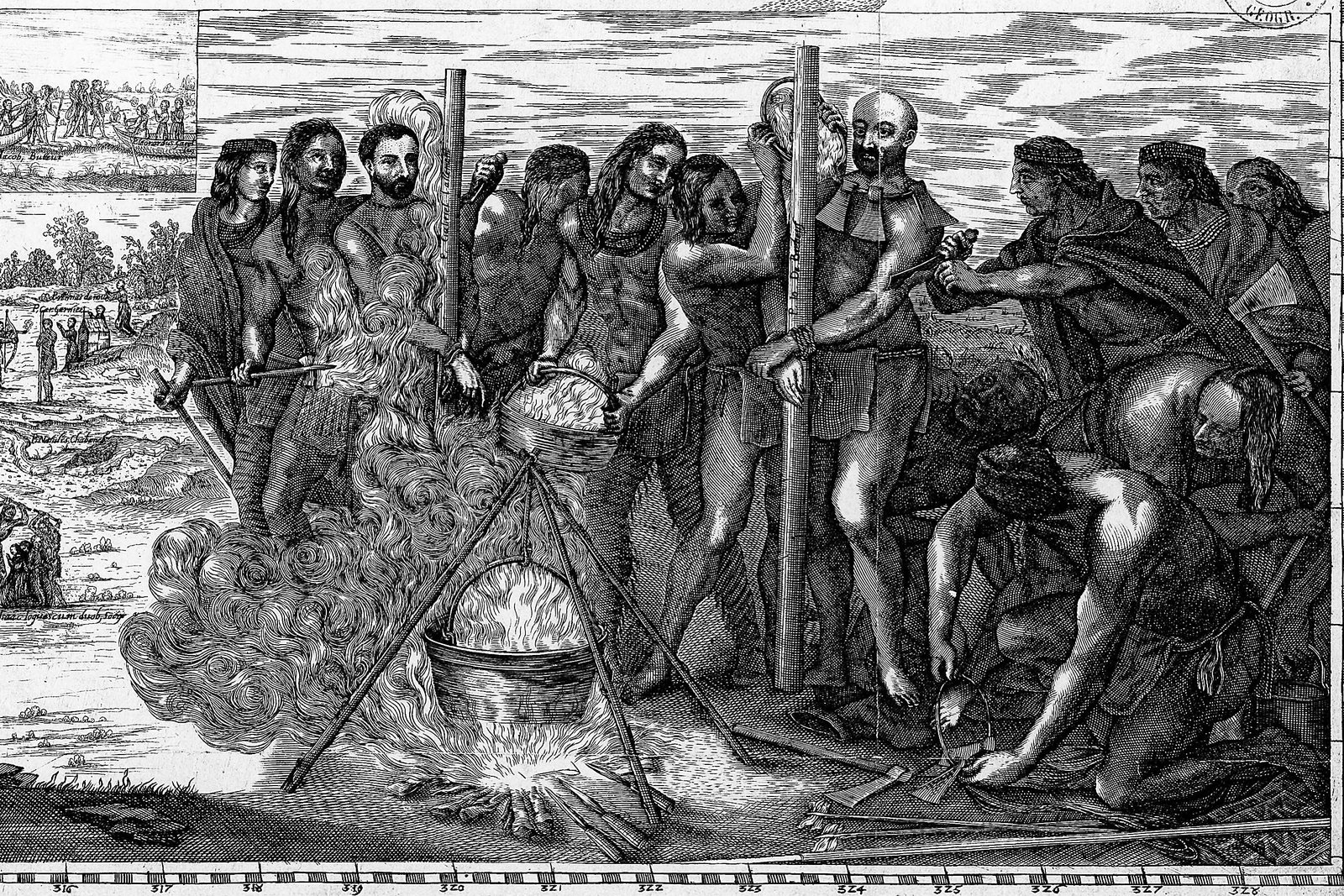
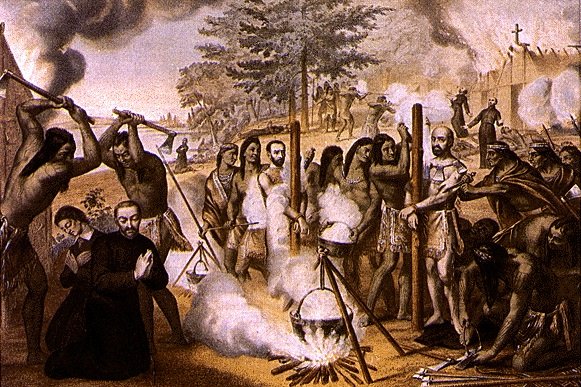
Francesco Giuseppe Bressani, engraving depicting the Huron mission and martyrdoms, 1657 — public domain.
Physically, Brébeuf was unusually well suited to the demands of the mission. Contemporaries described him as a large, powerfully built man, and the grueling months-long canoe journeys along the rivers and lakes of the interior, journeys that broke the health of many European missionaries, seem to have troubled him comparatively little. The Huron gave him the name Echon, a title connected to his endurance and physical presence, and he became known across the mission territory as a missionary who could keep pace, quite literally, with the demands of Indigenous travel and daily life.
Learning a language no European had mastered
What distinguished Brébeuf's approach to mission work was not his physical stamina alone but his deep, sustained commitment to understanding Huron language and culture on their own terms. He devoted himself to mastering Wendat, an Iroquoian language wholly unrelated to any European tongue, eventually becoming fluent enough to preach, counsel, and hear confessions without an interpreter, and compiling one of the first substantial dictionaries and catechisms ever written in the language. He also composed what is now recognized as the earliest Canadian Christmas carol, the "Huron Carol," written in the Wendat language and set to a traditional French melody, translating the Nativity story into imagery and vocabulary familiar to his Huron listeners.
Brébeuf's missionary strategy emphasized living within Huron communities on their own terms as much as possible, adapting to Indigenous patterns of hospitality, travel, and daily labor rather than insisting that converts first adopt French customs before receiving the Christian message. This approach set him apart from missionaries who took a more rigidly assimilationist view, and it earned him considerable respect among the Huron even as conversion itself often came slowly and unevenly, complicated by epidemic disease that swept through Huron villages in the wake of European contact and that some Huron, understandably, associated with the missionaries' arrival.
Escalating violence and the collapse of Huronia
By the 1640s, the Huron Confederacy found itself caught in an increasingly deadly conflict with the Iroquois Confederacy to the south, a rivalry sharpened by competition over the lucrative fur trade and access to European firearms, which the Dutch and later English suppliers of the Iroquois provided more readily than the French did for the Huron. Iroquois war parties launched increasingly large and destructive raids into Huron territory throughout the decade, and the Jesuit mission villages, tied closely to Huron communities, became repeated targets.
Isaac Jogues, another Jesuit missionary working among the Huron and allied peoples during this same period, was captured, tortured, and mutilated by Mohawk warriors in 1642, escaped with the help of Dutch traders, and returned to France before ultimately going back to the mission field, where he was killed in 1646. His story unfolded largely separately from Brébeuf's own missionary career, though both men were part of the same broader Jesuit mission to the peoples of the Great Lakes region and both would ultimately be martyred within a few years of each other.
Capture and death at Saint-Louis
The crisis reached Brébeuf directly in March 1649, when a large Iroquois force attacked and destroyed the Huron mission village of Saint-Louis. Brébeuf and a younger colleague, Gabriel Lalemant, were captured during the assault along with a number of Huron Christians. According to detailed accounts later compiled by surviving Jesuit missionaries, based on testimony from Huron witnesses who survived the raid, both priests were subjected to a prolonged ritual of torture typical of the period's warfare, including mock baptism, burning, and mutilation, before being killed. Witnesses reported that Brébeuf endured the ordeal with remarkable composure, continuing to encourage and console his fellow captives even as his own suffering intensified, and that his death came the same day, while Lalemant's torment continued longer into the following day.
Canonization and lasting memory
The destruction of the Huron mission in the years that followed scattered the Huron Confederacy itself, many of whose surviving members relocated westward or were absorbed into other Indigenous nations, a demographic catastrophe that reshaped the map of the Great Lakes region for generations. Brébeuf, Jogues, Lalemant, and five other Jesuit missionaries killed during this period of conflict came to be venerated collectively as the North American Martyrs, and Pope Pius XI canonized all eight together in 1930, recognizing a shared witness spread across nearly a decade of violence in the Great Lakes mission field. Brébeuf in particular is honored today as a patron of Canada, remembered less for any single dramatic act than for the sustained, patient labor of learning a people's language and way of life well enough to live, and ultimately to die, among them as something closer to a member of the community than an outsider. His feast, shared with the other North American Martyrs, falls on October 19 in the United States and September 26 in Canada.
Trivia
Who was Saint John de Brébeuf and when did he live?
What was distinctive about Brébeuf's missionary approach?
Who are the North American Martyrs?
How did John de Brébeuf die?
What is Saint John de Brébeuf the patron of, and when is his feast day?
You May Also Like
Related Reading