Saint John Eudes, Priest

A missionary who stayed close to the sick
John Eudes was born in 1601 in the Norman village of Ri, into a farming family that hoped he would take over the family estate. He chose instead to join the Congregation of the Oratory, a community of secular priests founded in France only a few years earlier, and was ordained in 1625, the same year an outbreak of plague struck Normandy with devastating force.
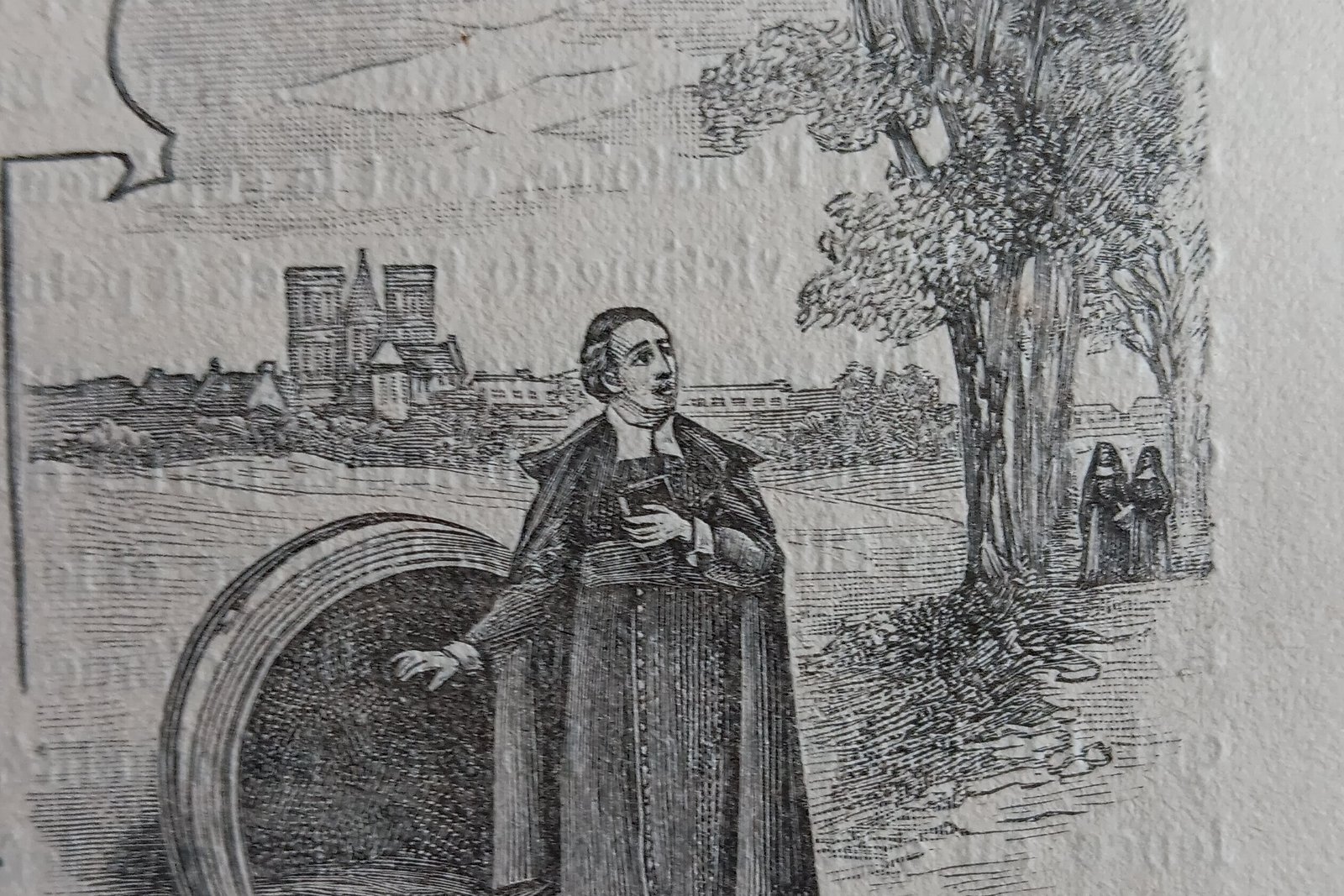
Anonymous French engraving, period print of Saint John Eudes — public domain.
Rather than avoid the danger, Eudes volunteered immediately to care for the sick and dying, a decision that meant physical isolation from his own religious brothers for weeks at a stretch; he reportedly lived inside an empty wine barrel set apart from the community house so as not to risk carrying infection back to the other priests. He survived that outbreak, and when plague returned to the region in 1631, he volunteered again, once more isolating himself in similar makeshift quarters while he tended the afflicted. That willingness to face physical danger directly, repeatedly, and without evident hesitation set the tone for the rest of his ministry, which combined intense practical charity with sustained, demanding missionary preaching across rural France for decades.
A preacher who founded two congregations
For years, Eudes traveled extensively through Normandy and neighboring regions of France conducting parish missions, weeks-long campaigns of intensive preaching, confession, and catechesis aimed at renewing the faith of ordinary rural Catholics, many of whom had limited access to consistent priestly instruction. His preaching missions were reportedly enormously popular, drawing large crowds and producing, by contemporary accounts, significant and lasting spiritual renewal in the parishes he visited.
Convinced that the quality of parish life depended above all on the quality of priestly formation, Eudes left the Oratory in 1643, not without some friction with his former superiors, to found a new congregation of secular priests specifically dedicated to training seminarians and conducting missions: the Congregation of Jesus and Mary, whose members became known as the Eudists. The new congregation established seminaries across Normandy and beyond, part of a broader movement in seventeenth-century French Catholicism to raise the educational and spiritual standards of parish clergy following the reforms of the Council of Trent.
Eudes also founded a distinct religious community for women, the Order of Our Lady of Charity, dedicated to the specific and, for the period, unusually compassionate mission of helping former prostitutes leave that life and rebuild stable, dignified futures, an initiative that grew out of his own pastoral encounters with such women during his mission preaching. The order Eudes founded eventually gave rise, in the following century, to the Good Shepherd Sisters, a related congregation that expanded the same mission on a much larger international scale.
The priest behind the Sacred Heart
Eudes's most lasting legacy, however, lies in the devotion to the Sacred Heart of Jesus and the Immaculate Heart of Mary, devotions closely associated in most Catholics' minds with the later visions of Saint Margaret Mary Alacoque at Paray-le-Monial in the 1670s. What is less widely known is that Eudes had already been composing liturgical texts, prayers, and a theological framework centered on devotion to the two hearts for years before Margaret Mary's visions began, developing the devotion independently out of his own study of Scripture and mystical theology within what is often called the French School of spirituality.
In 1672, Eudes celebrated what is generally regarded as the first Mass ever offered specifically in honor of the Sacred Heart of Jesus, complete with a liturgical text he had composed himself, and he had already been promoting devotion to the Immaculate Heart of Mary for years before that. While Margaret Mary's visions, and the promotion of the devotion by the Jesuit order in the following decades, did far more to spread the Sacred Heart devotion to a mass popular audience across the Catholic world, the Church has consistently credited Eudes as the effective founder of its liturgical form, the priest who first gave the devotion an actual Mass, feast, and structured prayer life rather than leaving it purely as private mystical experience.
Canonization after centuries
Eudes continued preaching and writing until close to the end of his life, producing substantial theological works on the spiritual life alongside his liturgical compositions, and he died in 1680 at Caen, worn down, by most accounts, from decades of relentless missionary travel and physical hardship. Formal recognition of his sanctity came only much later: he was beatified in 1909 and canonized by Pope Pius XI in 1925, nearly two and a half centuries after his death, a gap partly attributable to the disruptions of the French Revolution, which scattered records and temporarily suppressed the religious congregations he had founded.
His feast is celebrated on August 19, and both the Eudists and the religious communities descended from the Order of Our Lady of Charity continue his dual legacy today, one strand centered on priestly formation and missionary preaching, the other on charitable outreach to marginalized women, two very different expressions of the same underlying conviction that drove him into plague wards as a young priest: that no one, however endangered or however far from ordinary respectability, was outside the reach of Christian charity.
Trivia
Who was Saint John Eudes?
What did John Eudes do during the plague outbreaks in France?
What religious congregations did John Eudes found?
How is John Eudes connected to the Sacred Heart devotion made famous by Saint Margaret Mary Alacoque?
When is the feast of Saint John Eudes?
You May Also Like
Related Reading