Saint Josaphat, Bishop and Martyr

A merchant's apprentice drawn to monastic life
Josaphat Kuncevyč was born around 1580 in the town of Volodymyr, in the region of Volhynia, then part of the Polish-Lithuanian Commonwealth and now within modern Ukraine. As a young man he was apprenticed to a merchant in Vilnius, a promising path toward a comfortable trading career, but he felt increasingly drawn toward religious life instead, and in 1604 he entered the Order of Saint Basil the Great, an Eastern monastic order following the Byzantine liturgical tradition, taking the religious name Josaphat.
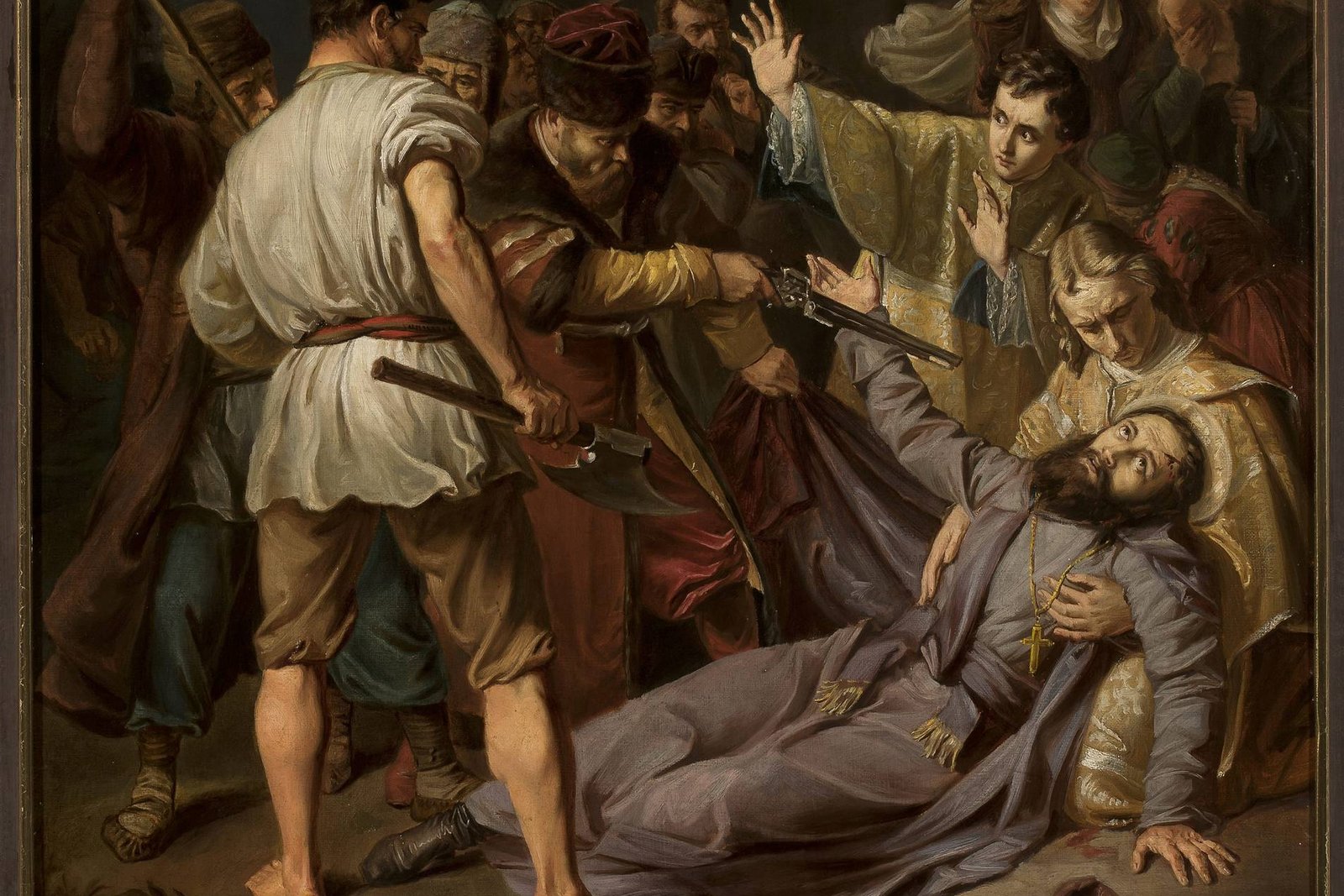
Józef Simmler, Martyrdom of Josaphat Kuntsevych, c. 1861 — public domain.
He was ordained a priest around 1609 and quickly developed a reputation for rigorous personal asceticism alongside considerable pastoral and administrative talent, qualities that led to his rapid promotion within his religious community and, in 1617, his appointment as Archbishop of Polotsk, a large and religiously divided diocese in what is now Belarus.
The Union of Brest and a church divided
To understand the conflict that would eventually cost Josaphat his life, it helps to understand the specific religious situation of the Ruthenian Church into which he had been ordained. In 1596, a group of Ruthenian Orthodox bishops in the Polish-Lithuanian Commonwealth signed the Union of Brest, an agreement bringing their church into communion with the pope in Rome while explicitly preserving their Eastern liturgical rites, their tradition of a married clergy, and much of their distinct ecclesiastical structure and identity, an arrangement that produced what is generally called a Uniate, or Eastern Catholic, church, in this case the ancestor of today's Ukrainian Greek Catholic Church.
The union proved deeply divisive. Many Ruthenian clergy and laypeople rejected it outright, viewing it as an unacceptable submission of their ancient Eastern Christian tradition to Latin, Roman authority, and Orthodox resistance to the union remained strong and organized in many parts of the Commonwealth, including within Josaphat's own diocese of Polotsk, for decades after the agreement was first signed. Josaphat, however, became one of the union's most committed and energetic advocates, working to strengthen it within his diocese through preaching, catechesis, disciplinary reform of the clergy, and vigorous personal example.
Rising tension and a fatal mob
Josaphat's efforts to consolidate the union within his diocese, which included measures to discipline clergy who continued to resist it and to bring wavering parishes formally into the Uniate fold, generated sustained and increasingly bitter local opposition. Orthodox partisans in the region regarded him as an aggressive and unwelcome enforcer of an agreement they had never accepted, and rumors and agitation against him spread through Polotsk and the surrounding towns over several years, fueled in part by political tensions between different factions within the Commonwealth's complex religious landscape.
The crisis reached its climax in November 1623 in the town of Vitebsk, within Josaphat's diocese, where hostility toward him had grown particularly intense. A crowd, reportedly incited by rumors and provocations against him, stormed the residence where he was staying. Josaphat was struck down, according to the most widely accepted accounts killed with an axe or halberd, and his body was then thrown into the nearby Dvina River, a brutal end that shocked observers even amid the frequently violent religious conflicts of the period.
Remorse, conversions, and a strengthened union
The killing produced an outcome quite different from what Josaphat's attackers likely intended. Rather than discrediting or weakening the Union of Brest in the region, accounts from the period, including reports later gathered for his canonization process, describe a wave of remorse among some of those connected to or sympathetic toward the killing, along with a subsequent increase in conversions to the Uniate Church in areas that had previously resisted it most strongly. The Polish king at the time, Sigismund III, who had supported the union, also used the killing as grounds for taking action against the leaders of the mob, further reinforcing royal backing for the union in the years that followed.
Whatever the precise historical mechanics behind this shift, Josaphat came to be regarded within the Uniate Church, and eventually within the wider Catholic Church, as a martyr whose death had, paradoxically, strengthened rather than undermined the cause of church unity he had died pursuing.
Canonization and a symbol of Eastern-Western reconciliation
Josaphat's cause for canonization moved forward with unusual speed relative to many other cases from the period, aided by the relatively well-documented and dramatic circumstances of his death. Pope Urban VIII beatified him in 1643, and Pope Pius IX canonized him in 1867, making him the first saint of the Eastern Catholic Churches to be formally canonized through the Latin Church's regular canonical process, a milestone reflecting his particular significance as a bridge figure between Eastern and Western Christianity.
His remains were eventually transferred to Saint Peter's Basilica in Rome, where he is honored today at an altar dedicated to him, a Ukrainian bishop resting within the heart of Western Christendom, in itself a quiet expression of the union he gave his life defending. Josaphat is remembered today especially by the Ukrainian Greek Catholic Church and other Eastern Catholic communities as a patron of the difficult, often painful work of restoring unity between churches long divided by history, politics, and mutual suspicion. His feast day is celebrated on November 12.
Trivia
Who was Saint Josaphat and when did he live?
What was the Union of Brest, and why did it matter to Josaphat's mission?
Why was Josaphat killed?
What effect did Josaphat's martyrdom have on the union he had promoted?
When was Josaphat canonized, and what is his feast day?
You May Also Like
Related Reading