Saint Kateri Tekakwitha

The only survivor in her family
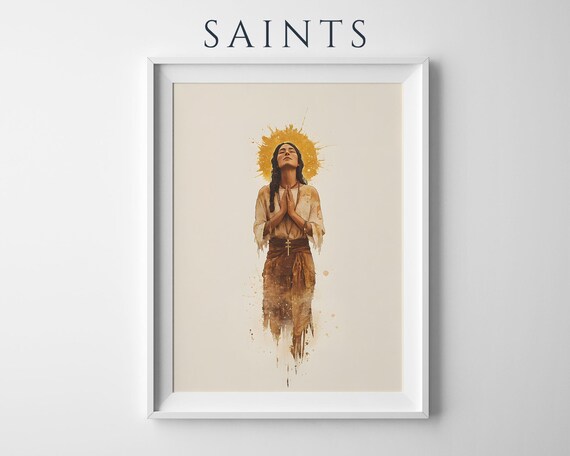
Kateri Tekakwitha was born in 1656 in Ossernenon, a Mohawk village in what is now Auriesville, New York, the child of a Mohawk father and a Christianized Algonquin mother who had herself been captured and brought into the village years earlier. At age four, smallpox swept through her family; both of her parents and her baby brother died within days of each other, and Kateri alone survived. The disease left her face permanently scarred and her eyesight so damaged that she was given the name Tekakwitha, often translated as "she who bumps into things" or "she who walks groping her way," because of how she moved through unfamiliar spaces. She was taken in by an uncle who had become the village's chief, and grew up in his longhouse doing the ordinary work expected of a Mohawk girl — tending crops, weaving, preparing food — while wearing a blanket over her head whenever she could, self-conscious about her scarred face.
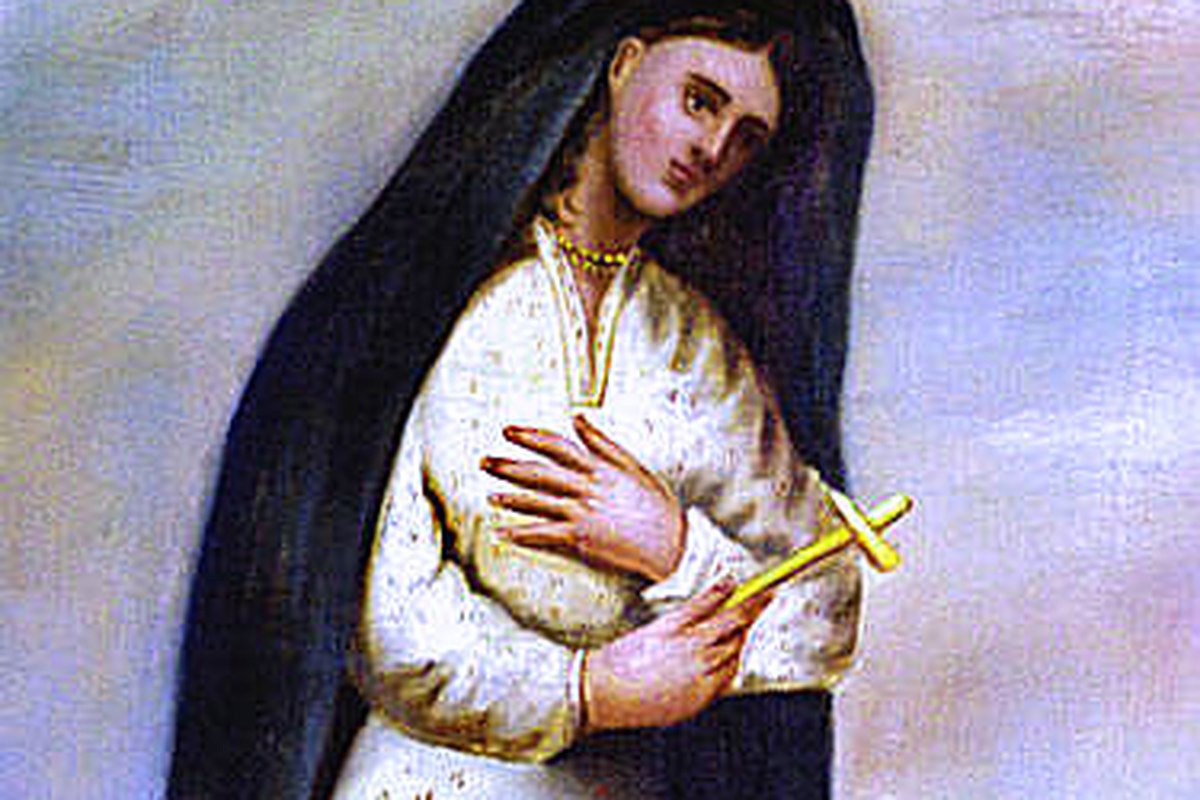
Portrait of Saint Kateri Tekakwitha, traditional depiction, public domain.
A faith discovered at ten, claimed at twenty
At ten, she was deeply impressed by the words of three visiting Jesuits — likely the first Christian missionaries she had ever encountered, part of the wider effort by French Jesuit priests to evangelize the peoples of the Great Lakes and St. Lawrence regions in the seventeenth century. She began shaping her life quietly around what she'd heard from them, though her uncle, wary of Christianity's effect on Mohawk traditions and alliances, resisted her interest for years. It was not until she was twenty that she was formally instructed in the faith and baptized Catherine, rendered in Mohawk as Kateri, by the Jesuit missionary Jacques de Lamberville on Easter Sunday, 1676. From that point on, she attended Mass daily and refused to work on Sundays, a decision her community read as a rejection of its way of life.
Fleeing two hundred miles for the freedom to practice it
That baptism came at a cost. Harassed, stoned, and threatened with torture in her home village — accused by some of witchcraft simply for refusing to marry — Tekakwitha fled roughly two hundred miles on foot and by canoe to the mission of St. Francis Xavier at Sault Saint Louis (present-day Kahnawake, near Montreal), a settlement French Jesuits had established specifically for Native converts. There she came to be known as the "Lily of the Mohawks," recognized for her kindness, her long hours of prayer before the Blessed Sacrament, and the severe penances she practiced, which included fasting and exposure to cold, in a spirituality shaped by both her own convictions and the ascetic examples she had heard about from the missionaries. She took a vow of perpetual virginity in 1679, unusual for a Mohawk woman of her time, dedicating herself entirely to prayer and to caring for the sick and elderly at the mission.
A short life and a lasting devotion
Kateri's health, weakened since childhood by smallpox, declined further under the penances she embraced, and she died on April 17, 1680, at only twenty-four. Witnesses at her deathbed reported that within minutes of her death, the smallpox scars that had marked her face since childhood seemed to vanish, leaving her skin smooth — an account passed down as pious tradition rather than official Church teaching, but one that spread quickly among both Native converts and French settlers and helped fuel devotion to her almost immediately. Pilgrims began visiting her grave at Kahnawake within years of her death, and she became one of the most venerated figures among Native American Catholics in both Canada and the United States, much as Our Lady of Guadalupe became central to Indigenous devotion in Mexico.
Recognition centuries later
Pope John Paul II beatified her in 1980, formally recognizing her as "Blessed" and opening the path toward canonization. In December 2011, the Vatican evaluated the testimony of a young boy in Washington state whose flesh-eating bacterial infection disappeared after his family and community prayed for Kateri's intercession; doctors could offer no medical explanation for the recovery, and Pope Benedict XVI recognized it as the miracle needed for canonization. She was declared a saint on October 21, 2012, becoming the first Indigenous person of North America raised to sainthood by the Catholic Church. She is honored today as a patron of ecology and the natural world, and her feast day, July 14 in the United States, draws pilgrims each year to shrines at Auriesville and Kahnawake — the two places, two hundred miles apart, that mark the beginning and the refuge of her short life.
A patroness for a wider Native Catholic community
Since her canonization, Kateri has become a rallying point for Native American and First Nations Catholics across the continent, many of whom had for generations felt caught between their ancestral identity and a Church whose missionaries had, at times, actively suppressed Indigenous culture and language. Devotion to her offered a different model: a Mohawk woman who embraced Christian faith without being asked to erase where she came from, and whose own community at Kahnawake continues to identify strongly with Catholic tradition today. The Tekakwitha Conference, an organization founded in 1939 and renamed in her honor, continues to support Native Catholic ministries across the United States and Canada, and her canonization Mass in 2012 drew Indigenous pilgrims from dozens of tribes and nations, many wearing traditional dress, a scene that would have been unimaginable in the era when missionaries first arrived at Ossernenon.
Trivia
Who was Saint Kateri Tekakwitha?
What happened to her as a child?
Why did she flee her home village?
When was she canonized?
Related Reading