Saint John Henry Newman, the Cardinal Who Followed “Kindly Light”

An Oxford don who took the early Church seriously
Newman was born in London in 1801 into a Church of England family, and by his mid-twenties he had built the kind of career that quietly marks a person out: a fellowship at Oriel College, Oxford, ordination as an Anglican clergyman in 1825, and appointment as vicar of the university church, St Mary the Virgin, in 1828. From that pulpit he became one of the most influential preachers in England, and by the early 1830s he was a leading figure in what came to be called the Oxford Movement (also known as Tractarianism, after the Tracts for the Times the group published) — a push within the Church of England to recover what its members saw as the Church's Catholic roots: its sacraments, its ancient liturgy, its continuity with the undivided Church of the first centuries. Newman didn't set out to become Roman Catholic. For years he argued, forcefully and publicly, that the Church of England already held that ancient inheritance in full, and that Rome had drifted from it.
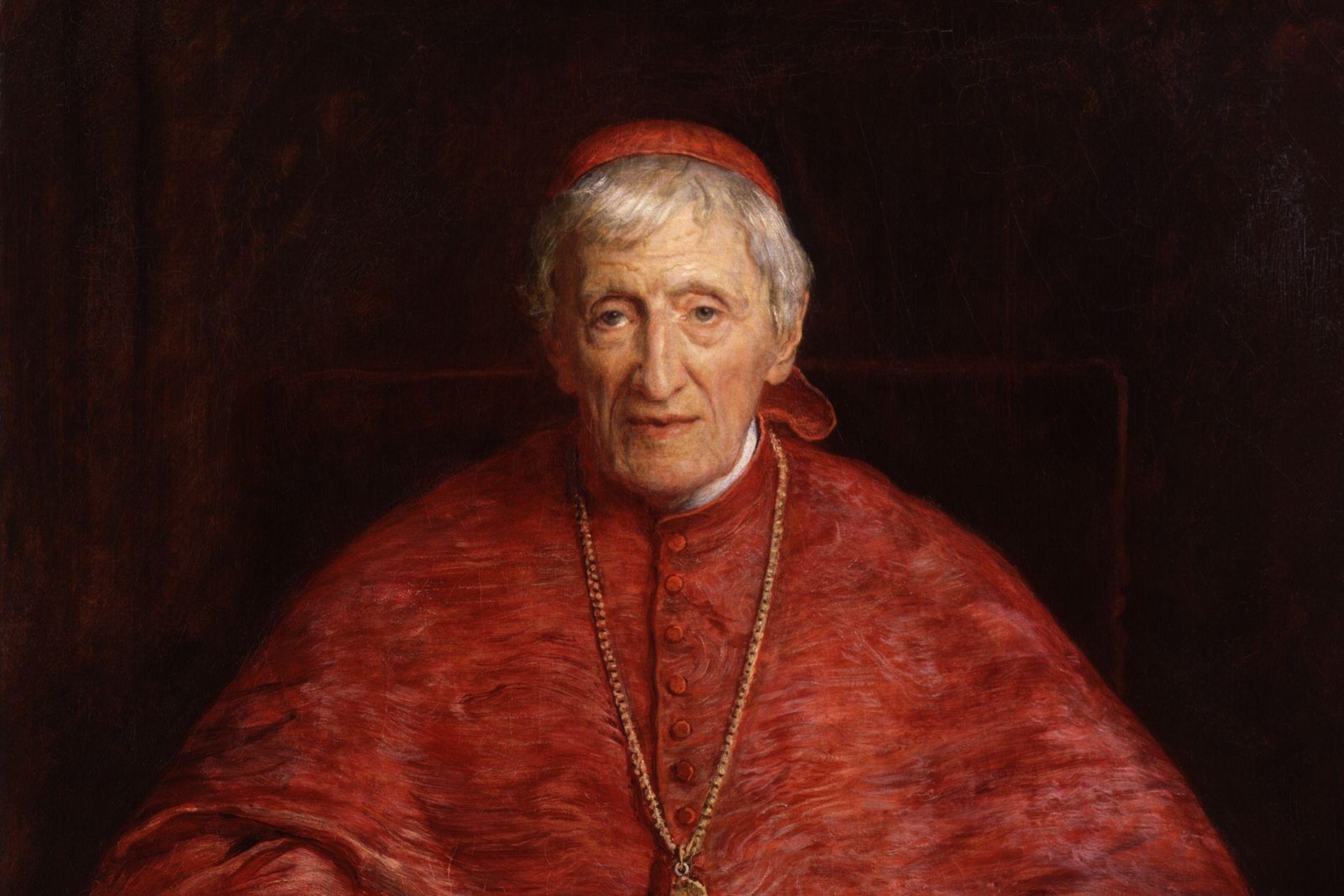
Sir John Everett Millais, Portrait of Cardinal John Henry Newman, 1881 — public domain.
The slow collapse of an argument
What changed his mind wasn't a single event but nearly a decade of patient historical study, much of it into the doctrinal controversies of the early Church — particularly the fourth- and fifth-century disputes over Arianism (which denied the full divinity of Christ) and Monophysitism (which denied Christ's full humanity). Reading how those controversies were actually settled, Newman became convinced that the pattern of authority that resolved them belonged to the see of Rome, not to a national church like the Church of England. He described the process in his own words years later in his spiritual autobiography, Apologia Pro Vita Sua — a book worth naming directly here, since it remains the primary and most reliable source for how Newman understood his own conversion, rather than later summaries of it. By 1843 he had resigned his post at St Mary's; two years later, on October 9, 1845, he was received into the Catholic Church at Littlemore, near Oxford, by Father Dominic Barberi, an Italian Passionist priest. The cost was immediate and steep — he lost his Oxford fellowship, his income, and most of his closest friendships overnight, at an age when starting over was no small thing.
From convert to Cardinal
Newman went to Rome, was ordained a Catholic priest in 1847, and returned to England to found the Birmingham Oratory, a community of priests living under the rule of Saint Philip Neri, which he led for the rest of his life. His years as a Catholic were not free of difficulty; he clashed at points with senior figures in the English Catholic hierarchy who viewed him with suspicion as a recent and prominent convert, and a proposed Catholic university project in Dublin — the occasion for his lectures later published as The Idea of a University — largely disappointed him in practice even as the ideas in it proved lasting. Recognition came late but decisively: in 1879, Pope Leo XIII made him a cardinal, an honor Newman had not sought and had assumed, given his age and his history of friction with parts of the hierarchy, he would never receive. He took as his motto "Cor ad cor loquitur" — heart speaks to heart — a phrase borrowed from Saint Francis de Sales that summed up his own approach to faith: not chiefly a matter of winning arguments, but of one person's honesty reaching another's.
A writer whose sentences outlasted his controversies
Newman's real influence beyond his own century rests heavily on what he wrote. Apologia Pro Vita Sua, composed at speed in 1864 after the clergyman Charles Kingsley publicly and unfairly accused him of dishonesty, turned a personal defense into what many consider the finest religious autobiography in English — an unusually candid account of exactly how and why a conviction changes over years rather than moments. His hymn "Lead, Kindly Light," written decades earlier during a serious illness while stranded on a ship in the Mediterranean, became one of the most widely sung hymns in the English-speaking world, Catholic and Protestant alike, its opening plea for guidance through "the encircling gloom" resonating with readers who knew nothing else about him. His theory of the development of doctrine — the idea that Church teaching can grow and clarify over centuries without becoming a different faith — shaped Catholic theology well into the twentieth century and was cited repeatedly at the Second Vatican Council. Even readers with no religious interest at all still study The Idea of a University for its argument that education should form a mind capable of relating truths to one another, not just accumulate facts.
Canonization, more than a century later
Newman died in 1890 and was buried, at his own request, in the same grave as his close friend and fellow Oratorian Ambrose St John — a detail sometimes seized on in modern debate, though contemporaries understood it within the conventions of deep clerical friendship rather than as evidence of anything scandalous, and the Church's cause for his sainthood was never slowed by it. His path to canonization moved through the normal stages: declared Venerable in 1991, beatified by Pope Benedict XVI in Birmingham in 2010 (Benedict XVI personally presided, an unusual step reflecting how highly he regarded Newman), and canonized by Pope Francis on October 13, 2019, making Newman the first English person to be declared a saint since the seventeenth century. His feast is kept on October 9, marking the anniversary of his reception into the Catholic Church rather than his death — a fitting choice for a man whose whole life turned on that one, costly decision. For readers who want to see the Oxford Movement's other side, the article on Saints John Fisher and Thomas More covers an earlier generation of English Catholics who paid an even higher price for the same conviction that Rome held the authority Newman spent a decade coming to recognize.
Trivia
Who was Saint John Henry Newman?
Why did Newman leave the Church of England?
What is Newman's most famous written work?
What is Newman's motto, and what does it mean?
When is Saint John Henry Newman's feast day, and is he a patron of anything specific?
You May Also Like
Related Reading