Saint Kentigern of Glasgow

An uncertain birth, a lasting legend
Reliable historical detail about Kentigern's early life is thin, and what survives comes largely through Lives written many centuries after his death, blending plausible historical material with the kind of elaborate origin legend common to early British and Celtic saints. Tradition places his birth in the sixth century, somewhere in the British-speaking kingdoms of what is now southern Scotland, and holds that he was raised and educated under a churchman named Serf (or Servanus) at a religious community on the Firth of Forth.
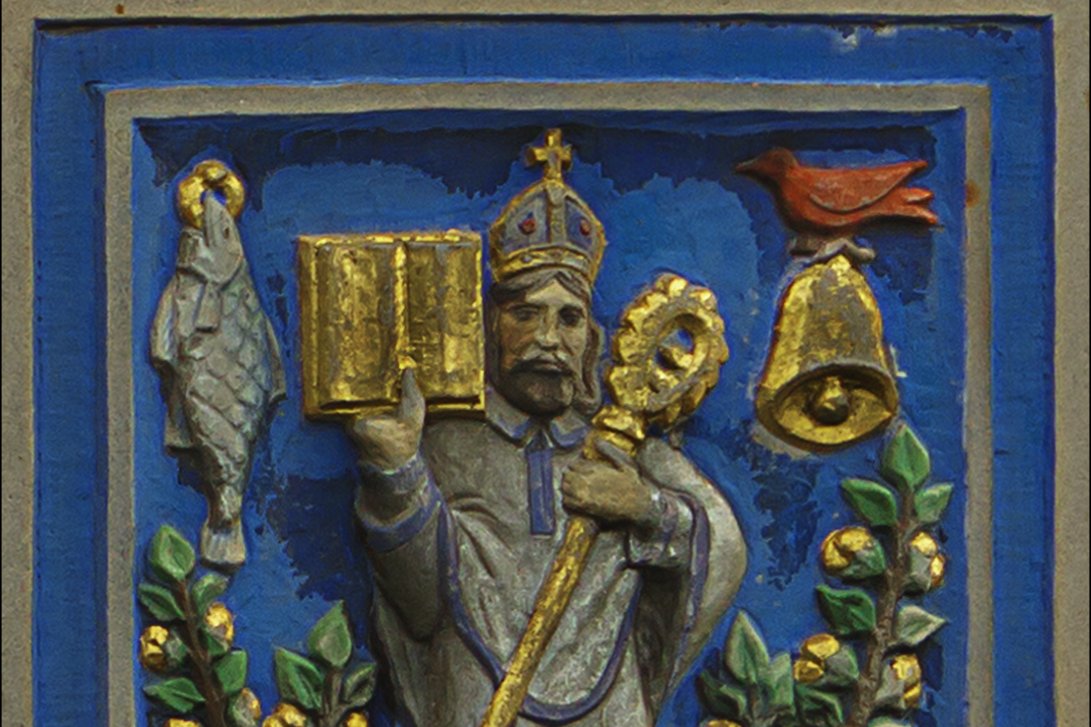
Carved relief of Saint Kentigern (Mungo) with his traditional emblems — fish, bird, bell, and tree — public domain.
The nickname that stuck to him for the rest of his life, and long after it, is said to date from this period: Mungo, meaning something close to "dear friend" or "dear one" in the old British Cumbric language once spoken across this region. Whatever its precise origin, the affectionate nickname displaced his given name so thoroughly in local memory that Glasgow's own cathedral, and much of Scottish tradition generally, refers to him as Mungo far more often than as Kentigern.
Founding a Christian community on the Clyde
Kentigern's mission centered on the region around the River Clyde, where, according to tradition, he established a religious community on the site of an earlier hermit's grave — traditionally identified as a man named Fergus — near what would become the city of Glasgow. Working as bishop over the ancient British kingdom of Strathclyde, Kentigern is credited with building the foundational Christian institutions in a region that, like much of post-Roman Britain, had a scattered and uneven Christian presence, shaped by earlier missionary work but far from uniformly or securely established.
Political instability in the region — the specific causes are not consistently detailed across the surviving accounts, though dynastic conflict among British rulers is the most commonly cited factor — is said to have forced Kentigern from Strathclyde at some point during his ministry. Tradition holds that he traveled south into Wales, where he founded a monastic community, later associated with the see of St Asaph, continuing his pastoral and missionary work in a new region before eventually being invited back north to resume his mission on the Clyde.
The four legends of Glasgow's coat of arms
Kentigern's memory is inseparable from a set of four specific miracle legends, preserved for centuries in a traditional rhyme and still visible today on Glasgow's civic coat of arms: "the bird that never flew, the tree that never grew, the bell that never rang, and the fish that never swam."
The bird refers to a story in which Kentigern is said to have restored to life a pet robin that had been accidentally killed, associated in some versions with his childhood under Saint Serf. The tree recalls a legend in which Kentigern, tasked as a boy with keeping a fire burning, miraculously relit it using hazel branches that had not caught flame before. The bell was reportedly given to Kentigern by the pope during a journey to Rome and used to call the local faithful to prayer and mourning. And the fish — the most famous of the four — refers to a legend in which Kentigern miraculously recovered a queen's lost ring from the belly of a salmon caught in the Clyde, resolving a scandal that could have cost her dearly, a story that bears a notable resemblance to similar "recovered ring" miracle tales attached to other medieval saints across Europe.
These stories should be read plainly as pious legend rather than documented history — their value lies in what they reveal about how deeply Kentigern's memory became woven into the civic identity of the city he is credited with founding, not as verified biographical fact.
The written source behind the legend
Nearly everything known about Kentigern in narrative detail comes down through a single major medieval source: a Life of Saint Kentigern written by a monk named Jocelin of Furness in the late twelfth century, roughly six hundred years after Kentigern's traditional death date, commissioned at the request of the bishop of Glasgow to bolster the cathedral's prestige and its claim to ancient sanctity. Jocelin drew on earlier fragmentary material, including an even older and now largely lost Life, but the surviving text reflects the concerns of twelfth-century Glasgow as much as any reliable memory of sixth-century events — a common pattern for early British and Irish saints, whose cults were often actively promoted and elaborated by later medieval cathedral chapters with a direct institutional interest in establishing an impressively ancient founder. Historians treat Jocelin's Life as valuable evidence for what twelfth-century Glasgow believed and wanted to believe about its patron, while remaining cautious about accepting its more elaborate episodes as literal historical fact.
A legendary meeting with Saint Columba
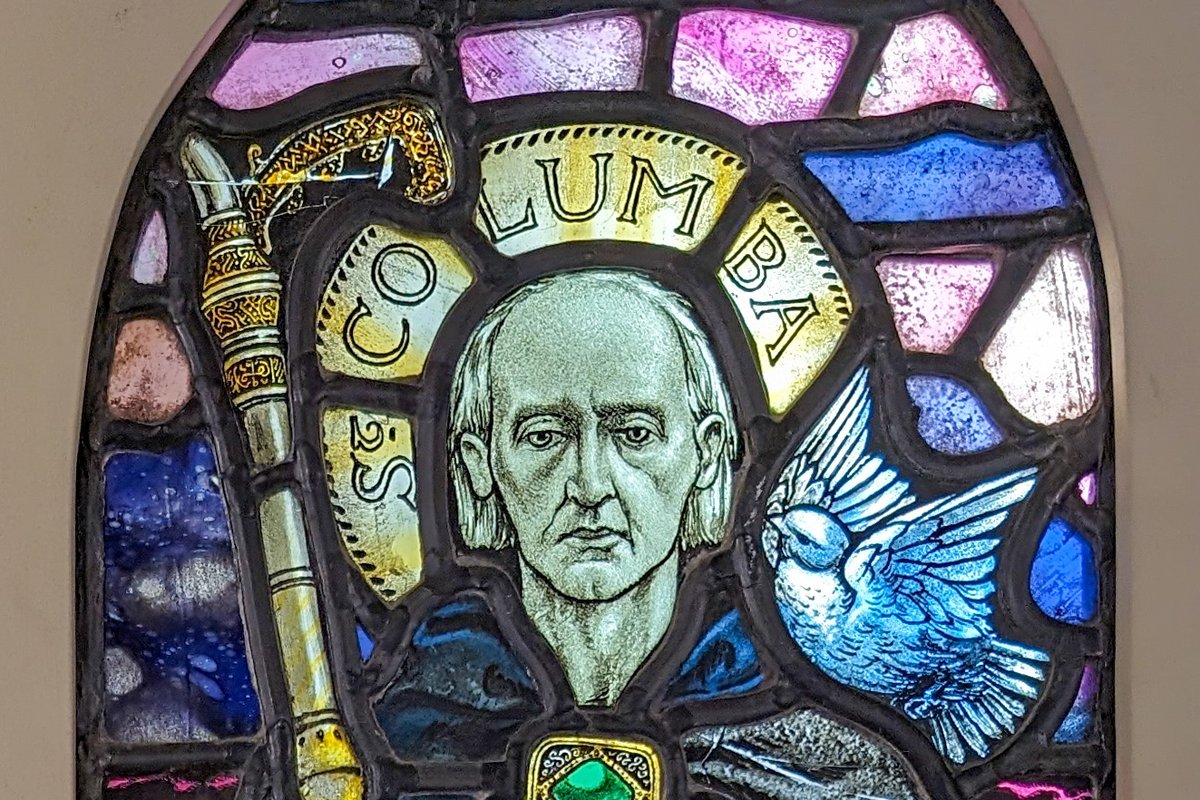
Among the traditions attached to Kentigern is an account of a meeting between him and Saint Columba, the Irish monastic founder of Iona, during which the two saints are said to have exchanged pastoral staffs as a gesture of mutual respect and blessing. Such a meeting, if it took place at all, would have brought together two of the most significant missionary figures operating in Britain during the second half of the sixth century, representing two somewhat different strands of early insular Christianity — Kentigern's British, Strathclyde-based mission and Columba's Irish-founded monastic network centered on Iona and spreading through Dál Riata and beyond. Modern historians treat the specific meeting as more likely a later legendary device meant to link the two saints' traditions together than a securely documented historical event, but it reflects a real and important truth about the period: that early British, Irish, and Pictish Christian communities were far more interconnected, through travel, correspondence, and shared monastic culture, than a purely national or regional framing of each saint's story tends to suggest.
Feast day and legacy
Kentigern died, according to tradition, on January 13, and that date remains his feast day. His memory is preserved above all in Glasgow Cathedral, built on the traditional site of his original foundation and one of the few Scottish medieval cathedrals to survive the Reformation largely intact, still containing a crypt traditionally associated with his tomb.
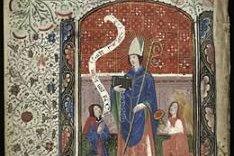
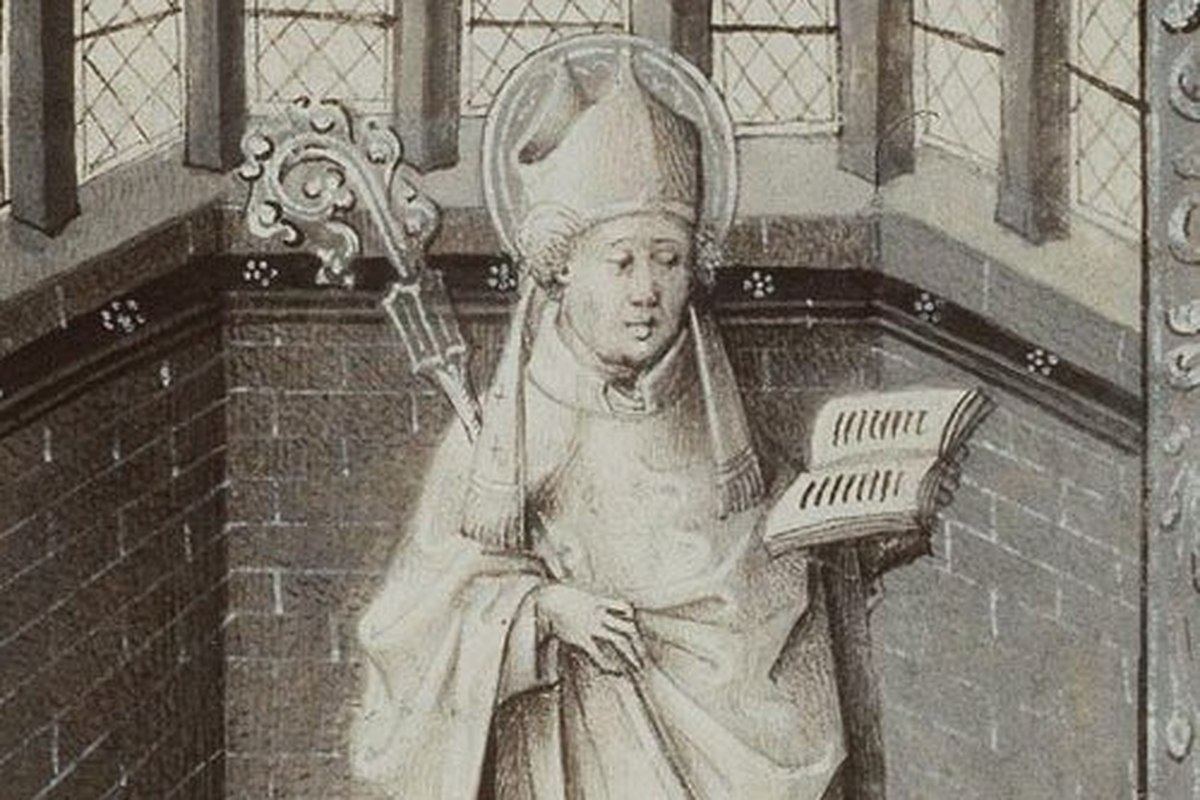
In art, Kentigern is depicted as a bishop in full vestments, almost always accompanied by some combination of his four emblematic symbols — the fish, bird, bell, and tree — a visual shorthand that has followed him for centuries and is preserved in the carved relief that anchors this article. Readers interested in the wider tradition of early British and Celtic missionary bishops working across the same general period and region may also want to read about Saint Willibrord, whose own missionary career, though centered on the Continent rather than Britain, represents the same broader wave of early medieval evangelization that shaped Kentigern's world.
Trivia
Who was Saint Kentigern, also known as Saint Mungo?
Why is Saint Kentigern called Mungo?
What do the symbols on Glasgow's coat of arms have to do with Saint Kentigern?
Did Saint Kentigern really go into exile in Wales?
When is the feast of Saint Kentigern?
You May Also Like
Related Reading