Saint Lambert of Maastricht

Educated for the episcopacy
Lambert was born around 636 into a noble Frankish family and was educated at Maastricht under Bishop Theodard, whom he would eventually succeed. When Theodard was killed — reportedly while traveling to petition the royal court over property disputes affecting his diocese — the young Lambert, still in his twenties, was appointed bishop in his place, with the backing of King Childeric II, who at the time held considerable influence over ecclesiastical appointments within his territory.
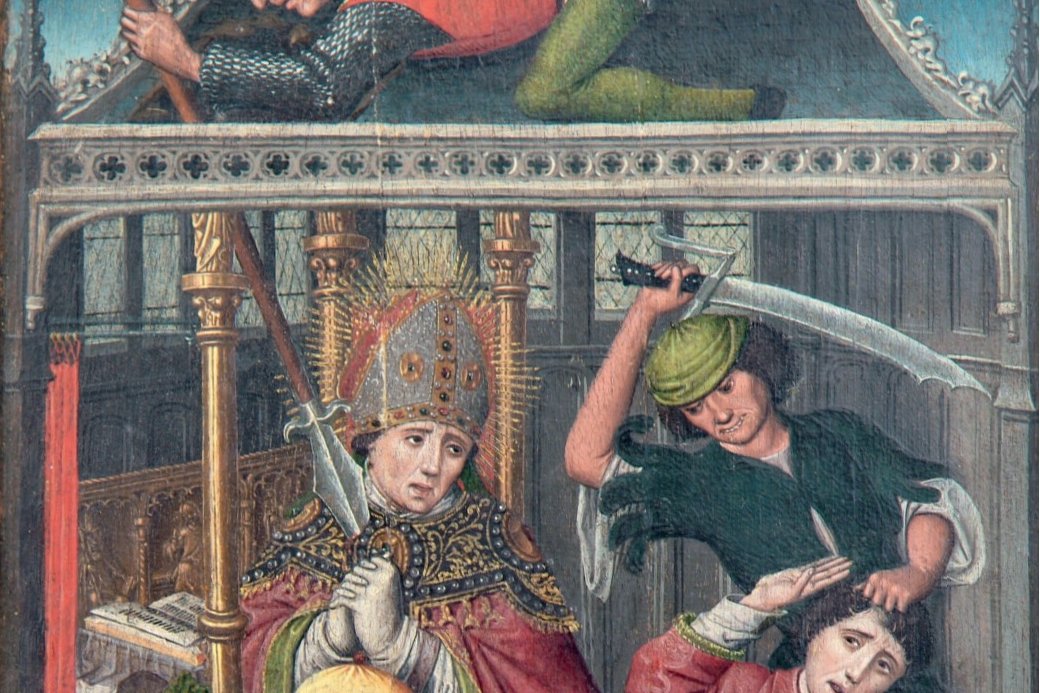
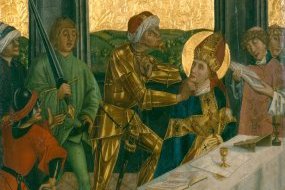
Jan van Brussel (workshop), The Martyrdom of Saint Lambert, diptych panel, c. 1490 — public domain.
This early, court-connected start to Lambert's episcopal career would soon prove to be a serious liability rather than an advantage.
Caught in the fallout of a palace coup
In 675, Childeric II was assassinated amid a wider political crisis within the Frankish kingdom, and the faction that seized power in the aftermath moved to displace many of the appointees and allies associated with the murdered king's regime — Lambert among them. Losing royal backing meant losing his diocese as well: he was removed from his position as bishop of Maastricht and spent the following years, by most accounts around seven, living in retreat at the monastery of Stavelot, observing a notably strict and disciplined religious routine despite the involuntary and politically driven nature of his removal.
Political fortunes in the Frankish kingdom shifted again by the early 680s, and Lambert was eventually restored to his see at Maastricht, where he resumed his episcopal duties, including renewed missionary work in the region — tradition connects him with some evangelizing activity among the population of Toxandria, in what is now the southern Netherlands and northern Belgium, extending Christian practice into territory that remained only partially converted.
A family feud turns fatal
Lambert's eventual death had nothing directly to do with his earlier political troubles. According to tradition, members of his own household or family became involved in a violent feud with another prominent local family, a conflict that culminated in the deaths of two of Lambert's relatives. In retaliation, armed men from the opposing family surrounded Lambert's residence at night, seeking vengeance against his household as a whole.
Accounts describe Lambert as choosing, in this final confrontation, not to allow armed resistance from those around him, and he was killed — according to the most widely repeated version of the story, while at prayer — around the year 705. The precise circumstances tying his death to matters of personal or family conduct, rather than to his role as bishop specifically, make his classification as a martyr a matter the Church has traditionally framed around the manner of his death and his refusal to permit violence in his own defense, rather than a straightforward case of dying for refusing to renounce the faith.
From Maastricht to Liège
Lambert's death had consequences that reshaped the religious geography of the region for centuries afterward. His relics were eventually brought to the site of his death, and a church built there became the nucleus of a growing settlement. His successor as bishop, Saint Hubert, formally transferred the episcopal see itself from Maastricht to this new site, which grew into the city of Liège — meaning that Lambert, who never lived to see it, is directly responsible for the foundation of one of the major cities of medieval and modern Belgium.
A cult that shaped the diocese
Devotion to Lambert spread quickly after his death, encouraged in part by his successors, who had every institutional reason to promote the memory of a bishop whose martyrdom had given their new see at Liège both a founding relic and a powerful patron. By the early eighth century, Lambert's cult had become one of the most significant in the Frankish Low Countries, and Liège Cathedral — dedicated to him and built over the traditional site of his death — grew into one of the great episcopal churches of the medieval Empire before it was destroyed during the French Revolutionary period. The bishops of Liège, who governed both a diocese and, from the Middle Ages onward, a substantial prince-bishopric with real temporal power, continued to invoke Lambert as their founding patron for the better part of a thousand years.
Lambert's story also sits within a broader pattern of seventh- and eighth-century Frankish bishops whose deaths, whatever the precise personal or political circumstances, were absorbed by the Church into a narrative of martyrdom because of how they died rather than strictly why. Modern historians sometimes note the tension between the violent, family-feud origins of Lambert's death and the later hagiographical tradition, recorded in an early Life written not long after his death, which emphasizes his personal holiness, his refusal of violence, and his death at prayer — the elements that mattered most for how the medieval Church understood sanctity, even when the underlying dispute was, at its root, a secular matter of family honor rather than persecution for the faith.
Feast day and iconography
Lambert's feast is celebrated on September 17. In art, he is typically depicted as a bishop in full vestments, often shown at the moment of his martyrdom, sometimes holding a sword or lance as a reference to the manner of his death — the exact scene captured in the late-medieval diptych panel that anchors this article, showing armed attackers surrounding him in his own house.
Readers interested in the wider network of Frankish bishops working in the Maastricht-Liège region during this period may also want to read about Saint Hubert of Liège, Lambert's direct successor, whose own episcopate built directly on the foundation — quite literally — that Lambert's death had unexpectedly established.
Trivia
Who was Saint Lambert of Maastricht?
Why was Saint Lambert exiled from his diocese?
How did Saint Lambert die?
What is the connection between Saint Lambert and the city of Liège?
When is the feast of Saint Lambert?
You May Also Like
Related Reading