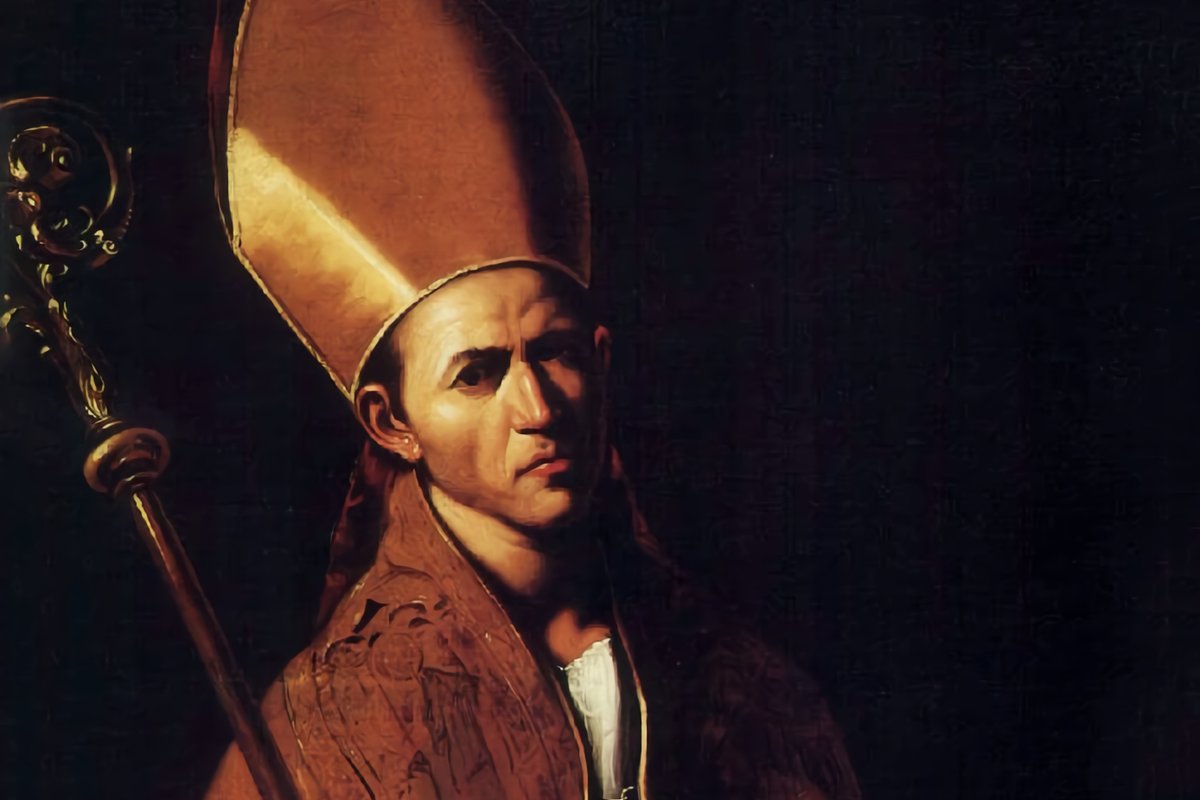
Saint Apollinaris, Bishop and Martyr

A bishop remembered more by his church than by his biography
Ravenna, on Italy's Adriatic coast, would go on to become one of the most important cities in the late Roman and early Byzantine world — briefly the capital of the Western Roman Empire in the fifth century, and later a key Byzantine stronghold in Italy. Tradition holds that Christianity first took organized root there through Apollinaris, said to have been sent from Rome and consecrated bishop by Saint Peter the Apostle himself, making him, according to that same tradition, the first bishop of Ravenna and one of the earliest missionary bishops of northern Italy.
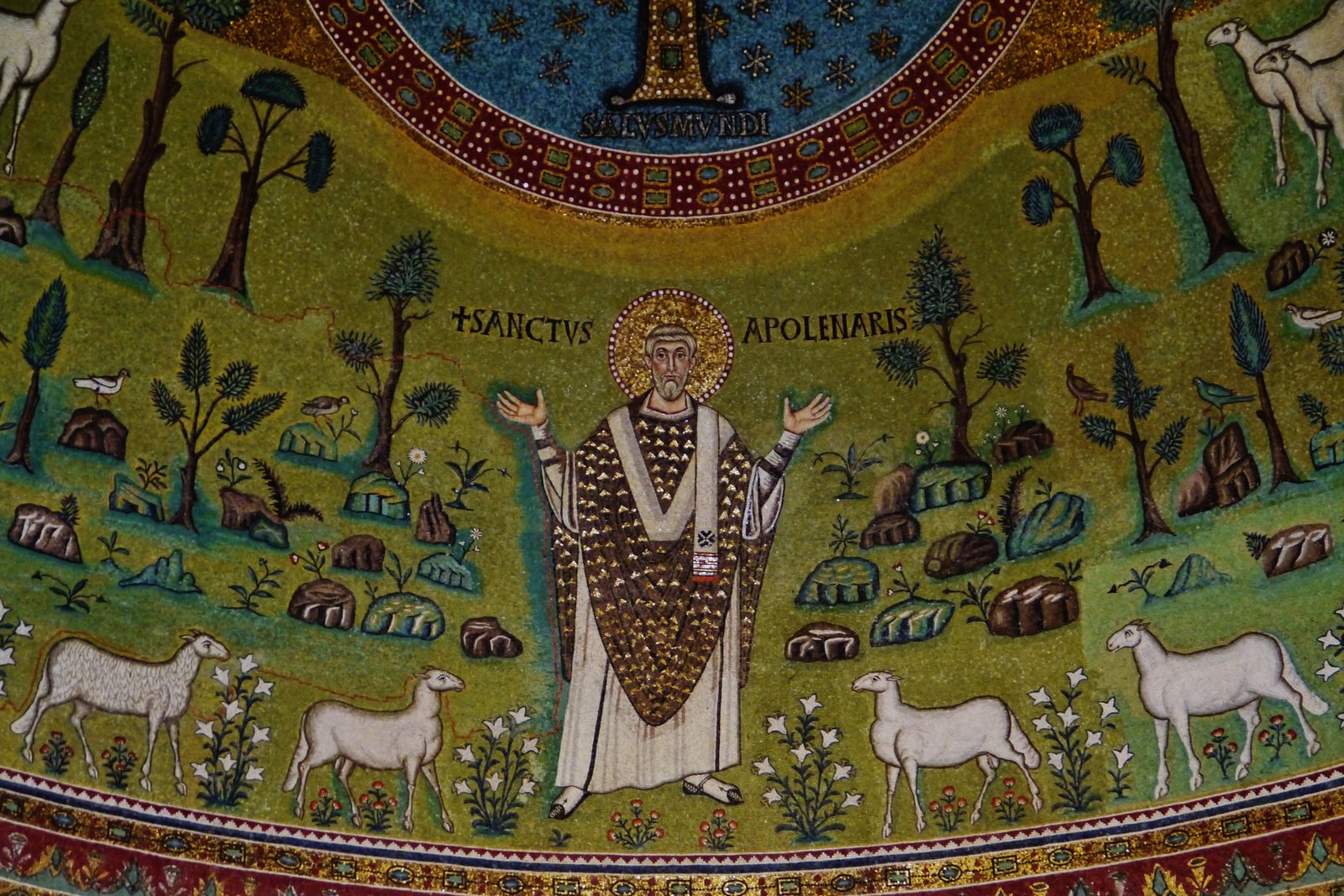
Apse mosaic of Saint Apollinaris, Basilica of Sant'Apollinare in Classe, Ravenna, 6th century. Photo by Zairon, Wikimedia Commons — CC BY 4.0.
It's important to be honest about the limits of what history actually records here. The earliest detailed written accounts of Apollinaris's life — his consecration, his ministry, the specific circumstances of his death — come from documents composed several centuries after he is traditionally believed to have lived, a common pattern for many early bishop-martyrs whose cults took firm root in a city long before anyone wrote down a full narrative of their lives. This does not mean the tradition is fabricated; it means, as with many early saints venerated since antiquity, that the core outline — an early bishop, persecuted for his preaching, eventually martyred — rests on long-standing local tradition and liturgical memory rather than a contemporary biography we can independently verify in every detail. The Church distinguishes carefully between what is asserted with confidence (that Apollinaris was venerated from antiquity as Ravenna's founding bishop and martyr) and what belongs to the fuller narrative details supplied later by pious tradition.
A ministry marked by repeated persecution
According to that tradition, Apollinaris's preaching in Ravenna provoked hostility from local pagan authorities and populace almost immediately, and he was beaten and driven out of the city on more than one occasion — a detail consistent with the broader pattern of persecution facing Christian missionaries and bishops across the Roman Empire in its first few centuries, before Christianity's legal status changed dramatically under Constantine in the early fourth century. Rather than abandoning Ravenna after being expelled, Apollinaris reportedly returned repeatedly, continuing to preach and build up the small Christian community there despite the danger, a persistence the tradition frames as central to his sanctity: not a single dramatic act of defiance, but a sustained willingness to keep returning to a hostile city for the sake of the small flock gathering there.
The final chapter of the tradition holds that Apollinaris was beaten so severely during one of these episodes of persecution that he died from his injuries, either immediately or after a period of decline — accounts vary on the exact circumstances — earning him recognition as a martyr, one who died specifically because of his fidelity to preaching and shepherding the Christian community he had been sent to build.
The basilica that outlasted the record of his life
Whatever the precise historical uncertainties surrounding Apollinaris's own biography, the strength of his cult in Ravenna by the early Christian and Byzantine periods is not in doubt. In 549 AD, the Basilica of Sant'Apollinare in Classe was consecrated near the site of his traditional burial, a few miles outside Ravenna in what was then the city's port district, Classe. The basilica was built during the reign of the Ostrogothic kingdom and consecrated under Byzantine rule shortly after the Byzantine general Belisarius reconquered Ravenna from the Ostrogoths — a period when the city was one of the wealthiest and most artistically significant centers in the entire Mediterranean world.
The basilica remains, to this day, one of the most extraordinary surviving monuments of early Christian art in Italy. Its apse mosaic depicts Apollinaris himself, arms raised in prayer, standing amid a green pastoral landscape of sheep — a visual echo of his role as shepherd-bishop of Ravenna — beneath a jeweled cross set against a starry sky, rendered in the shimmering gold-glass mosaic technique that defines Ravenna's churches. Along with several other Ravenna monuments from the same era, including the Basilica of San Vitale, the church is recognized today by UNESCO as part of the Early Christian Monuments of Ravenna, cited specifically for the exceptional artistic and technical achievement of its mosaics, among the finest and best-preserved anywhere from the early Byzantine world.
A cult that shaped Ravenna's identity
Apollinaris's veneration became deeply woven into Ravenna's civic and religious identity over the following centuries. A second, even more famous basilica within the city itself, the Basilica of Sant'Apollinare Nuovo — originally built as a palace church under the Ostrogothic king Theodoric in the early sixth century and later rededicated to Apollinaris — also survives today, its long nave lined with mosaic processions of martyrs and virgins that rank among the most celebrated works of art from the entire early medieval period. Between the two basilicas bearing his name, Apollinaris arguably has a stronger claim to a lasting artistic legacy than almost any other bishop-martyr of comparably uncertain biography from the early Church.
This pattern — a saint whose personal history is thinly documented, but whose cult generates monumental, enduring devotion — is not unique to Apollinaris; it echoes the way devotion to other early martyrs, such as the anonymous First Martyrs of the Holy Roman Church, grew and persisted despite gaps in the historical record. What made these cults durable was not documentary certainty but the continuous, lived memory of a community that kept returning to the same tomb, the same church, the same feast day, across generations.
Feast day and continuing veneration
Saint Apollinaris is commemorated on July 20 in the Roman Catholic calendar, and remains the principal patron saint of Ravenna, where his feast is still marked with particular local devotion. In some regions of Italy and elsewhere, he has also traditionally been invoked by those suffering from gout and certain other physical ailments, a form of patronage that developed through local custom over the centuries rather than through any documented episode in his own life. Nearly two thousand years after the events tradition assigns to him, Apollinaris remains most vividly present not through a detailed written biography, but through gold mosaic walls that have outlasted empires — a reminder that sanctity, once it takes hold in a community's memory, tends to outlive the paper trail entirely.
Trivia
Who was Saint Apollinaris?
When did Saint Apollinaris live?
How did Apollinaris die?
Why is the Basilica of Sant'Apollinare in Classe important?
What is the feast day of Saint Apollinaris?
You May Also Like
Related Reading