Saint Ludmila

An early conversion in a pagan land
Ludmila was born around 860, likely into a Slavic noble family in the region that would become Bohemia, and married Bořivoj I, who became the first historically documented Christian ruler of the Přemyslid dynasty that would govern Bohemia for centuries. Around 883, Ludmila and Bořivoj were baptized, according to tradition by Saint Methodius, the missionary to the Slavs whose work with his brother Cyril had already begun reshaping Slavic Christianity through translated Scripture and liturgy in the Slavic vernacular. Their conversion placed them among the earliest Christian rulers in a region still overwhelmingly pagan, a genuinely risky political and spiritual choice that met real resistance from parts of the Bohemian nobility still attached to older religious practices.
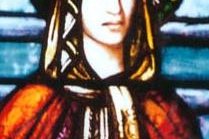
Stained glass window of Saint Ludmila, St. Wenceslaus Church, Cedar Rapids, Iowa — used under CC BY-SA 3.0, photograph by JesseG.
Bořivoj's reign and early death left Ludmila as an influential figure at the Bohemian court through the reigns of her sons, and she used that position to promote the still-fragile Christian faith in Bohemia, including reportedly founding or supporting some of the earliest churches in the region. Her influence became most consequential, though, not through her sons' generation but through her grandson's — when her son Vratislaus I died, leaving his own young son Wenceslaus as heir, Ludmila took direct responsibility for the boy's upbringing and religious formation, a role that would put her on a collision course with Wenceslaus's mother.
Rivalry with Drahomíra
Vratislaus's widow, Drahomíra, herself of Slavic pagan background before her marriage, became regent for the young Wenceslaus, but Ludmila's role in the boy's religious education gave her real, competing influence over how he would be formed — and, by extension, over the future direction of Bohemia's still-young Christian identity. Medieval chroniclers describe genuine tension between the two women over this influence, though the sources for the period are limited and were mostly written after the fact by parties sympathetic to Ludmila and Wenceslaus, so some caution is appropriate about how the conflict has been characterized.
What is well documented is the outcome: in 921, Drahomíra sent two nobles, Tunna and Gommon, to Ludmila's residence at Tetín, where they strangled her with her own veil — a detail so specific and so repeated across independent early sources that historians generally accept it as accurate rather than later embellishment. Ludmila's murder didn't achieve its apparent aim of removing her influence permanently; if anything, it cemented her reputation, and a cult around her as a martyr developed quickly in the years that followed, with her remains eventually translated to Prague.
A grandmother's legacy in a caroled king
Wenceslaus grew to adulthood having absorbed the Christian formation Ludmila had given him as a boy, and became Duke of Bohemia in 921, the same year his grandmother was killed, ruling with a reputation for piety, justice, and support of the Church that closely echoed what chroniclers say Ludmila had instilled in him. He was murdered himself in 935 — by his own brother Boleslaus, in a killing with disturbing echoes of the family violence that had already claimed his grandmother — and was canonized as a martyr shortly after, becoming Bohemia's most important national saint. His fame reached far beyond Central Europe centuries later through the English Christmas carol "Good King Wenceslas," which turned a story about winter charity into one of the best-known carols in the English-speaking world, still sung by people who mostly don't know it commemorates a real Bohemian duke raised by a grandmother who was murdered for her influence over him.
Ludmila's own cult, meanwhile, developed alongside her grandson's rather than being eclipsed by it. She came to be venerated as one of the patron saints of Bohemia in her own right, and specifically as a patron connected to grandmothers and to the religious formation grandparents give their grandchildren — a patronage that grows directly and specifically out of the one clearly documented achievement of her life: raising a child who would go on to shape his country's Christian identity for the following millennium.
A cult that predates formal canonization
Like most saints venerated from the earliest medieval period, Ludmila was never canonized through the centralized papal process that developed only later in Church history — her sainthood rests on the older model of popular acclamation and local episcopal recognition, confirmed by the swift development of a genuine cult immediately following her death and by the translation of her relics to Prague not long afterward. That translation, moving her remains from Tetín to the growing center of Bohemian Christian life, was itself a deliberate statement: it placed Ludmila's memory at the physical heart of the very dynasty and Church she had helped establish, ensuring her story stayed bound to Bohemia's ongoing religious identity rather than fading into a purely local or family-specific memory tied only to the site of her murder.
Feast day and lasting veneration
Ludmila's feast is kept on September 16. Her remains rest today in the Basilica of St. George at Prague Castle, within sight of the cathedral that holds the remains of the grandson she raised — a proximity that reflects how closely their two cults have always been linked in Bohemian and Czech devotion. Among early medieval royal martyrs whose deaths came at the hands of their own family, Ludmila's story shares real structural similarities with figures like Saint Edward the Martyr in England, murdered a few decades later in comparable circumstances of court rivalry — a reminder that the dangers facing early Christian rulers in this period often came from inside their own households rather than from external enemies.
Trivia
Who was Saint Ludmila?
Why was Ludmila killed?
How is Ludmila connected to Saint Wenceslaus?
Was Bohemia already Christian when Ludmila converted?
When is Saint Ludmila's feast day?
You May Also Like
Related Reading