Saint Martin de Porres, Religious

Born into the racial hierarchy of colonial Peru
Martin de Porres was born in Lima in 1579, the illegitimate son of Juan de Porres, a Spanish nobleman, and Ana Velázquez, a freed woman of African descent, with some accounts also noting Indigenous ancestry. Colonial Peruvian society at the time operated under a rigid racial hierarchy that structured nearly every aspect of legal and social life, and Martin's mixed heritage placed him in a precarious position from birth. His father initially refused to acknowledge him as his son, though he later provided some support and eventually arranged for Martin's education, including an apprenticeship with a barber-surgeon that gave the young man practical medical skills, setting bones, administering basic treatments, and performing minor surgery, skills he would later put to extensive use in his religious life.
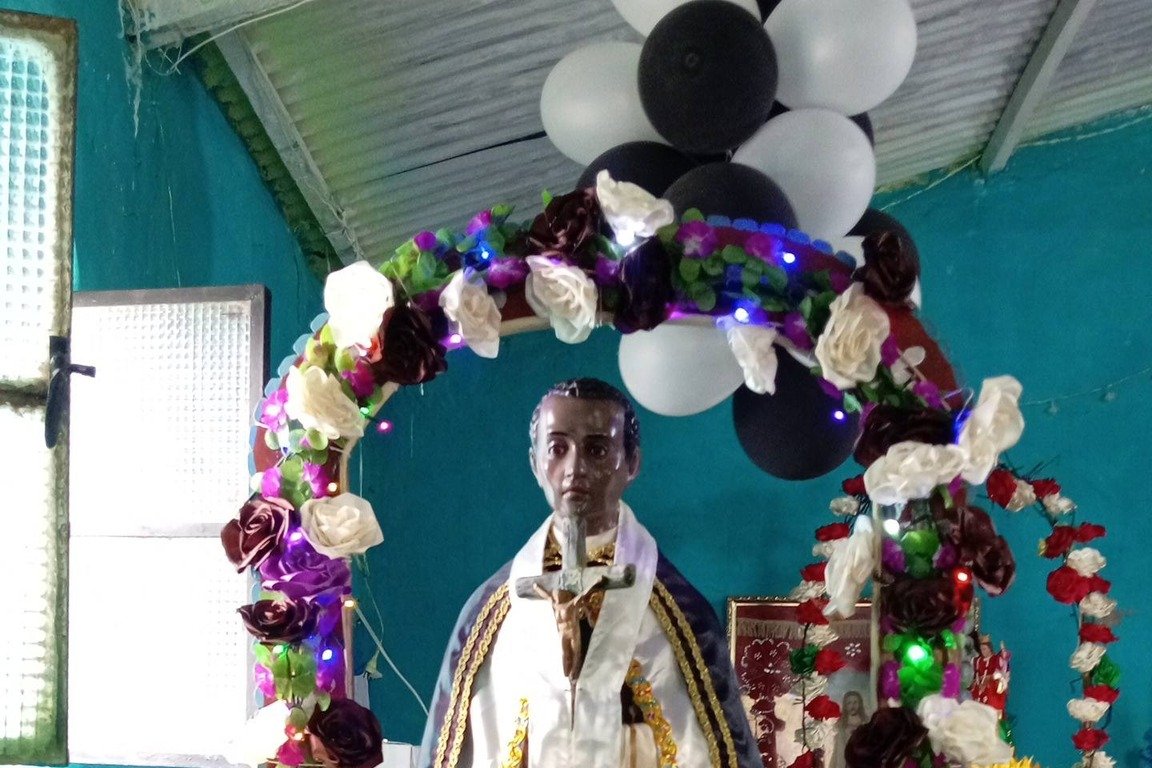
Photo by Jeysson Ordinola, statue of Saint Martin de Porres, Lancones, cropped, CC0, via Wikimedia Commons.
As a teenager, Martin sought to join the Dominican community at the Convent of the Holy Rosary in Lima, but colonial Spanish law at the time restricted individuals of African or mixed-race ancestry from professing full religious vows in many orders, a legal barrier rooted in the same racial hierarchy that had shaped his childhood. Rather than being turned away entirely, Martin was accepted into the community as a servant, performing the lowest and most menial tasks available within the priory: sweeping, laundry, and infirmary work among them.
Nine years of humble service before full vows
Martin remained in this reduced status for roughly nine years, during which his humility, work ethic, and evident personal holiness became increasingly impossible for his Dominican community to overlook. He applied his barber-surgeon training to the priory's infirmary, caring for sick friars and, increasingly, for the poor and enslaved people of Lima who had nowhere else to turn for medical attention. His reputation for charity and healing grew steadily within the city, extending well beyond the walls of the priory itself.
Eventually, moved by the evident depth of his vocation, the Dominican community successfully petitioned for an exception to the legal and canonical restrictions that had kept Martin from professing full vows, and he was admitted as a full religious brother in 1603. He would spend the rest of his life in that same Lima priory, continuing and steadily expanding the same work of charity that had first marked him out during his years of humble service.
A ministry that crossed every social boundary
What distinguished Martin's ministry was its remarkable breadth. Lima in his lifetime was a deeply stratified colonial city, with sharp divides separating Spanish colonists, enslaved Africans, Indigenous Peruvians, and people of mixed heritage like Martin himself, and access to medical care, food, and basic charity often followed those same racial and social lines. Martin's care pointedly ignored them. He treated the sick regardless of race or social standing, established an orphanage and a hospital for children, distributed food and medicine to the poor of Lima on a scale that reportedly strained the priory's own resources, and worked to secure care for enslaved Africans brought to the city, treating them with the same attention he gave to Spanish colonists of high social standing.
He also became known for founding what amounted to one of Lima's earliest organized charitable operations independent of direct government or noble patronage, raising funds from wealthy benefactors to support the orphanage, hospital, and ongoing relief work he had built up around the priory, demonstrating an unusual talent for practical organization alongside his personal acts of charity.
Miracles, animals, and popular devotion
A large body of tradition, recorded by contemporaries and by those who compiled testimony for his later canonization process, attributes numerous miraculous events to Martin during his lifetime, including reports of healings that defied ordinary medical explanation, and accounts of bilocation, appearing in two places at once, connected to reports from missionaries in distant regions who described encountering him despite his apparently never having left Lima. Such accounts, like similar reports connected to other mystics in Catholic tradition, are treated by the Church as matters of pious tradition rather than formally defined doctrine.
Martin also developed a particular and widely remembered reputation for gentleness toward animals, an aspect of his life that became one of the most distinctive elements of his popular devotion. Stories describe him caring for stray cats and dogs around the priory, and even, according to a well-known tradition, negotiating a kind of truce between the priory's cat, dog, and a troublesome mouse, feeding all three from the same dish rather than treating the mouse purely as vermin to be eliminated. Whatever the precise historical accuracy of individual stories, this consistent thread of universal, boundary-crossing compassion, extended to enslaved people, the poor, the sick, and animals alike, forms the core of how Martin has been remembered and venerated ever since.
Canonization and lasting significance
Martin de Porres died in Lima in 1639, and his cause for canonization moved forward over the following centuries, slowed at various points by the same broader historical patterns of racial prejudice that had shaped much of his own lifetime. Pope Gregory XVI beatified him in 1837, and Pope John XXIII canonized him in 1962, making him the first Black saint of the Americas to be formally canonized by the Catholic Church, a milestone widely noted at the time as carrying particular significance amid the broader twentieth-century struggle against racial segregation and discrimination across the hemisphere.
Today Martin de Porres is venerated as a patron of racial harmony and interracial justice, as well as of barbers, public health workers, and those living in poverty, a set of patronages that trace directly back to the concrete, practical shape his ministry took in colonial Lima. His feast day is celebrated on November 3, and his popular devotion remains especially strong throughout Latin America and among Black Catholic communities across the Americas.
Trivia
Who was Saint Martin de Porres and when did he live?
Why was Martin de Porres initially unable to become a full Dominican friar?
What was Martin de Porres known for during his lifetime?
What is Martin de Porres the patron saint of?
When was Martin de Porres canonized and what is his feast day?
You May Also Like
Related Reading