Saint Mary Magdalene

A woman who funded Jesus's ministry
Mary Magdalene takes her name from Magdala, a town in northern Galilee. According to the Gospels, Jesus cleansed her of seven demons, after which she became one of several women who financially supported his ministry, traveling alongside him and the other disciples and helping care for the group's material needs.
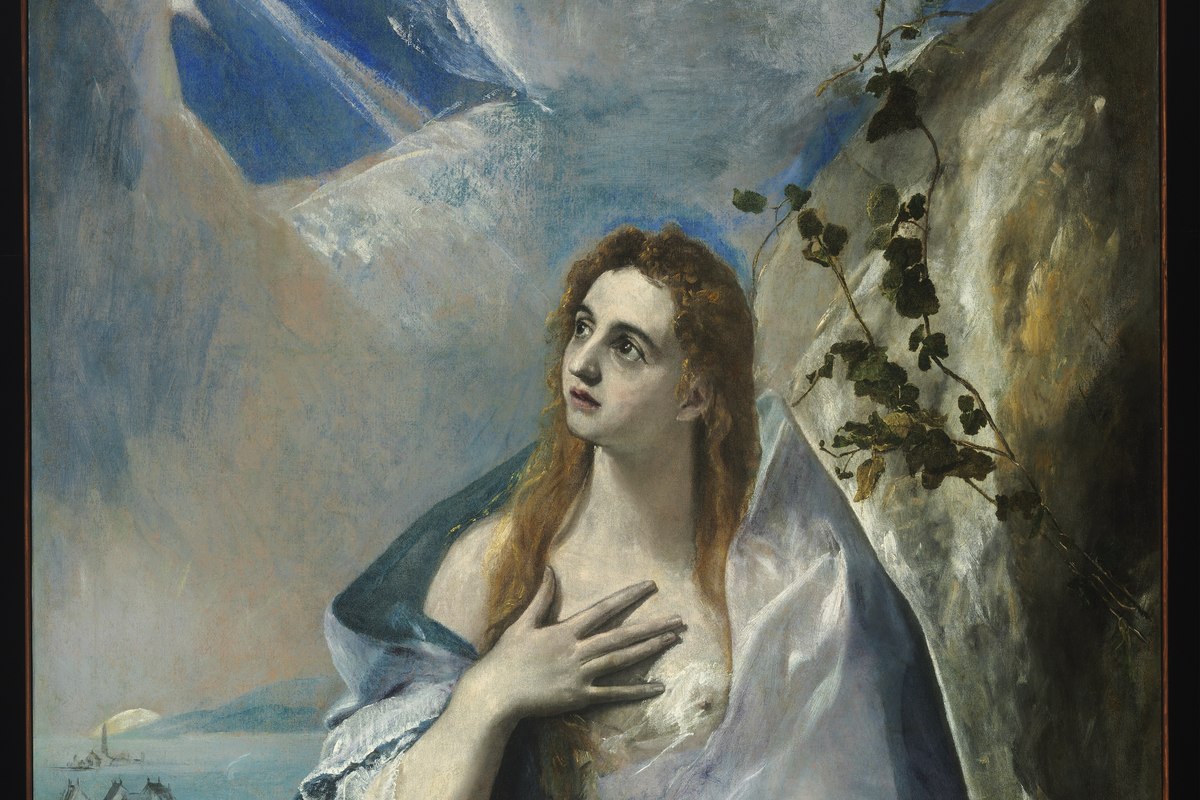
Traditional depiction of Saint Mary Magdalene, public domain.
The Gospel of Luke introduces her among a group of women "who had been healed of evil spirits and infirmities," specifically naming "Mary, called Magdalene, from whom seven demons had gone out" (Luke 8:2, RSV-CE), alongside Joanna, Susanna, "Joanna, the wife of Herod’s steward Chuza, Susanna, and many others who provided for them out of their resources." (Luke 8:3, RSV-CE). Scripture doesn't specify what form these afflictions took, and later Christian writers have generally read "seven demons" less as a count of individual evil spirits and more as a way of describing an especially severe and complete affliction — the number seven carrying, in Jewish and early Christian symbolism, a sense of totality or completeness. What the Gospel is clear about is the direction her life took afterward: healed, she didn't simply return home, but became one of the women who followed Jesus most closely for the rest of his ministry.
Present at the cross when others had fled
All four canonical Gospels agree on a detail many of the male disciples could not claim: Mary Magdalene witnessed both the crucifixion and the burial of Jesus. She remained at the foot of the cross even as most of his followers had already scattered, staying with him through the crucifixion's full course when leaving would have been far easier and far safer.
The first person to see him after the resurrection
According to John's Gospel, Mary Magdalene went to the tomb while it was still dark and found the stone already rolled away. She ran to tell Peter and the "beloved disciple," who confirmed the tomb was empty, but it was Mary who stayed behind and became the first to encounter the risen Jesus directly. "Jesus said to her, 'Mary.' She turned and said to him in Hebrew, 'Rabboni!' (which means Teacher)" (John 20:16, RSV-CE). He then gave her a specific instruction: "Stop holding on to me, for I have not yet ascended to the Father. But go to my brothers and tell them, ‘I am going to my Father and your Father, to my God and your God.’" (John 20:17, RSV-CE). She obeyed immediately: "Mary of Magdala went and announced to the disciples, “I have seen the Lord,” and what he told her." (John 20:18, RSV-CE).
The Apostle to the Apostles
Because she was the first to carry news of the resurrection to the other apostles, Saint Thomas Aquinas honored her with the title "Apostle to the Apostles" — first witness, and first messenger, of the event at the very center of Christian faith. It's a striking title for anyone to hold in a first-century Jewish context, where a woman's testimony was not typically given standing as legal evidence — making the Gospels' insistence that she was the first witness, rather than a more socially credible male disciple, a detail many scholars view as an argument in favor of the resurrection accounts' authenticity, since it isn't the kind of detail an ancient author would likely have invented.
Untangling centuries of confusion
Later tradition, particularly in the West, conflated Mary Magdalene with two other women who appear separately in the Gospels: Mary of Bethany, the sister of Martha and Lazarus who anointed Jesus's feet with expensive perfume, and an unnamed "sinful woman" in Luke's Gospel who washed Jesus's feet with her tears. The identification of all three as a single person dates largely to a homily preached by Pope Gregory the Great in 591, and it became the standard Western understanding for well over a thousand years — shaping countless paintings, hymns, and popular devotions that pictured Magdalene primarily as a repentant sinner. Eastern Christianity never adopted this conflation, always treating the women as distinct figures, and modern Catholic scholarship has largely followed that lead: the 1969 revision of the Roman calendar quietly separated the readings associated with the three women, effectively retracting Gregory's identification without dramatically announcing the change. Mary Magdalene's story, read on its own terms, is not one of scandal followed by repentance but simply one of healing followed by unwavering loyalty — a woman who stayed when others left, and who was trusted first with the news that mattered most.
A raised feast and an enduring image
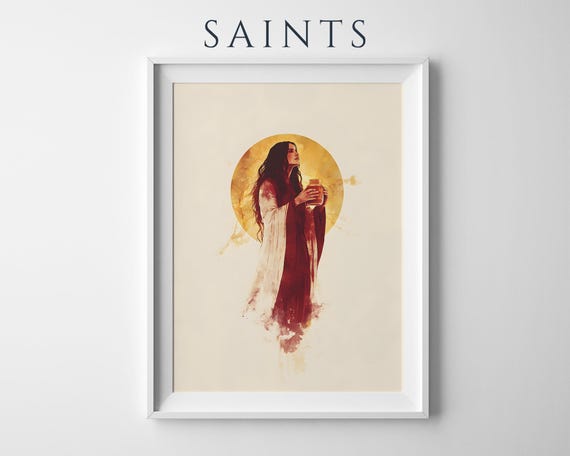
In 2016, Pope Francis raised Mary Magdalene's July 22 commemoration from a memorial to a full feast day — the same liturgical rank held by the celebrations of the apostles themselves, a formal recognition that reinforced her long-standing title as Apostle to the Apostles. Artists across the centuries have most often shown her with long, loose hair and a small jar of ointment or perfume, an image that survives from the older, conflated tradition linking her to the woman who anointed Jesus's feet — a visual shorthand that has outlasted the theological confusion it originally grew out of. Her traditional patronages, as penitents' and contemplatives' patroness, likewise carry forward that older association even as scholarship today draws a clearer line between Mary Magdalene and the other women once folded into her story.
Trivia
Who was Saint Mary Magdalene?
What did she witness that most other disciples did not?
What happened at the tomb on Easter morning?
Why is she called the 'Apostle to the Apostles'?
Is Mary Magdalene considered a patron saint of anything?
Related Reading