Saint Lazarus of Bethany

A friend Jesus loved, and let die anyway
The Gospel of John is careful to establish, before anything else, how close this family was to Jesus. Lazarus lived in Bethany, a village near Jerusalem, with his sisters Martha and Mary — the same Mary, John notes, "who had anointed the Lord with perfumed oil and dried his feet with her hair" (NABRE, John 11:2). When Lazarus fell seriously ill, the sisters sent word to Jesus with a message that assumed he would come at once: "Master, the one you love is ill" (John 11:3).
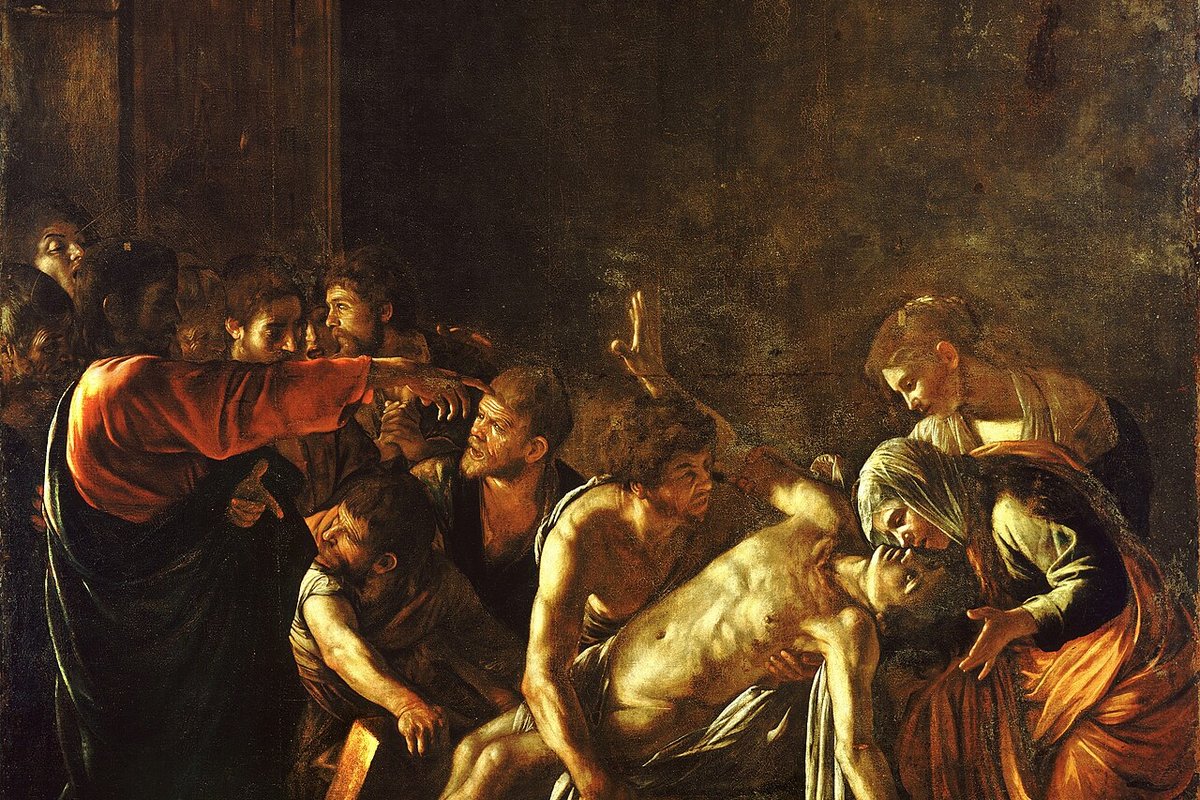
Michelangelo Merisi da Caravaggio, "The Raising of Lazarus," c. 1609, Regional Museum of Messina — public domain.
He didn't come at once. John records that Jesus, on hearing the news, "remained for two days in the place where he was" (John 11:6) before finally telling his disciples, "Let us go back to Judea" (John 11:7). By the time he reaches Bethany, Lazarus has been dead and buried four days (John 11:17) — long enough, in the culture and climate of first-century Judea, that no one would have doubted he was truly dead. That detail matters enormously to how the story plays out.
"Lord, if you had been here"
Both sisters, separately, greet Jesus with the same anguished line: "Lord, if you had been here, my brother would not have died" (NABRE, John 11:21, 11:32). It's Martha who gets the theological exchange that follows, when Jesus tells her, "I am the resurrection and the life; whoever believes in me, even if he dies, will live" (John 11:25). But it's Mary's grief, and the grief of the mourners around her, that produces one of the shortest and most quoted verses in the entire New Testament: "And Jesus wept" (John 11:35).
At the tomb, Jesus orders the stone rolled away. Martha objects on the most practical grounds imaginable: "Lord, by now there will be a stench; he has been dead for four days" (John 11:39). Jesus has it opened anyway, prays aloud, and then, in a voice John records simply as loud, calls into the tomb: "Lazarus, come out!" (John 11:43). "The dead man came out, tied hand and foot with burial bands, and his face was wrapped in a cloth" (John 11:44).
A raising with consequences
John frames this event as the last and greatest of the signs Jesus performs before his own death — and the text is explicit that it has real, immediate political consequences. Many who saw it believed in Jesus, but others reported it to the religious authorities, who convened the Sanhedrin specifically over this incident, worried that "all will believe in him, and the Romans will come and take away both our land and our nation" (John 11:48). It's in this same council meeting that the high priest Caiaphas makes his infamous statement that it would be better for one man to die for the people — a line John records as an unintended prophecy of Jesus's own crucifixion. In a real sense, raising Lazarus is the event that sets Jesus's own death in motion.
Not the beggar from the parable
One confusion worth clearing up directly: this Lazarus, the historical friend of Jesus from Bethany, is a completely different figure from the Lazarus who appears in one of Jesus's parables, told earlier in Luke's Gospel. In that story, a poor, sore-covered beggar named Lazarus lies at the gate of a rich man who ignores him; after both men die, the beggar is "carried away by angels to the bosom of Abraham," while the rich man suffers torment and begs, futilely, for Lazarus to be sent back to warn his living brothers (NABRE, Luke 16:22-31). It's a parable — a teaching story, not a historical account — and its Lazarus never returns from the dead at all; the rich man's request for exactly that kind of resurrection sign is what gets refused. The two figures share nothing but a name, though centuries of art and popular memory have sometimes blurred them together.
A brief, quiet life afterward
Scripture says nothing definite about what became of Lazarus once the shock of his return wore off, beyond noting that crowds came specifically to see the man who had been raised from the dead, and that this alone was enough to make some religious leaders want him dead a second time (John 12:9-11). Later Christian tradition filled the silence with legend: one strand, especially strong in the Eastern churches, holds that Lazarus eventually became bishop of Kition on Cyprus; another, more prominent in medieval France, holds that he sailed with his sisters to Marseille and became bishop there. Neither can be verified as history, and both should be read as pious tradition layered onto a figure Scripture otherwise leaves alone after his one extraordinary appearance. What the Gospel does leave behind is enough on its own: a man called by name out of a sealed, four-day-old tomb, and a household in Bethany that Jesus, by John's own account, simply loved.
Trivia
Where in the Bible is the story of Lazarus's resurrection found?
Is Saint Lazarus of Bethany the same person as the Lazarus in Jesus's parable?
Why did Jesus wait two days before going to Lazarus?
What happened to Lazarus after Jesus raised him?
What is Saint Lazarus the patron saint of, and when is his feast day?
You May Also Like

Related Reading