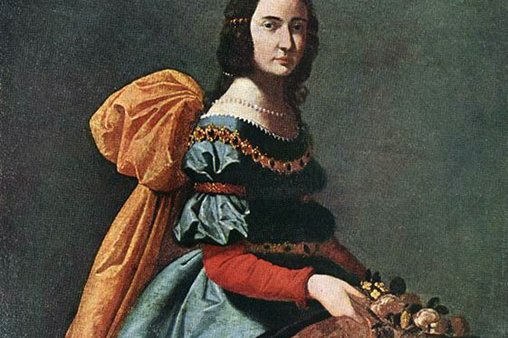
Saint Radegund of Poitiers

A childhood built on conquest
Radegund was born around 520, a princess of the Thuringian royal house in what's now central Germany. Her childhood ended abruptly: in 531, the Franks under King Clothar I and his brother Theuderic crushed the Thuringian kingdom, and the young Radegund was taken as part of the spoils of war, sent west to be raised in Clothar's own household at his royal estate of Athies, in what's now northern France. It's a detail worth sitting with — she wasn't a guest or a ward in any gentle sense, but a captive being groomed, over years, to become the wife of the king whose armies had destroyed her family and her homeland. Frankish sources record that Clothar had also had her brother killed, either during the original conquest or in a later purge of Thuringian royals who might have threatened his authority — the timeline is disputed among the sources, but the fact of the killing is not.
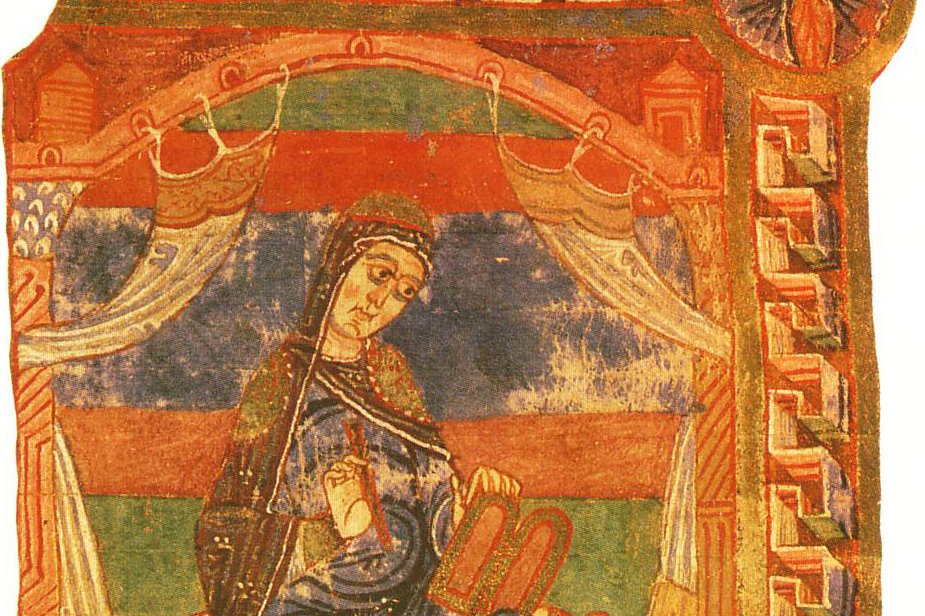
Saint Radegund, from the Life of Saint Radegund, 11th century, Bibliothèque municipale de Poitiers, Ms. 250 — public domain.
By around 540, Radegund was of an age to marry, and Clothar made her his wife — one of several wives and concubines he kept simultaneously, a common enough arrangement among Merovingian kings of the period but no less difficult a position for the queen expected to accept it. What the sources describe from these years isn't a portrait of romantic reconciliation. Radegund reportedly spent as much time as she could in prayer, fasting, and quiet acts of charity toward the poor, servants, and the sick — behavior her biographer Venantius Fortunatus, a poet and later bishop who knew her personally, later framed as evidence that she'd never really stopped living as a consecrated soul even while queen. Whether that framing reflects genuine contemporary perception or later devotional shaping is hard to fully untangle, but the pattern of behavior itself is well attested.
Walking away from a throne
The break came sometime around 550, after Clothar had her remaining brother killed — an act that, by every account, was the final rupture. Radegund fled the court. What she did next was not simply run; it was a deliberate, canonically shrewd move. She went to Medard, the bishop of Noyon, and asked him to consecrate her as a deaconess — an ordained, recognized religious status within the Church at the time. Clothar's own men reportedly tried to stop the ceremony, and Medard hesitated under the pressure, until Radegund is said to have argued, forcefully, that refusing to consecrate a soul who wanted to give herself to God would cost him more than any king's anger. He consecrated her.
That single act mattered enormously. It meant Radegund wasn't simply an estranged wife who might be reclaimed or punished — she was now, in the eyes of the Church, a woman formally committed to religious life, a status that gave her flight a legitimacy Clothar could not easily override, even if he never fully accepted the loss. She spent a period after this living quietly, doing charitable work and building the connections that would let her found something permanent.
Building the Abbey of the Holy Cross
Around 552–557 (the sources vary on the exact founding date), Radegund established a convent at Poitiers that became the Abbey of the Holy Cross — Sainte-Croix. She placed a younger nun, Agnes, as abbess rather than taking the role herself, a choice that let Radegund devote her energy to the community's broader standing and resources rather than its daily governance. Under the Rule of Caesarius of Arles, the monastery she built became one of the most disciplined and intellectually serious women's religious communities in Gaul — a place where nuns were expected to be literate, where Radegund herself corresponded with churchmen, poets, and royalty across the Frankish world.
Her most celebrated achievement was diplomatic rather than architectural: in the mid-560s, Radegund petitioned the Byzantine emperor Justin II and empress Sophia for a relic of the True Cross, and remarkably, they sent one. Its arrival at Poitiers in 569 was a genuine sensation, commemorated in verse by Venantius Fortunatus — the same poet-turned-bishop who wrote her earliest biography — in hymns still sung in the Church today, including Vexilla Regis ("The Royal Banners Forward Go"), composed for the relic's procession into the city. The relic gave the abbey its name and made Poitiers a significant pilgrimage destination for centuries afterward.
A queen who kept making peace
What sets Radegund apart from many royal women who entered religious life after difficult marriages is that she didn't simply retreat from the political world — she kept working it, deliberately, from inside the cloister. Merovingian Gaul in this period was a landscape of near-constant feuding between Clothar's sons and grandsons after his death in 561, brothers and cousins fighting over territory with a brutality that makes the era one of the bloodier stretches of early medieval European history. Radegund, through letters and personal appeals, repeatedly tried to intervene — urging reconciliation between warring kinsmen, some of whom were her own former husband's sons and thus, in a real sense, family she'd inherited without ever fully belonging to.
She wasn't always successful; no single letter from a retired queen was going to end Merovingian civil war outright. But chroniclers of the period, including Gregory of Tours, record her as a figure kings and bishops alike took seriously enough to correspond with and occasionally heed, an unusual degree of ongoing political relevance for a woman who had formally renounced court life decades earlier. It's this combination — genuine withdrawal from royal power paired with genuine, sustained use of the influence that power had given her — that later tradition remembers when it calls her a peacemaker among kings, even though no formal ecclesiastical title ever attached that specific word to her name.
Death and lasting influence
Radegund died at Poitiers on August 13, 587, and was buried at the monastery she'd founded; Gregory of Tours, who knew her, presided at her funeral and later included an account of her life and the miracles associated with her tomb in his own writings, giving her one of the better-documented early medieval female sanctities we have. Venantius Fortunatus's biography, along with a second vita written by the nun Baudonivia (a member of Radegund's own community who explicitly wrote to fill in what Fortunatus had left out, especially regarding Radegund's inner spiritual life), together give historians an unusually rich, if devotionally shaped, picture of a woman who moved from captive princess to queen to founding abbess to informal diplomat, all within a single, remarkably eventful life. Her cultus — the informal, ancient pattern of recognition typical of saints from this era, rather than a later formal canonization process — spread widely across France in the centuries that followed, and Sainte-Croix continued as a religious community, in one form or another, for well over a thousand years after her death.
Trivia
Who was Saint Radegund?
Why did Radegund leave her husband, King Clothar I?
What is Radegund famous for founding?
Is Saint Radegund considered a peacemaker?
When is Saint Radegund's feast day?
You May Also Like
Related Reading