Saint Medard and the Forty Days of Rain

A bishop from a family of two saints
Medard was born sometime between roughly 456 and 470 (sources disagree on the exact year) near Saint-Quentin, in the region of Picardy in what's now northern France, to a Frankish father and a Gallo-Roman mother — a mixed heritage typical of the region in this period, as Frankish settlers and the older Gallo-Roman population gradually merged. His twin brother, Gildard, also became a bishop and is likewise venerated as a saint, and the two are sometimes remembered together in local devotion, though Medard's cultus grew considerably larger and more widespread over the centuries.
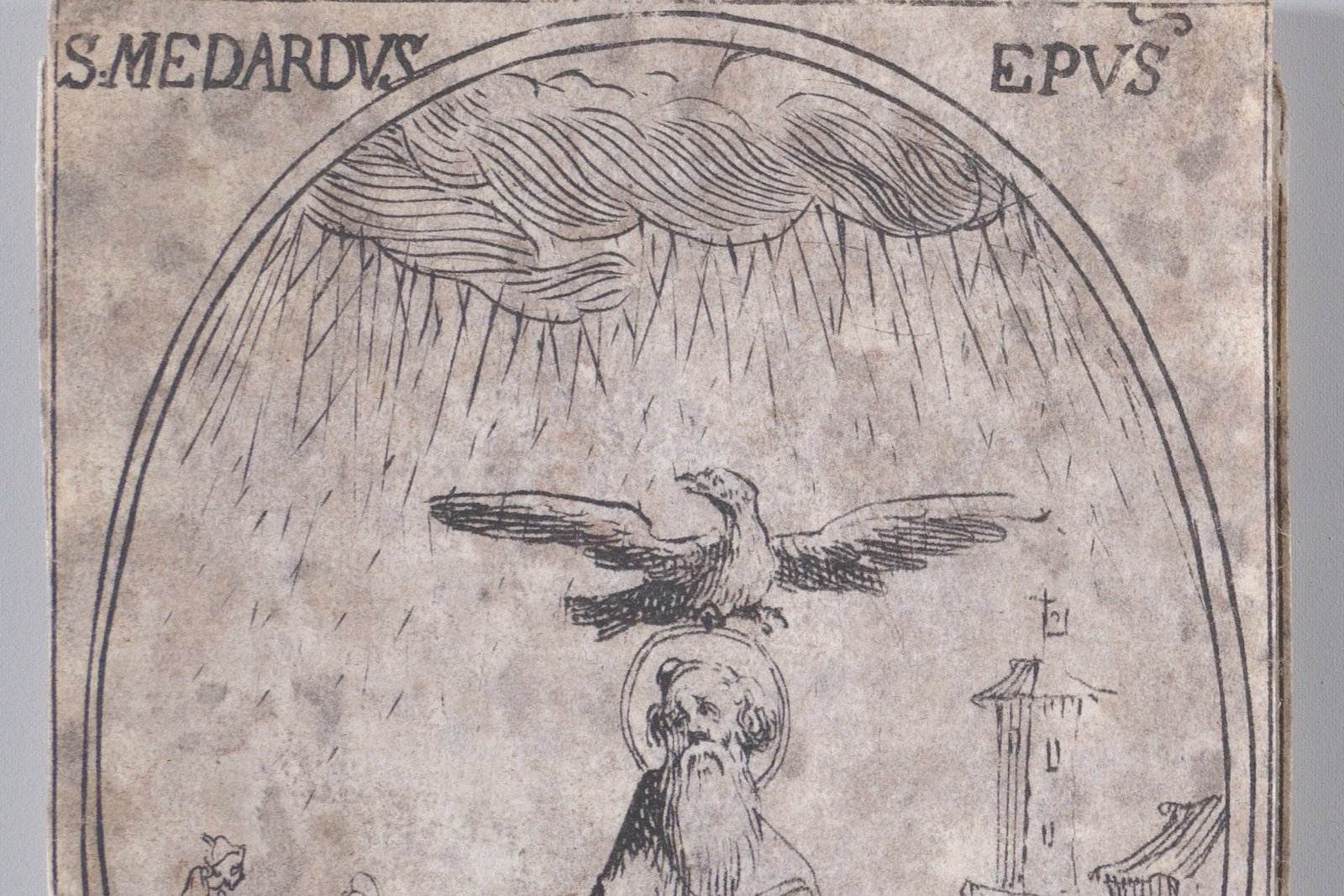
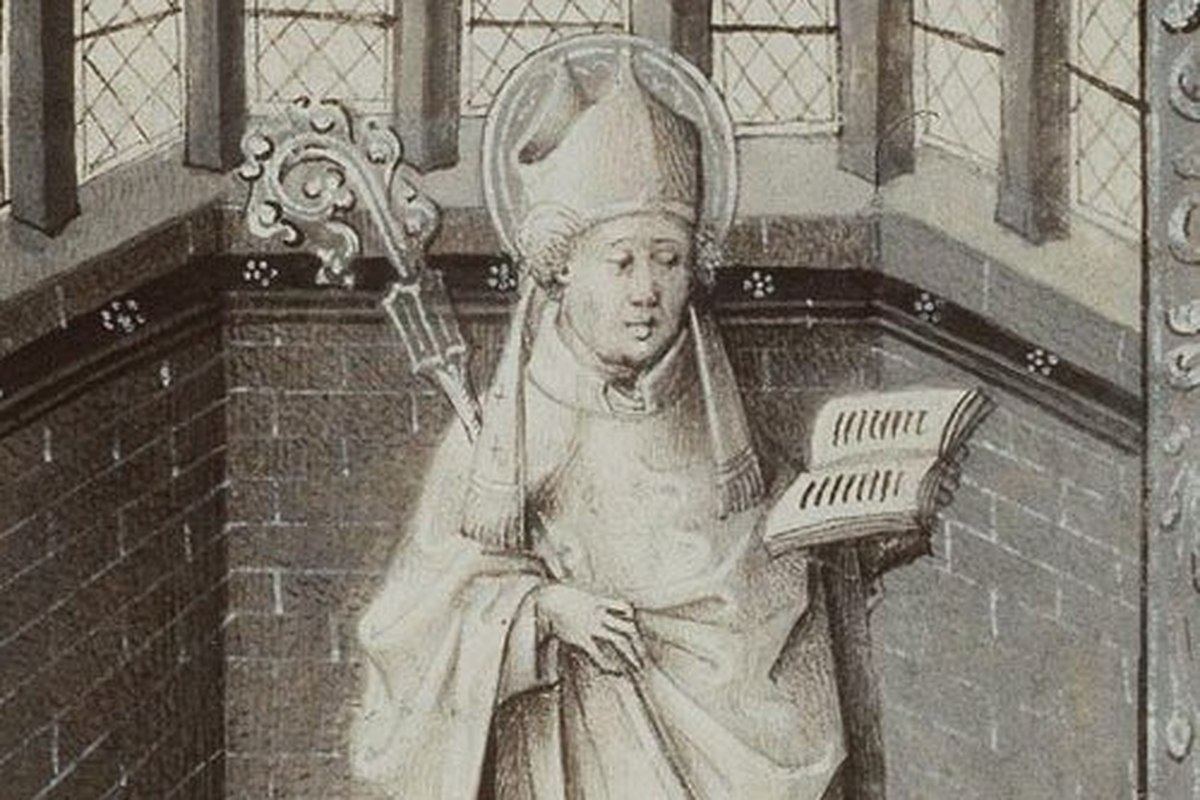
Jacques Callot, Saint Medard, Bishop, 1636, Metropolitan Museum of Art, New York — public domain (CC0).
Medard was ordained relatively late in life by medieval standards, becoming a priest around age 33, and continued serving actively for decades afterward before his elevation to the episcopate. He became Bishop of Vermand around 530, later transferring the seat of his diocese to Noyon — a move that placed the bishopric at Noyon for centuries afterward and explains why Medard is sometimes referred to in sources as Bishop of Noyon even though his consecration predates that specific relocation.
A voice at the Merovingian court
What distinguishes Medard from many bishops of his era, whose biographies are thin on documented specifics, is his recorded closeness to the Merovingian royal family — the ruling dynasty of the Franks during this period. He's remembered as a confidant and advisor within Clothar I's circle, a position that put a rural bishop from Picardy in direct contact with the highest levels of Frankish royal politics.
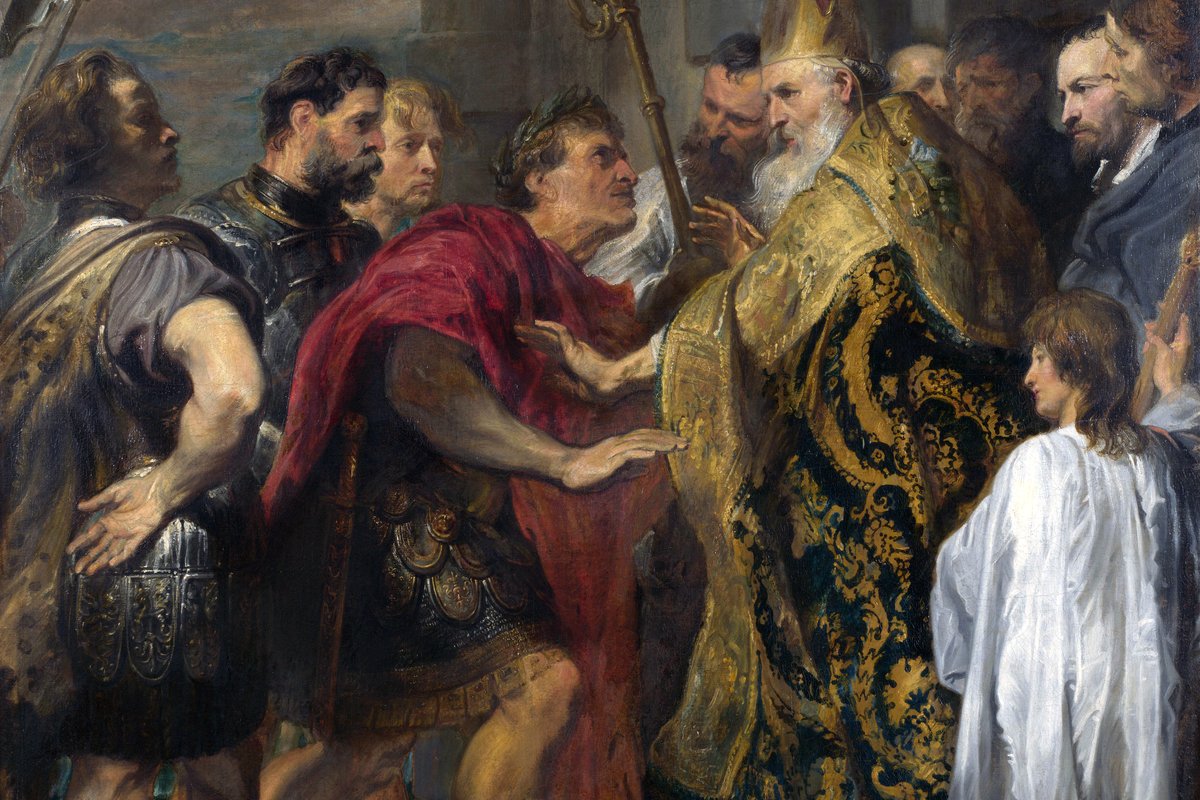
The clearest and best-documented example of Medard exercising this influence involves Radegund, one of Clothar's wives, who fled the marriage and sought Medard out specifically to be consecrated as a deaconess — a formal, ordained religious status that would give her departure recognized standing within the Church rather than leaving her as a runaway wife with no protected status at all. Sources describe Clothar's own men attempting to physically block the ceremony, and Medard hesitating under that pressure until Radegund pressed him, forcefully, on the spiritual cost of turning away a soul who wanted to consecrate herself to God. He went ahead with it. It's a small, vivid episode, but a genuinely significant one — a bishop choosing to risk a king's anger to honor a determined woman's religious vocation, at real personal and political cost to himself.
Founder, preacher, and a crown for virtue
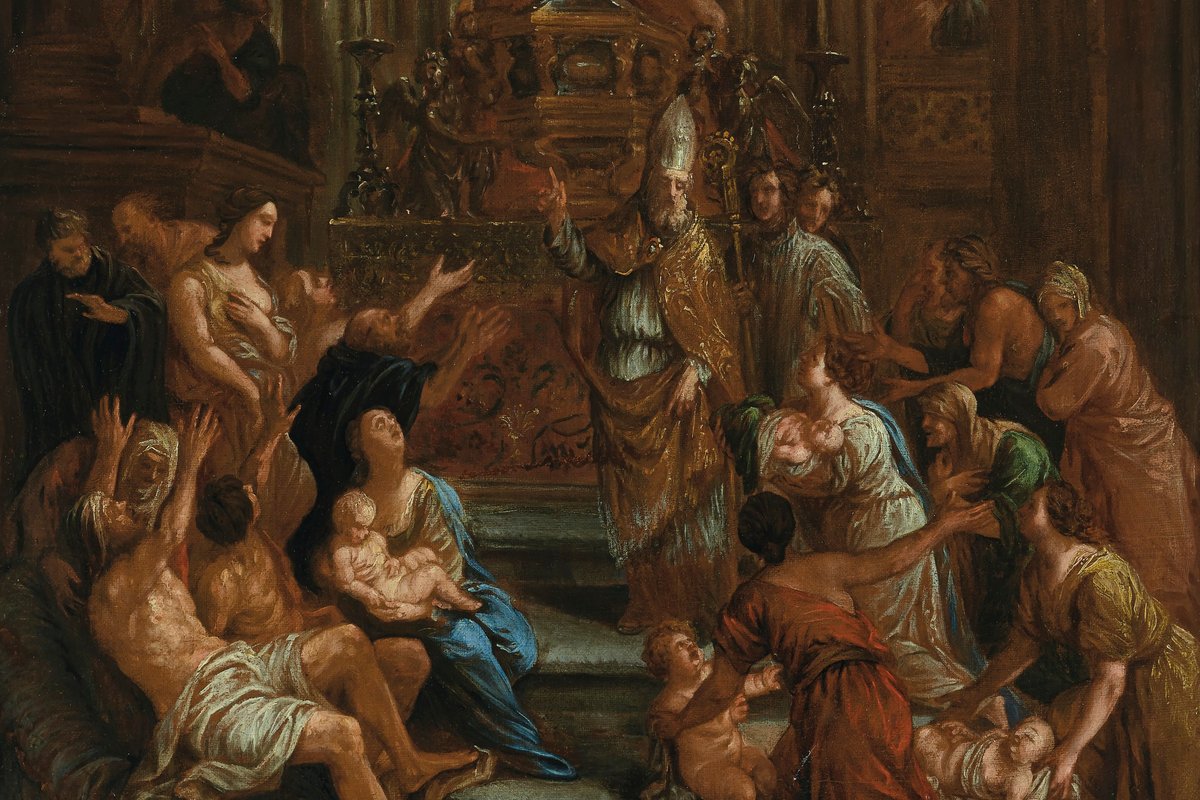
Medard was active well beyond the royal court. He's credited with founding the Abbey of Saint-Médard at Soissons, which became an important religious center and eventually held his own relics after his death, drawing pilgrims for centuries. He was known as an energetic preacher across his diocese, working — like many bishops of this period — to consolidate and deepen Christian practice in a region where conversion was often more thorough among the Frankish nobility than among the wider rural population.
One tradition credited to Medard that outlasted almost everything else about him, aside from the weather folklore, is the custom of the rosière — crowning a young woman of exceptional virtue and good conduct from Salency, near his birthplace, with a wreath of roses each year. Medard is said to have instituted this custom personally, and remarkably, some version of the Salency rosière ceremony continued to be observed, on and off, for well over a thousand years afterward, evolving considerably from its early medieval form but tracing its origin consistently back to him.
Where the weather legend comes from
The proverb tying Saint Medard's feast day to forty days of subsequent weather — "if it rains on Saint Medard's, it rains for forty more days" — has no basis in anything documented about Medard's actual life. It belongs to a broad category of European folk weather lore that attaches predictive power to particular saints' days scattered through the agricultural calendar, often days that fall at meaningful points in the farming year. June 8 sits close to the period when grain crops in much of France are ripening toward harvest, a stretch of weeks when sustained rain could genuinely threaten a harvest's success — which likely explains why a weather superstition attached itself to a date in early June specifically, regardless of which saint happened to be commemorated on it.
One popular legend, often depicted in his iconography (including the imagery of an eagle sheltering him with its wings, as seen in devotional engravings), describes an eagle protecting the young Medard from a rainstorm — a story that may have helped cement his particular association with rain in popular memory, even though the underlying forty-day prediction has no connection to that or any other episode from his documented biography. It's a good example of the distinction worth keeping clear in any saint's story: a genuine, if minor, legendary tradition (the sheltering eagle) sitting beside a much later folk superstition (the forty-day forecast) that simply borrowed his feast day as a convenient calendar peg, with the two often blurring together in popular memory even though they don't actually share an origin.
Medard died sometime around 545 to 560 — sources vary on the precise year — and was buried at Soissons, where his tomb and the abbey built around it became a significant pilgrimage site through the medieval period. His feast is kept on June 8, and in France, at least, that date still gets watched a little more closely than most.
Trivia
Who was Saint Medard?
What is the Saint Medard weather legend?
Did Saint Medard actually have anything to do with weather?
How is Saint Medard connected to Saint Radegund?
When is Saint Medard's feast day?
You May Also Like

Related Reading