Saint Stephen of Hungary: The Pagan Prince Who Built a Christian Kingdom

From Vajk to Stephen
Stephen was born around 975 with the name Vajk, son of Geza, the ruling prince of the Magyars — the nomadic-turned-settling people who had arrived in the Carpathian Basin roughly a century earlier and remained, at the time of his birth, largely outside the Christian world taking shape around them in the rest of Europe. Geza, sensing the political and diplomatic advantages of aligning with Western Christendom, had begun cultivating ties with German and Bohemian Christian powers, and around 985 had his young son baptized, reportedly by Saint Adalbert of Prague, giving the boy the Christian name Stephen.
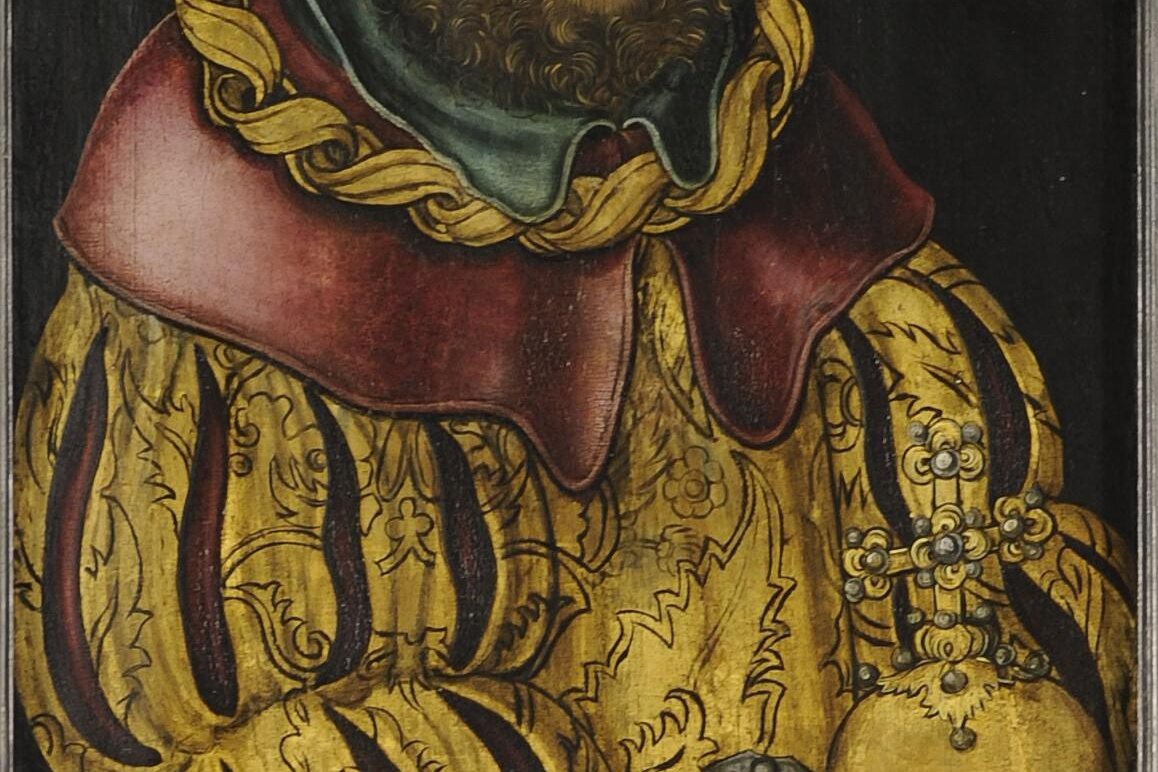
Lucas Cranach the Elder, Saint Stephen, King of Hungary, c. 1510 — public domain
That baptism set the direction of the rest of Stephen's life, even though the Magyar people as a whole remained, at that point, largely unconverted and often actively resistant to the idea. When Stephen succeeded his father as ruling prince around 997, he inherited not just a title but an unfinished, contested project — a Christian ruler presiding over a people who, in significant part, were not yet Christian at all.
Consolidating a kingdom, and a crown from Rome
Around the year 1000 (some sources place it as late as early 1001), Stephen was crowned the first King of Hungary. Tradition holds that the crown used in this coronation, or at least papal recognition and blessing for it, came directly from Pope Sylvester II, marking Hungary's formal entry into the community of Christian European kingdoms rather than remaining a frontier power viewed with suspicion by its neighbors — the same founding impulse that, farther north, Saint Margaret of Scotland would embody in reforming her adopted kingdom. This coronation is the origin point of what became known as the Holy Crown of Hungary, a jeweled crown that would go on to function, across nearly a millennium of Hungarian history, as something closer to a national sacred relic than an ordinary piece of regalia — Hungarian legal and political tradition for centuries held that sovereignty itself resided symbolically in the crown, not merely the person wearing it.
It's worth noting for accuracy's sake that the crown surviving today, examined by generations of art historians, appears to be a composite object combining a Byzantine-style lower section and a Latin-style upper section, likely assembled from pieces of different periods — meaning its precise physical continuity with whatever crown Stephen originally wore is genuinely debated by scholars, even though its symbolic identification with Stephen's founding of the kingdom has remained unbroken and central to Hungarian national identity regardless of that debate. During the twentieth century, the crown's near-mythical status was reinforced further when it was taken out of Hungary at the close of the Second World War to keep it from Soviet forces, eventually held for decades by the United States before being formally returned to Hungary in 1978.
Building a Christian kingdom from the ground up
Coronation alone did not make Hungary Christian; Stephen spent much of his reign building the institutional Church infrastructure required to make the conversion durable rather than nominal. He established dioceses and archdioceses, founded and endowed monasteries, invited foreign — chiefly Italian, German, and Czech — clergy to help train a native Hungarian priesthood, and issued law codes requiring church attendance, tithing, and adherence to Christian marriage practice.
This process was not gentle. Stephen faced, and in several documented cases forcibly suppressed, resistance from Magyar nobles and tribal leaders who saw the new religion, and the centralized royal authority that came with it, as a direct threat to their traditional autonomy. The most significant of these conflicts was his defeat of his kinsman Koppany, a rival claimant to power who represented both a political challenge to Stephen's rule and a continuation of traditional Magyar religious practice against the new Christian order. As with many rulers credited with "Christianizing" a people in this period, Stephen's legacy combines authentic religious conviction and institution-building with a considerable amount of coercive political consolidation — both threads belong in an honest account of how Hungary became a Christian kingdom.
Death, canonization, and a lasting national identity
Stephen's later years were marked by personal tragedy, most significantly the death of his son and intended heir, Emeric, in a hunting accident in 1031, which left the succession of his still-young kingdom uncertain. Stephen himself died in 1038, and disputes over succession followed, as they often did in newly consolidated medieval kingdoms.
His reputation for sanctity endured regardless. Pope Gregory VII formally canonized Stephen in 1083, in a notable joint ceremony that also elevated Emeric to sainthood — an unusual double canonization of father and son. Stephen remains the patron saint of Hungary, and his feast, observed on August 16 universally and on August 20 within Hungary itself, doubles as one of the country's most significant national holidays, marking both the founding of the Hungarian state and the foundation of its Christian identity in a single commemoration — a fusion of nation and faith that few other saints' feast days achieve so completely.
Trivia
Who was Saint Stephen of Hungary?
What was Stephen's birth name?
What is the Holy Crown of Hungary and is it really Stephen's crown?
How did Stephen Christianize Hungary?
When was Stephen canonized and what is he patron of?
You May Also Like
Related Reading