Saint Bernward of Hildesheim

An imperial tutor before he was a bishop
Bernward was born around 960 into a noble Saxon family and received an education that combined the standard clerical curriculum of the period with an unusually practical grounding in the arts — sources describe him studying not only theology and liturgy but also metalworking, architecture, and manuscript illumination under skilled instructors, training that would shape the entire distinctive character of his later career as bishop.
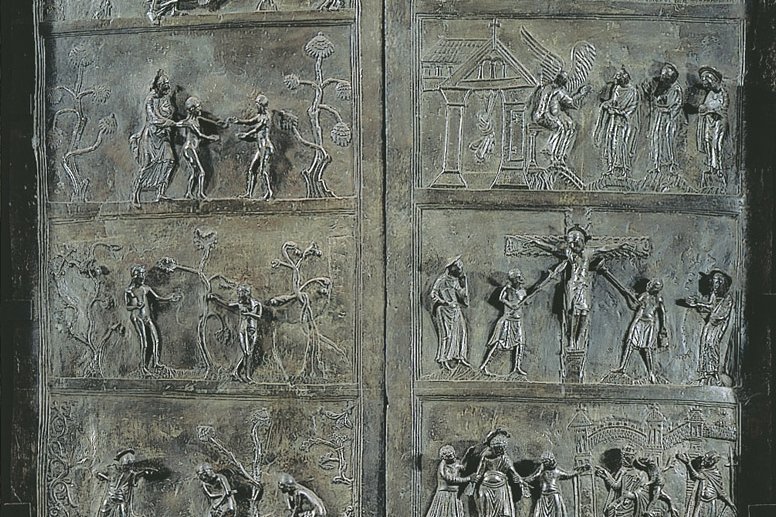
The Bernward Doors, cast bronze, 1015, Hildesheim Cathedral — public domain.
His talents and connections brought him to the imperial court, where he was appointed tutor to the young Otto III, crowned Holy Roman Emperor as a child in 983 under the regency of his mother and grandmother. Serving as tutor to a boy who would grow up to rule one of medieval Europe's most significant empires placed Bernward at the very center of Ottonian court life during a formative and closely watched period, and the relationships he built there continued to shape his career even after Otto came of age and Bernward moved on to his own episcopal appointment.
Bishop of Hildesheim
Bernward became bishop of Hildesheim in 993, a position he held for nearly three decades until his death. As bishop, he proved to be an active and energetic administrator, but what distinguishes him particularly from most of his episcopal contemporaries is the degree to which he remained personally and practically engaged in artistic production throughout his tenure, rather than functioning solely as a wealthy patron directing the work of others from a distance.
Hildesheim under Bernward became a significant center of Ottonian-era art and craftsmanship, its workshops producing metalwork, manuscripts, and architecture of a quality and ambition that drew attention well beyond the immediate diocese. Bernward is also credited with architectural work, including his involvement in the design of the abbey church of St. Michael's at Hildesheim, itself later recognized as an important example of Ottonian ecclesiastical architecture.
The bronze doors of 1015
Bernward's best-known and most enduring achievement is the pair of monumental bronze doors he had cast for Hildesheim Cathedral in 1015. Standing roughly sixteen feet tall and cast as single, continuous bronze panels — a remarkable technical achievement for the period, requiring casting techniques not widely matched again in Western Europe for the better part of a century — the doors are decorated with sixteen relief scenes, eight per leaf, arranged to draw a deliberate theological parallel between two biblical narratives: the story of the Fall, from Genesis, on the left, and the life, death, and resurrection of Christ on the right, read in mirrored sequence so that scenes of sin and scenes of redemption directly correspond to one another as a viewer's eye moves down the doors.
The level of narrative and theological sophistication built into the doors' design, combined with the technical mastery required to cast them successfully in bronze, has made them one of the most extensively studied works of medieval European art. They remain in place at Hildesheim Cathedral today, over a thousand years after their casting, a direct and remarkably well-preserved link to Bernward's own hands-on engagement with the arts of his diocese.
Bernward's Column and further commissions
Alongside the doors, Bernward is also associated with the so-called Bernward Column, another major bronze casting from the same period, spiraling with relief scenes from the life of Christ in a format consciously modeled on ancient Roman triumphal columns such as Trajan's Column in Rome — a striking example of how Ottonian artists and patrons drew directly on Roman imperial visual tradition to convey Christian religious authority. Both works remain among the defining artistic achievements associated with Hildesheim during Bernward's episcopate.
St. Michael's Church and a UNESCO legacy
Bernward's architectural ambitions reached their fullest expression in the abbey church of St. Michael's at Hildesheim, which he began building around 1010 as the center of a monastic foundation he established himself. The church's design — a balanced, symmetrical plan with matching apses at both ends, a clear geometric logic governing its proportions, and a set of ceiling paintings and decorative details that survived, remarkably, into the modern era — is regarded by architectural historians as one of the purest surviving expressions of Ottonian church architecture, a style that deliberately revived aspects of earlier Carolingian and late antique building traditions to project imperial and ecclesiastical authority through architectural form. St. Michael's, together with Hildesheim Cathedral and its Bernward Doors, was jointly recognized as a UNESCO World Heritage Site in 1985, a modern acknowledgment of just how significant Bernward's combined architectural and artistic program remains to the history of medieval European art, even after the church suffered serious damage during Allied bombing in the Second World War and required extensive postwar restoration.
A bishop caught in wider imperial politics
Bernward's episcopate was not purely a story of artistic patronage insulated from the wider conflicts of his era. He became embroiled in a long-running jurisdictional dispute with the neighboring archbishopric of Mainz and the abbey of Gandersheim over rights of ecclesiastical oversight — a conflict serious enough that it required intervention from both the emperor and the pope to resolve, and one that illustrates how even a bishop remembered primarily for his artistic and architectural achievements still had to navigate the same tangled web of overlapping secular and ecclesiastical authority that shaped the career of nearly every significant German churchman of the Ottonian era, from Bernward's own predecessor to contemporaries like Meinwerk of Paderborn, whose own building projects a few years later drew on a broadly similar model of the wealthy, artistically engaged prince-bishop.
Feast day and canonization
Bernward died on November 20, 1022, and was canonized in 1192 by Pope Celestine III, roughly 170 years after his death — a gap that reflects how the formal canonization process, still developing during this period, had by then become more centralized and procedurally demanding than in earlier centuries. His feast is kept on November 20.
Bernward stands out among medieval bishop-saints for the unusually direct, hands-on relationship he maintained with the arts throughout his episcopate, a distinctive combination of administrative, pastoral, and genuinely artisanal engagement that few of his contemporaries matched. Readers interested in other bishops of the Ottonian and post-Ottonian German church who left comparably lasting institutional and cultural legacies may also want to read about Saint Otto of Bamberg, whose own episcopate a century later combined administrative skill with a very different kind of ambitious undertaking: the missionary conversion of Pomerania.
Trivia
Who was Saint Bernward of Hildesheim?
What are the Bernward Doors?
Why was Saint Bernward tutor to Emperor Otto III?
Was Saint Bernward himself a craftsman?
When is the feast of Saint Bernward?
You May Also Like
Related Reading