Saint Wulfstan of Worcester

A monk's rise in a changing England
Wulfstan was born around 1008 near Long Itchington in Warwickshire, and entered monastic life at Worcester's cathedral priory as a young man, rising steadily through positions of responsibility within the community — precentor, then sacrist, then prior — over a period spanning the final decades of Anglo-Saxon rule in England. By the time he was elected bishop of Worcester in 1062, he had spent essentially his entire adult life within one religious community, developing a reputation among his fellow monks for personal simplicity, careful pastoral attention, and an unshowy but genuine holiness that would later prove decisive in circumstances he couldn't have anticipated when he took office.
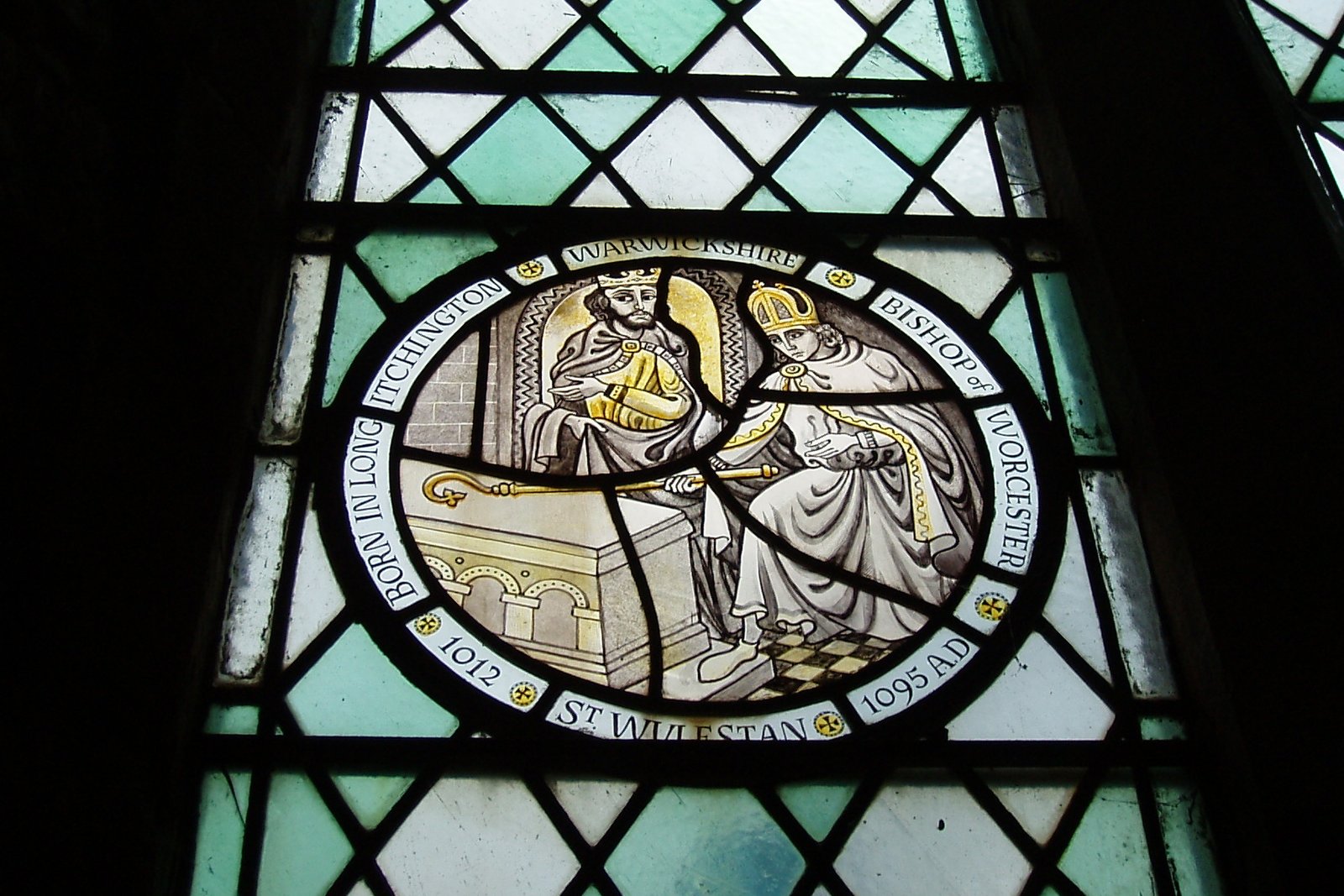
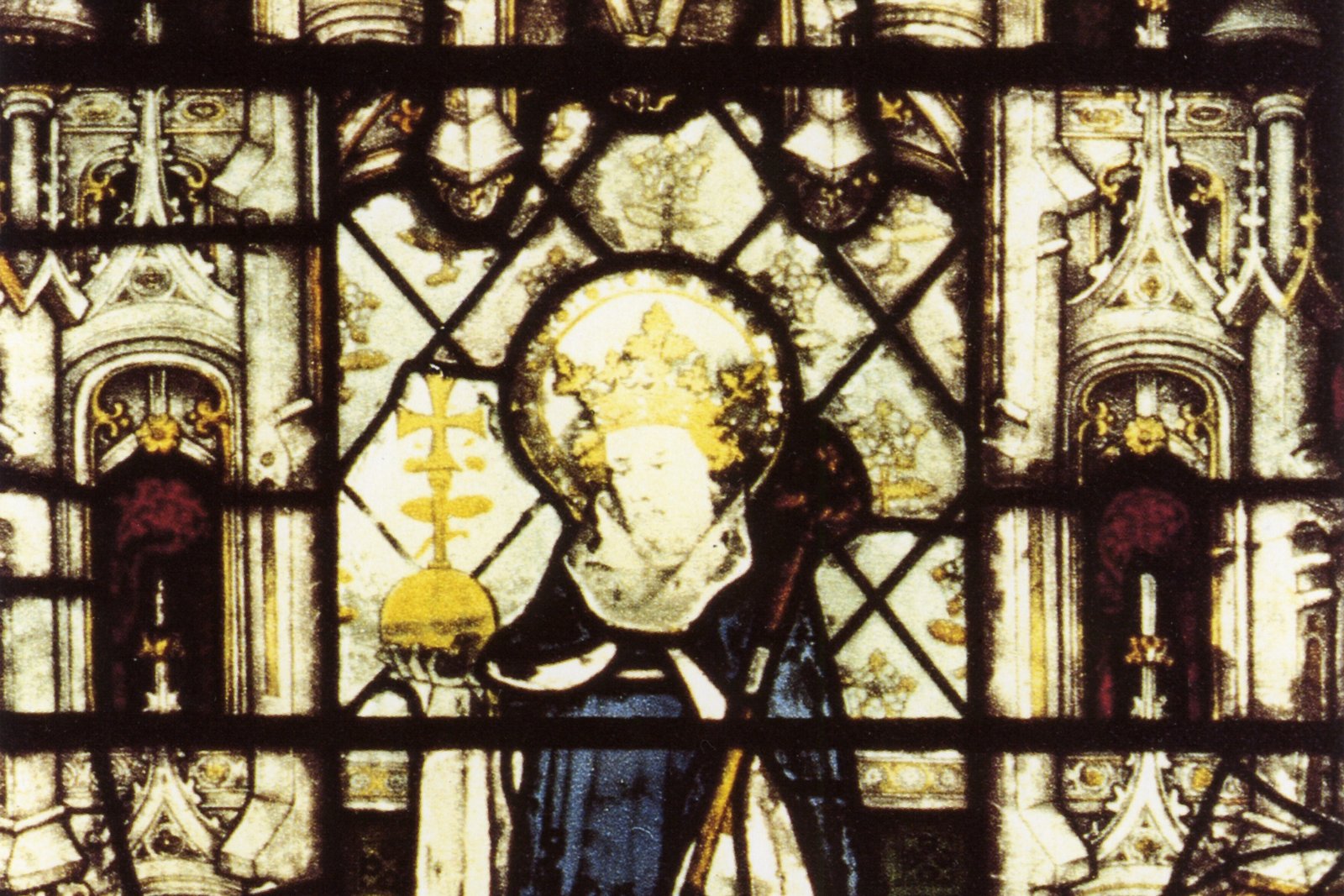
Stained glass window depicting Saint Wulfstan, Holy Trinity Church, Long Itchington — used under CC BY-SA 2.0, photograph by Amanda Slater.
Those circumstances arrived just four years later, in 1066, when William, Duke of Normandy, invaded and conquered England following the death of Edward the Confessor and the defeat of King Harold at Hastings. The Norman administration that followed moved systematically to replace English-born Church leadership with Norman appointees, a policy that eliminated nearly every English-born bishop and abbot within a generation of the conquest. Wulfstan was a striking exception. He kept his position at Worcester through the entire Norman consolidation of power and continued to serve as bishop there until his death nearly three decades later, one of the only English-born bishops of his generation to do so.
Why the Normans let him stay
The explanation later tradition gives for Wulfstan's survival, recorded in the biography written by the Norman historian William of Malmesbury — himself generally sympathetic to the new Norman establishment, which makes his praise of an English holdover bishop notable — centers on Wulfstan's evident and undeniable personal holiness, which made him difficult to remove even for an administration with every institutional incentive to replace him with a more politically reliable Norman appointee. Whatever the precise mix of genuine reputation and practical political calculation involved, Wulfstan navigated the transition successfully, maintaining working relationships with the new Norman hierarchy — including Archbishop Lanfranc, himself newly installed at Canterbury — while continuing to govern his diocese in a manner consistent with his pre-conquest priorities.
He also proved himself loyal enough to be trusted with real responsibility under the new regime: in 1088, when a rebellion broke out against William II, Wulfstan, despite his advanced age, actively supported the king's cause, defending Worcester itself against rebel forces — a demonstration of practical loyalty that further secured his position and reputation within the post-conquest establishment.
Taking on the Bristol slave trade
The achievement most distinctly associated with Wulfstan's episcopate is his sustained public campaign against the trade in English slaves operating out of the port of Bristol, shipping captives — often kidnapped or coerced English people — across to Ireland to be sold. Slavery persisted in parts of England and Ireland well into the medieval period despite growing ecclesiastical opposition across much of Western Europe, and Bristol had become a significant hub for this specific trade route by Wulfstan's time. According to contemporary and near-contemporary accounts, Wulfstan preached against the practice repeatedly and directly, traveling to Bristol itself to confront the trade at its source rather than simply condemning it from a distance.
Sources close to the period credit Wulfstan's sustained preaching campaign with contributing significantly to the eventual decline and effective suppression of the Bristol slave trade within a few decades — a genuine practical achievement, distinct from the more purely devotional or administrative accomplishments typically emphasized in accounts of medieval bishops, and one that places Wulfstan among a relatively small number of medieval churchmen who took direct, sustained public action against slavery specifically, rather than treating it as a background feature of the society they governed.
A rare bridge between two eras of English Church life
Wulfstan's specific position — an Anglo-Saxon-trained monk who spent his final decades working alongside the new Norman ecclesiastical hierarchy under Archbishop Lanfranc, whose own reorganization of the English Church replaced nearly every other English-born bishop of Wulfstan's generation — makes him one of the very few genuine living bridges historians have between pre-conquest and post-conquest English Church life. His continued presence at Worcester gave the diocese a rare institutional continuity through the conquest that most other English sees simply didn't retain, preserving local liturgical customs, administrative practices, and even a measure of Anglo-Saxon monastic culture within a diocese that, elsewhere in England, was being rapidly and thoroughly Normanized during exactly these same years.
A cathedral rebuilt, a legacy preserved
Wulfstan also oversaw a major architectural project during his episcopate: beginning in 1084, he directed the rebuilding of Worcester Cathedral in the emerging Romanesque style, a substantial undertaking that placed Worcester among the significant cathedral building projects of the early Anglo-Norman period. The crypt from that building campaign survives essentially intact today, regarded as one of the best-preserved examples of late eleventh-century architecture in England — a direct physical link to Wulfstan's own episcopate, still standing beneath the later medieval cathedral that grew up around and above it.
Wulfstan died in 1095, having served as bishop of Worcester for thirty-three years spanning one of the most disruptive transitions in English history. He was canonized in 1203, and his tomb at Worcester Cathedral became an important medieval pilgrimage site in its own right — significant enough that King John, centuries later, specifically requested burial near Wulfstan's shrine, a mark of the saint's lasting reputation within English royal and religious memory. His feast is kept on January 19.
Trivia
Who was Saint Wulfstan of Worcester?
Why did Wulfstan keep his position after the Norman Conquest?
What did Wulfstan do about the slave trade?
What building projects is Wulfstan known for?
When is Saint Wulfstan's feast day?
You May Also Like

Related Reading