Saint Willibald: the Anglo-Saxon Monk Who Walked to Jerusalem

Born into a family of missionaries
Willibald was born around 700 in Wessex, in what is now southern England, into a family that would produce an unusual number of saints. His father is venerated as Saint Richard the Pilgrim, his brother as Saint Winnibald, and his sister as Saint Walburga — the same Saint Walburga whose feast night gave rise to the folk celebration of Walpurgis Night. As a child, Willibald was reportedly sent to a monastery at Bishop's Waltham after a serious illness his parents believed he had survived through God's intervention, and he grew up in monastic life from an early age. That upbringing set the pattern for the rest of his life: when he was around twenty, rather than settling into a quiet English monastery, he set out with his father and his younger brother Winnibald on a pilgrimage that would take him further than almost any Englishman of his era had gone.
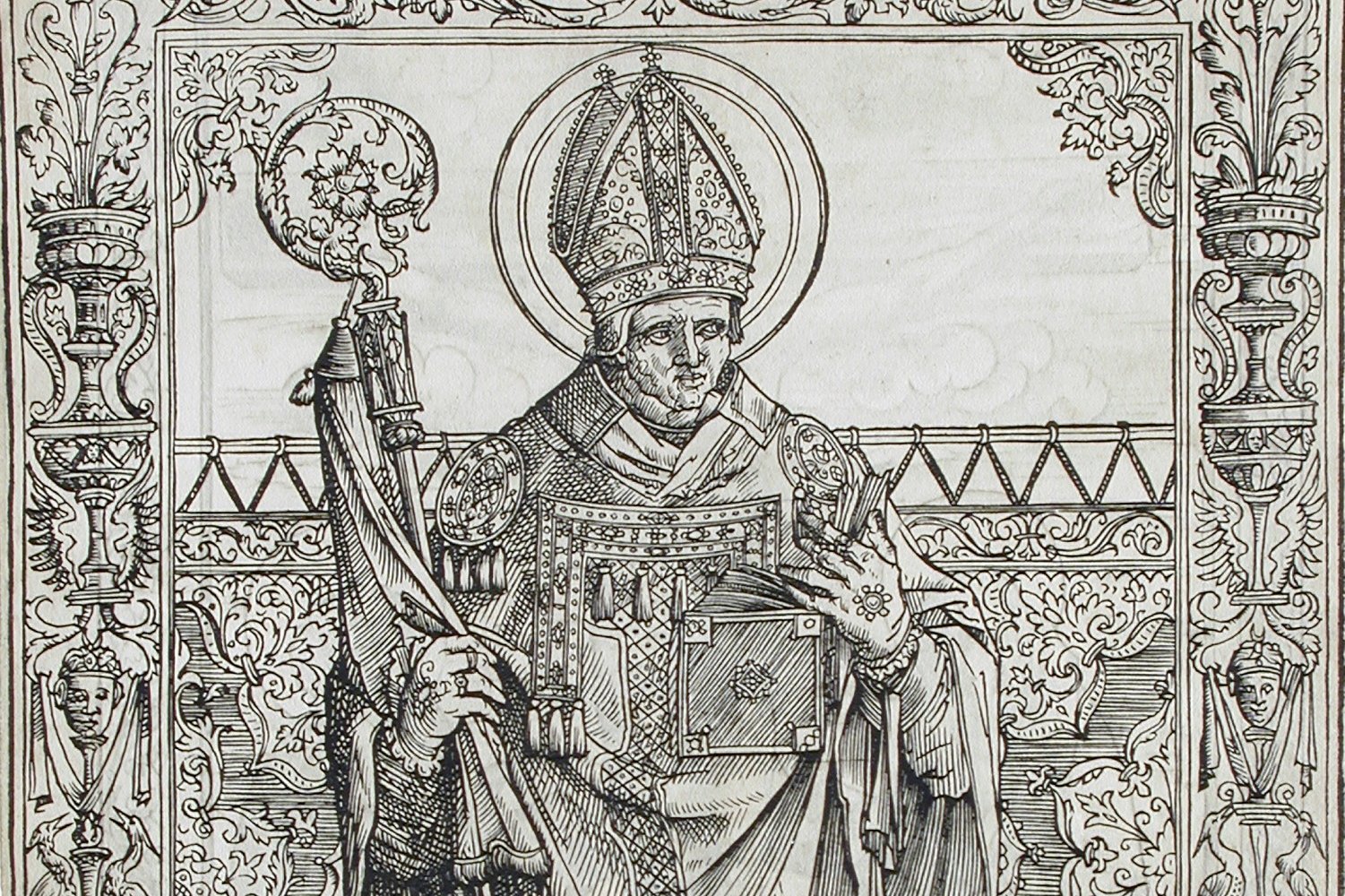
Anonymous German artist, Saint Willibald manuscript leaf, printed 1517, LACMA — public domain.
A journey that nearly ended in prison
The party traveled first to Rome, where Willibald's father died and was buried — his tomb is still shown at Lucca, a stop on the route, according to later tradition. From there, Willibald pressed on alone toward the Holy Land, traveling through Cyprus and along the coast of what is now Syria and Lebanon before reaching Jerusalem. The journey was genuinely dangerous: in the Syrian city of Homs, local authorities under Muslim rule arrested Willibald and his companions on suspicion that the traveling foreigners were spies, a real and reasonable concern for a region contested between the Byzantine and Umayyad worlds. He was held for a period before being released, and continued on to visit the major sites associated with the life of Christ — Bethlehem, the Jordan, and Jerusalem itself, where by his own community's later reckoning, he became the first recorded Englishman to set foot in the city. He spent roughly two years living and studying near Jerusalem before turning back toward Europe, a return journey that took him through Constantinople and eventually to the great Benedictine monastery of Monte Cassino in Italy, where he stayed and served for around a decade.
Called from Rome to help evangelize Germany
Willibald's reputation as a disciplined, well-traveled monk eventually reached Rome, and Pope Gregory III sent him to join a kinsman already deep into one of the most consequential missionary efforts in early medieval Europe: Saint Boniface, the English-born "Apostle of the Germans." Boniface ordained Willibald a priest and put him to work establishing churches and monastic communities in Bavaria and Franconia, regions where Christianity had only a shallow foothold among a largely pagan population. In 741 or 742, Boniface consecrated Willibald as the first Bishop of Eichstätt, a newly created diocese in Bavaria, a post he would hold for well over forty years until his death. Willibald's brother Winnibald and sister Walburga soon joined him in the region as well, with Winnibald founding the monastery of Heidenheim and Walburga eventually serving as abbess there after his death — turning the whole family into a working missionary team spread across a single stretch of southern Germany.
Building a diocese from almost nothing
Founding a diocese in the eighth century meant far more than administrative paperwork; it meant physically establishing churches, training local clergy, and slowly displacing older pagan religious practices with a functioning Christian community, often with limited resources and against real local resistance. Willibald is credited with founding Eichstätt Cathedral itself and with organizing the diocese's early monastic life, working in close cooperation with his brother's foundation at Heidenheim. He remained active into extreme old age by the standards of his time, continuing to govern the diocese he had founded until his death around 787, having spent more years building the Church in Bavaria than he had spent, decades earlier, traveling to see the places where Christianity began.
A travel account that survives to this day
What makes Willibald's story unusually well-documented for an eighth-century figure is the Hodoeporicon of Saint Willibald — literally, "a book of the journey" — dictated late in his life to Hugeburc, a nun at Heidenheim and a relative of his, who interviewed him directly and wrote down his account of the pilgrimage. It stands today as one of the earliest surviving Western European travel narratives to the Holy Land, valuable to historians not as pious legend but as a genuine, detailed record of what such a journey actually involved in the eighth century — the geography, the dangers, the sacred sites as they existed centuries before the Crusades reshaped them. That combination — a documented traveler's account alongside decades of concrete missionary work — is part of what distinguishes Willibald from many early medieval saints whose lives survive mainly through later, embellished hagiography. His feast is kept on July 7, and he remains the patron of the Diocese of Eichstätt he spent most of his adult life building.
Trivia
Who was Saint Willibald?
Was Willibald related to any other saints?
What happened to Willibald on his journey to the Holy Land?
How do we know the details of Willibald's travels?
When is Saint Willibald's feast day, and what is he a patron of?
You May Also Like

Related Reading