Saint Erkenwald, London's Forgotten Patron Bishop

A nobleman who founded two abbeys before becoming bishop
Erkenwald was born, most likely, into a royal or noble East Anglian family in the seventh century, though the surviving details of his early life are thin compared to what's known about his later career. What is well established is that before he was ever a bishop, Erkenwald was already a significant religious founder: he established Chertsey Abbey in Surrey as a monastery for men, becoming its first abbot, and Barking Abbey in Essex as a religious house for women, which he placed under the leadership of his own sister, later venerated as Saint Ethelburga of Barking, as its first abbess. Founding linked male and female religious houses, often led by siblings from the same noble family, was a recognized and respected pattern of Christian patronage in seventh-century Anglo-Saxon England, and both of Erkenwald's foundations went on to become significant, long-lasting monastic communities in their own right — Barking Abbey in particular remained an important and wealthy house for women religious for centuries afterward.
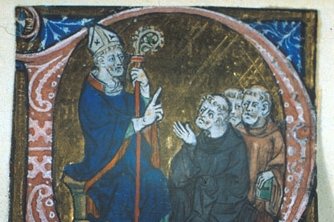
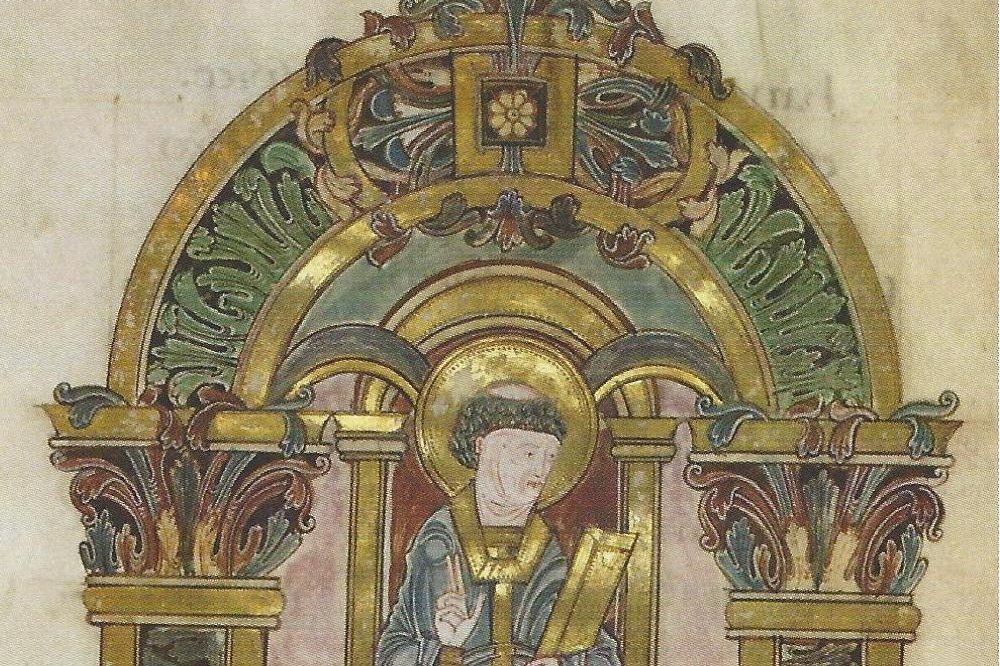
Anonymous illuminator, historiated initial of Saint Erkenwald from the Chertsey Breviary, c. 1300 — public domain.
Called to serve as Bishop of London
Around 675, Erkenwald was appointed Bishop of London, a see that at the time covered a substantial territory across what is now southeastern England, still in the earlier, formative decades of Anglo-Saxon Christianity following the mission of Saint Augustine of Canterbury some seventy years earlier. As bishop, Erkenwald continued the practical, patient work of consolidating Christian institutions in a region where the faith, while established, was still relatively new by the standards of the wider Christian world. Later medieval sources describe him as a bishop known for personal austerity and pastoral dedication, though — as with many Anglo-Saxon saints whose biographical detail comes mainly from writers working generations after their deaths — the fuller, more anecdotal picture of his personal character should be read as devotional tradition layered onto a genuinely historical figure, rather than as contemporary eyewitness reporting.
London's own patron before the Reformation
Erkenwald died around 693, and in the centuries that followed, his tomb at Old St Paul's Cathedral — the medieval predecessor to the current, post-Great-Fire building — grew into one of the most important pilgrimage sites in London. His shrine drew visitors and donations that helped sustain the cathedral for generations, and by the later Middle Ages, Erkenwald functioned, in practical terms, as London's own patron saint, a status that faded only with the Reformation-era suppression of saints' shrines and relics across England in the sixteenth century, which swept away his cult along with most of the rest of medieval England's local pilgrimage traditions. That his name is largely unfamiliar to Londoners today, despite centuries of prominence, reflects just how thoroughly that suppression reshaped English religious memory rather than any real gap in how significant he once was to the city.
A medieval poem built around his memory
Erkenwald's later medieval reputation is well illustrated by a Middle English alliterative poem simply titled St Erkenwald, probably composed in the late fourteenth century by an anonymous author sometimes associated stylistically with the poet behind Sir Gawain and the Green Knight, though this attribution remains debated among scholars. The poem tells a legendary story set at Old St Paul's, in which workers rebuilding the cathedral uncover the perfectly preserved body of a righteous pagan judge who had lived and died before Christ, and whose soul, though virtuous, remained excluded from salvation for lack of baptism. Erkenwald's grief and prayer over the body, in the poem, lead to a miraculous baptism by his own tears, saving the judge's soul at the last possible moment. This is a literary and theological composition reflecting the depth of later medieval devotion built up around Erkenwald's memory — a work of imaginative fiction inspired by his cult, not a record of events from his actual seventh-century life, and it should be read and appreciated as exactly that. Its survival and continued study by medieval literature scholars today is itself a kind of testament to how far Erkenwald's cult had spread by the fourteenth century, inspiring not just pilgrimage and liturgical veneration but original vernacular poetry nearly seven hundred years after his death.
A quietly enduring legacy
Erkenwald's feast is kept on April 30, and while his public profile today is far smaller than that of contemporaries like Saint Cuthbert of Lindisfarne, his historical footprint was substantial in his own time and for centuries after: two enduring monastic foundations, decades of pastoral work consolidating Christianity across an important English diocese, and a shrine that made him, for the better part of nine hundred years, the closest thing London had to its own patron saint. His story is a useful reminder of how thoroughly the Reformation's suppression of shrines reshaped which medieval English saints remained widely remembered and which quietly faded from popular memory, regardless of how significant they had actually been.
Trivia
Who was Saint Erkenwald?
What were the two monasteries Erkenwald founded?
Why was Erkenwald important to medieval London specifically?
What is the medieval poem “St Erkenwald” about?
When is Saint Erkenwald's feast day?
You May Also Like
Related Reading