Saint Chad of Mercia

Trained in the Lindisfarne tradition
Chad was one of four brothers, all of whom entered religious life, raised in Northumbria and trained within the monastic tradition established at Lindisfarne under Saint Aidan of Lindisfarne — the same school of Irish-influenced Northumbrian monasticism that shaped so many of the leading English churchmen of the mid-seventh century. Chad's elder brother Cedd was already an accomplished missionary bishop by the time Chad came into prominence, and Chad succeeded him as abbot of the monastery at Lastingham in Yorkshire after Cedd's death during a plague outbreak in 664 — the same epidemic that swept through much of Britain and Ireland that year, killing a striking number of the era's leading religious figures.
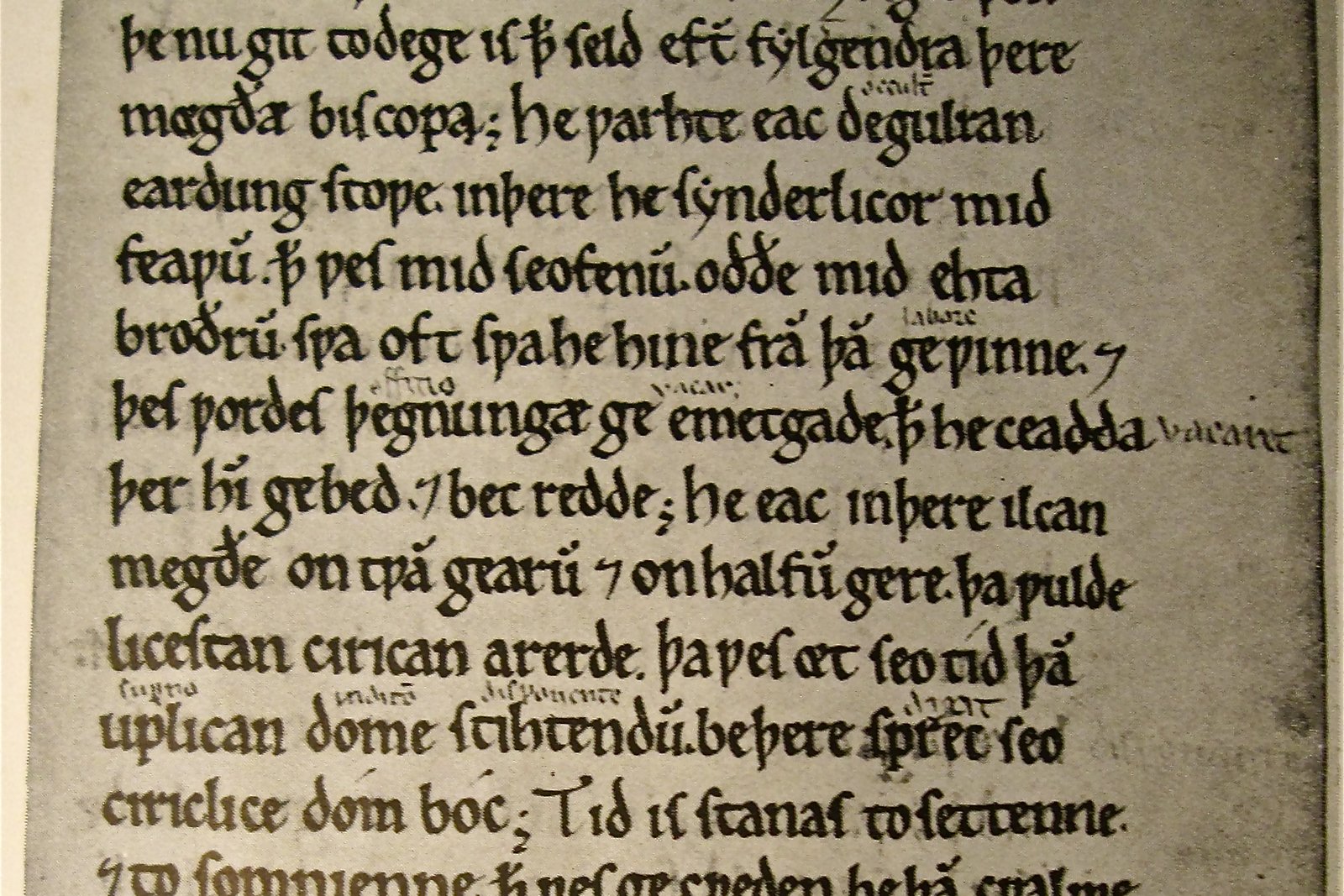
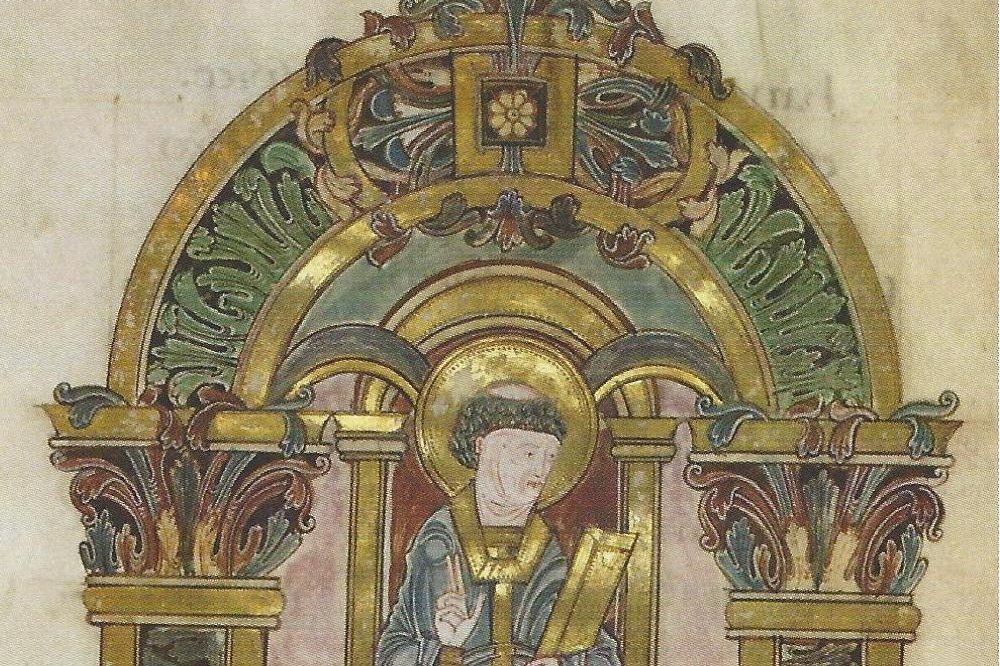
Old English manuscript page naming Bishop Ceadda (Chad), Worcester scriptorium tradition, glossed by the 13th-century "Tremulous Hand of Worcester" — public domain.
Chad also reportedly spent time studying in Ireland, part of a broader pattern among Northumbrian churchmen of his generation who sought out Irish monastic learning even as the wider English Church was, during these same decades, working through the tensions between Irish and Roman liturgical customs that came to a head at the Synod of Whitby in 664.
An irregular consecration and an unusual response
In 664 or shortly after, Chad was chosen to become Bishop of York, but the circumstances of his consecration were unusual: it was performed by Wine, the Bishop of Winchester, assisted by two bishops who followed British — rather than properly Roman-recognized — liturgical customs, a combination that fell short of the canonical standards the wider Church expected for a valid episcopal consecration. When Theodore of Tarsus arrived in England in 669 as the newly appointed Archbishop of Canterbury, tasked with bringing greater order and uniformity to the English Church, he reviewed Chad's consecration and judged it improperly performed.
What happened next is the detail Bede singles out for particular praise: rather than contesting Theodore's ruling or defending his position, Chad accepted the judgment immediately, reportedly telling Theodore that if his consecration had indeed been irregular, he was happy to resign, since he had never considered himself fully worthy of the office of bishop in the first place. Theodore, struck by this response, chose to consecrate Chad again himself — this time following correct canonical procedure — and shortly afterward appointed him to a different see entirely: bishop of the Mercians, the Anglo-Saxon kingdom centered in the English Midlands.
Bishop of the Mercians at Lichfield
As bishop of Mercia, Chad established his episcopal seat at Lichfield, where he built a monastery and lived, according to Bede's account, with striking personal austerity — traveling on foot to visit his diocese rather than on horseback, until Theodore himself insisted he ride when the distances involved made walking impractical for a bishop with such wide pastoral responsibilities. Bede's history preserves this and several similar details specifically to illustrate Chad's humility, a virtue Bede returns to repeatedly whenever Chad's name comes up in the broader narrative of the English Church's early development.
Chad's time as bishop of Mercia was brief — he died around 672, only about two and a half years after his second consecration, reportedly of the same kind of plague that had claimed his brother Cedd years earlier. Even so, the diocese he established endured, and Lichfield remained its episcopal seat for centuries afterward, developing into one of the important cathedral cities of medieval England.
Bede's account of Chad's death
Bede devotes an unusually detailed passage to the circumstances of Chad's final illness, and the episode is worth setting out because it illustrates just how central Chad became to Bede's larger portrait of holy death within the Ecclesiastical History. According to Bede, a monk named Owine, who had left a comfortable position in a noblewoman's household to serve as a lay brother under Chad, heard a sudden burst of singing coming from the sky outside the oratory where Chad was praying alone, a sound that grew louder, seemed to descend and enter the building, and then withdrew back into the heavens after about half an hour. Chad, coming out, told Owine that heavenly visitors had come to announce his approaching death and summoned his monks to prepare themselves and him for it; seven days later, Chad died. Whatever one makes of the specific vision, Bede's careful, almost eyewitness framing of the story — naming the monk, describing the timing precisely — reflects the value early medieval readers placed on a saint's death being marked by some visible or audible sign of divine favor, a recurring motif throughout Bede's history and one he clearly regarded Chad as fully meriting.
The Chad Gospels and Lichfield's cathedral tradition
The illuminated Gospel book known today as the Chad Gospels, or the Lichfield Gospels, was produced sometime in the eighth century — after Chad's own lifetime — most likely in a scriptorium somewhere in the Insular artistic tradition associated with centers like Lindisfarne and the Irish monastic world that had also shaped Chad's own formation. Its association with Lichfield and with Chad's name reflects how thoroughly his memory had become bound up with the cathedral community he founded within a few generations of his death, functioning as both a liturgical treasure and a physical symbol of the diocese's claim to an unbroken line back to its first bishop. The manuscript survives today, partially, as one of the significant treasures of Anglo-Saxon book art, and its continued presence at Lichfield Cathedral remains a tangible link between the modern diocese and the humble seventh-century bishop who first established it.
Feast day and legacy at Lichfield
Chad's feast is kept on March 2. He was venerated as a saint almost immediately after his death, and his tomb at Lichfield became a significant pilgrimage site through the medieval period; Lichfield Cathedral, still dedicated to him today, preserves this connection directly. The illuminated Gospel book long associated with Lichfield and known as the Chad Gospels — though not created during Chad's own lifetime — reflects the lasting prestige the see he founded carried in Anglo-Saxon England.
Chad's example of quiet, unresisting humility in the face of a disputed appointment remained one of the most frequently cited episodes in Bede's entire Ecclesiastical History, held up as a model of how ambition for high office should be balanced against genuine readiness to relinquish it. Readers interested in the broader Northumbrian monastic tradition that produced Chad may also want to read about Saint Aidan of Lindisfarne, whose foundational missionary work a generation earlier shaped the entire school of English monasticism Chad grew up within.
Trivia
Who was Saint Chad of Mercia?
Why did Saint Chad resign as Bishop of York?
What is the source for most of what we know about Saint Chad?
Where was Saint Chad's monastery, and where is he buried?
When is the feast of Saint Chad?
You May Also Like
Related Reading