Saint Hermann Joseph, the Boy Who Offered Mary an Apple

A poor child in a wealthy city
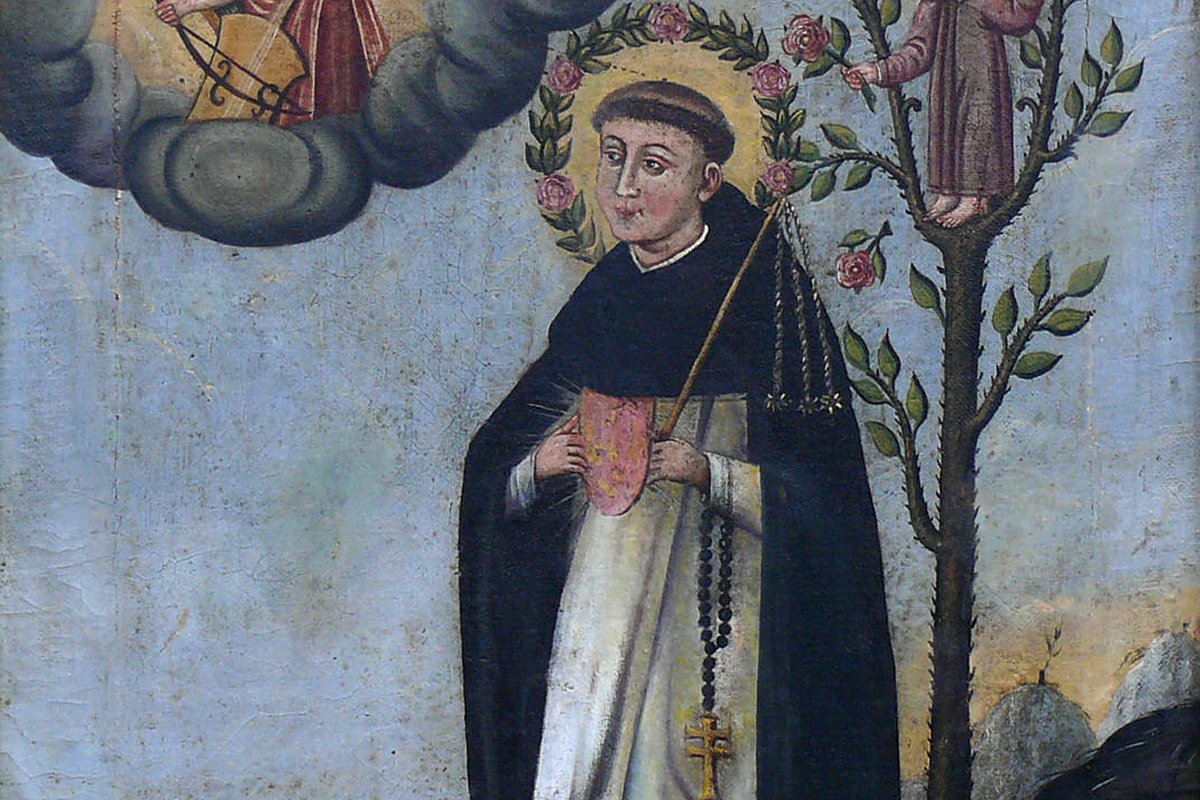
Hermann was born around 1150 in Cologne, one of the largest and richest cities in the Holy Roman Empire, but into a family with very little of that wealth. According to the tradition that grew up around him, he was a sickly, poor child who found comfort not among other children but in a nearby church, where he would visit a statue of the Virgin Mary and the infant Christ as though paying a visit to family. The most famous story from this period — that young Hermann once offered the statue an apple from his own pocket, and that its carved hand reached out to accept it — belongs to the devotional tradition recorded by later medieval biographers rather than to any contemporary eyewitness record, and should be read as legend illustrating the child's devotion rather than documented fact. What can be said with more confidence is that this pattern of intense, personal, almost conversational closeness to Mary defined Hermann's spiritual life from childhood onward, and it never really left him.
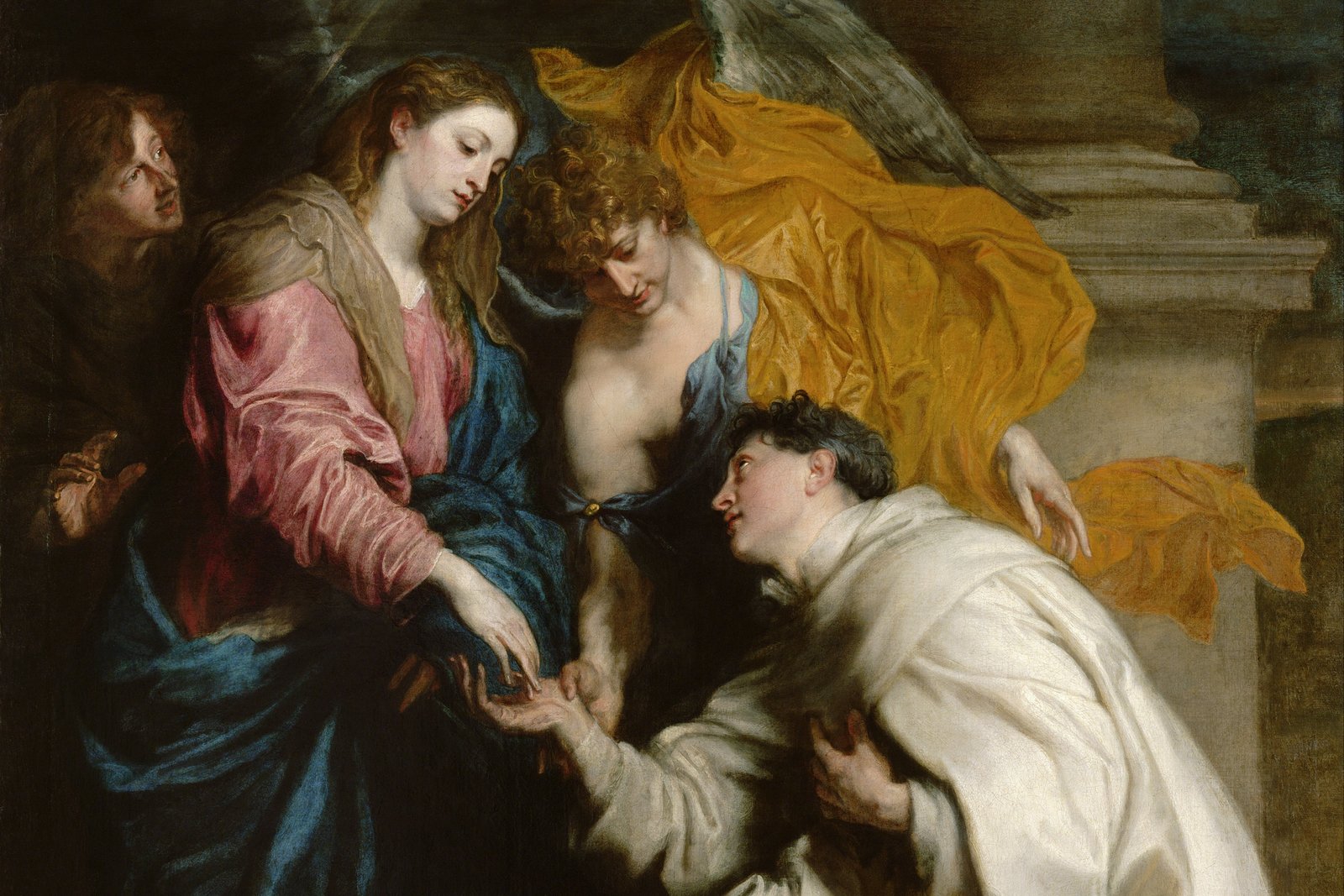
Anthony van Dyck, The Vision of the Blessed Hermann Joseph, c. 1629–1630 — public domain.
Joining the Premonstratensians at Steinfeld
As a young man, Hermann entered Steinfeld Abbey in the Eifel region of western Germany, a house of the Premonstratensian order — canons regular following the Rule of Saint Augustine, founded earlier in the twelfth century by Saint Norbert of Xanten, who combined the discipline of monastic life with active pastoral and preaching work. Hermann spent the rest of his life at Steinfeld and its associated houses, living the ordinary round of a medieval canon's life — prayer, study, manual work — while gaining a reputation among his community for an unusually deep interior life. He is remembered by his contemporaries as gentle, humble, and often self-effacing about the visions and mystical experiences later attributed to him, more inclined to quietly serve than to draw attention to what he reported experiencing in prayer.
A vision that gave him a second name
The event that most shaped how later generations remembered Hermann is what tradition calls his "mystical marriage" — an experience, reported in his own community's later accounts, in which he received a vision of Mary placing a ring on his finger as a sign of complete spiritual union, and in which she instructed him to take the additional name "Joseph," aligning him symbolically with her own husband's lifelong closeness to her. This is why he is known in the tradition as Hermann Joseph rather than simply Hermann — one of a small number of saints who carry a name given, according to devotional tradition, directly through a reported vision rather than at baptism. The mystical marriage became a recognizable devotional motif in later Catholic art, most famously captured in a large oil painting by the Flemish master Anthony van Dyck around 1629–1630, showing Hermann kneeling before Mary enthroned with the infant Christ as she extends a ring toward him — a vivid visual summary of a spiritual tradition built up over centuries rather than a documentary record of a single dated event.
A life remembered for gentleness, not spectacle
Unlike some medieval mystics whose reported visions came with dramatic public consequences — prophecy, conflict with Church authorities, direct involvement in political affairs — Hermann's reputation rested almost entirely on the quiet, sustained character of his inner devotion and on a personal humility his own community singled out repeatedly in later accounts of his life. He is also remembered as a writer of hymns and devotional verse addressed to Mary, work that, while not as widely studied today as the writings of better-known medieval mystics, reflects the same consistent, personal register found throughout the traditions about his life. He died in 1241 at Hoven, near Steinfeld, and was buried at the abbey that had been his home for most of his adult life.
Equivalent canonization, centuries after his death
Hermann Joseph's veneration developed the way many medieval local cults did — through sustained, organic devotion at Steinfeld and the surrounding region long before any formal Church process examined his case. He was never canonized through the ordinary procedure involving a postulator, formal investigation, and required miracles; instead, in 1958, Pope Pius XII confirmed his centuries-old cultus through what the Church calls equivalent canonization, a recognition reserved for cases — like that of Saint Bruno of Cologne, founder of the Carthusians — where an unbroken, long-standing local veneration already exists and a full modern canonization process would add little beyond formal confirmation. His feast is kept on April 7, and Steinfeld Abbey, still standing in the Eifel region today, remains connected to his memory as the place where a poor boy's private conversations with a statue grew, over decades of quiet religious life, into one of medieval Germany's most enduring Marian devotions.
Trivia
Who was Saint Hermann Joseph?
Why is he called “Hermann Joseph” instead of just Hermann?
What is the story behind the famous apple, and is it historical?
What does the mystical marriage depicted in art actually represent?
When is Saint Hermann Joseph's feast day, and how was his sainthood recognized?
You May Also Like

Related Reading