What the Catholic Church Actually Teaches About Angels and Demons

A teaching many assume has quietly faded
Ask a room of practicing Catholics whether the Church officially teaches that angels and demons are real, and the answers often vary more than you might expect — some assume the language is largely symbolic today, a poetic way of talking about good and evil rather than a claim about actual beings. It's an understandable assumption in a culture that has grown skeptical of unseen realities generally. But it's also, according to the Church's own official teaching, simply incorrect.
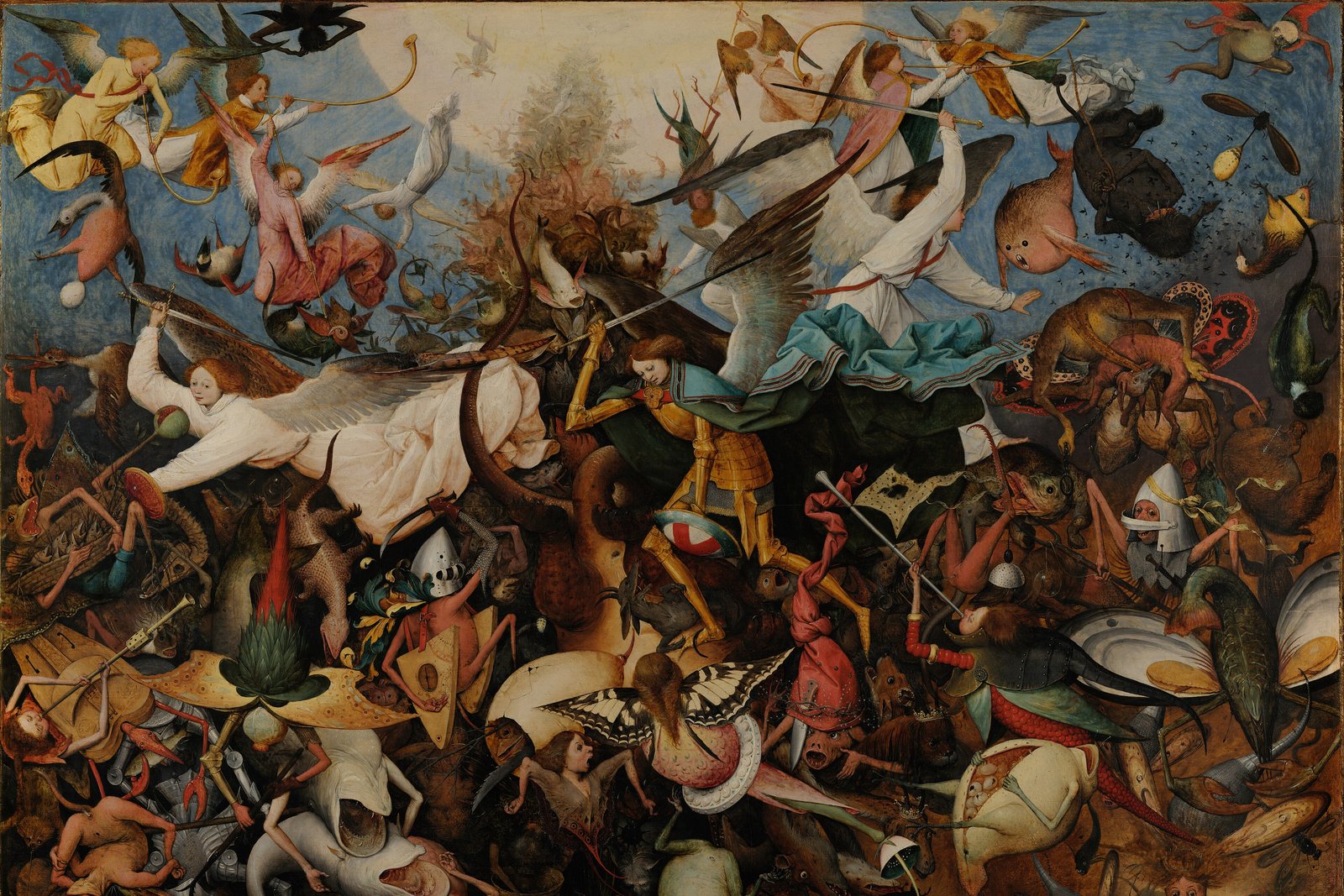
Pieter Bruegel the Elder, The Fall of the Rebel Angels, 1562, Royal Museums of Fine Arts of Belgium, Brussels — public domain.
The Catechism of the Catholic Church, promulgated in 1992 as the authoritative summary of Catholic doctrine, is unambiguous on this point: "The existence of the spiritual, non-corporeal beings that Sacred Scripture usually calls 'angels' is a truth of faith. The witness of Scripture is as clear as the unanimity of Tradition" (CCC 328). This isn't a marginal or optional belief — it's presented as a settled matter of the faith, grounded in both Scripture and the Church's continuous teaching across two millennia.
What angels actually are, according to Church teaching
Catholic doctrine describes angels as "purely spiritual creatures" — beings with intelligence and free will, but without physical bodies, created directly by God rather than developing from any other form of existence (CCC 330). They're described as "personal and immortal creatures, surpassing in perfection all visible creatures," reflecting the traditional understanding that angels occupy a place in creation above humanity in terms of natural capability and knowledge, even as human beings hold a unique dignity of their own as creatures made in God's image and destined for bodily resurrection.
The Church's teaching draws heavily on the extensive biblical record of angelic activity — angels guarding the Garden of Eden, delivering messages to prophets, and ministering directly to Christ — treating these accounts not as metaphor but as genuine historical testimony to the actions of real beings, consistent across both the Old and New Testaments and affirmed by the unbroken teaching of the Church Fathers and later theologians such as Saint Thomas Aquinas, who devoted extensive sections of the Summa Theologiae to angelic nature and activity.
Demons: not a separate creation, but a fall
Perhaps the most theologically significant clarification the Catechism offers concerns the origin of demons — and it's a point worth stating precisely, because popular imagination often gets it wrong. The Church does not teach that God created two separate categories of spiritual being, one good and one evil, from the very beginning. Instead, Catholic doctrine holds that all angels, including those who would become demons, were originally created good by God, and that demons are angels who freely and permanently chose to reject God.
"The devil and the other demons were indeed created naturally good by God, but they became evil by their own doing" (CCC 391). The Catechism further specifies that this rejection was "a radical and irrevocable rejection of God and his reign by some of the angels, made irrevocable by the very nature of their spiritual being" (CCC 392-393) — meaning that unlike human beings, who can repent and change course throughout an earthly life, angels made their fundamental choice for or against God in a single decisive moment, after which that choice became permanently fixed. This teaching is explored in more depth in the account of the fallen angels and the war in heaven.
Distinguishing doctrine from popular legend
One of the more subtle but important aspects of Church teaching in this area is its restraint. While Scripture and Tradition affirm the existence and fall of the demons clearly, the Church has generally avoided officially defining many of the specific details that popular imagination and devotional literature have since attached to the subject — precise numbers of fallen angels, detailed hierarchies of demonic rank, or dramatic narrative specifics beyond what Scripture itself states. Much of that additional detail belongs to pious tradition, apocryphal literature, or later theological speculation rather than to defined dogma, and careful Catholic teaching distinguishes clearly between the two categories.
What the Church does affirm with confidence is the basic reality and moral stakes involved: that a genuine spiritual conflict exists, that demonic influence and temptation are real possibilities in human life, and that Christ's victory over sin and death, celebrated above all at Easter, includes decisive victory over the power of these fallen spirits — a note of confidence, not fear, that runs through how the Church presents this teaching overall.
Why the Church still maintains a rite of exorcism
Consistent with this teaching, the Catholic Church maintains an official rite of exorcism, used in cases where genuine demonic possession or influence is suspected. Far from being practiced casually, current Church discipline requires that exorcisms of this formal kind be performed only by a priest specifically authorized by his bishop, and only after a careful process of discernment — typically involving medical and psychological evaluation — has ruled out natural explanations for the symptoms presented. This deliberate caution reflects the Church's broader theological instinct in this area: taking the reality of angels and demons seriously as an article of faith, while resisting sensationalism or superstition in how that belief is actually lived out and applied.
A teaching that remains, deliberately, unchanged
For a Church often assumed to have quietly modernized away its more supernatural claims, the doctrine on angels and demons stands out for its consistency. The Catechism's language on this subject draws directly and explicitly on centuries of continuous teaching, treated not as an embarrassing holdover from a pre-scientific age but as a coherent and still-affirmed part of the Catholic understanding of reality — one in which the visible world is only part of the picture, and where both angels and demons remain, in the Church's own careful words, genuinely and personally real.
Trivia
Does the Catholic Church teach that angels are literally real beings?
What does the Church teach angels actually are?
How does the Church explain what demons are?
Was Satan created evil by God?
Does the Church still perform exorcisms today?
Related Reading