Jesus Christ the King

A king who redefines the word under interrogation
Of all the moments the Gospels could have chosen to address Jesus's kingship directly, they choose his trial — hours before his execution, under interrogation by the man with the power to order his death. Asked about it plainly, Jesus doesn't deny the title: "My kingdom does not belong to this world. If my kingdom did belong to this world, my attendants [would] be fighting to keep me from being handed over to the Jews. But as it is, my kingdom is not here." (John 18:36, RSV-CE). It's an answer that accepts the word "king" while completely relocating what the word is built on — not territory, not an army, not the leverage Pilate actually holds over him.
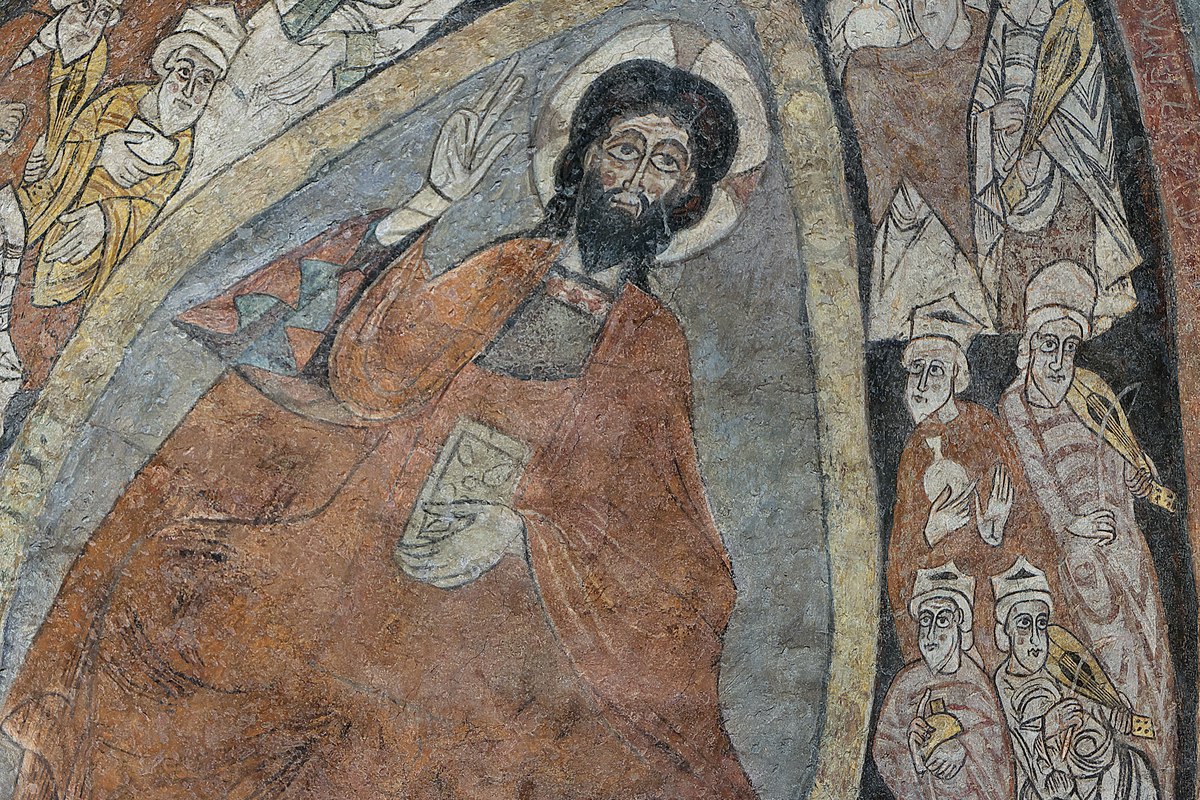
Maiestas Domini fresco, Church of San Justo y Pastor, Segovia — photo by José Luis Filpo Cabana, CC BY-SA 4.0.
Kingship tied to truth, not force
Pilate presses further; Jesus answers, "You say I am a king. For this I was born and for this I came into the world, to testify to the truth. Everyone who belongs to the truth listens to my voice." (John 18:37, RSV-CE). It's a striking redefinition to offer at the exact moment it carries the least practical benefit — Jesus gains nothing strategically by claiming a kingdom built on truth rather than power, standing as he is before someone who could simply have him killed regardless of the answer.
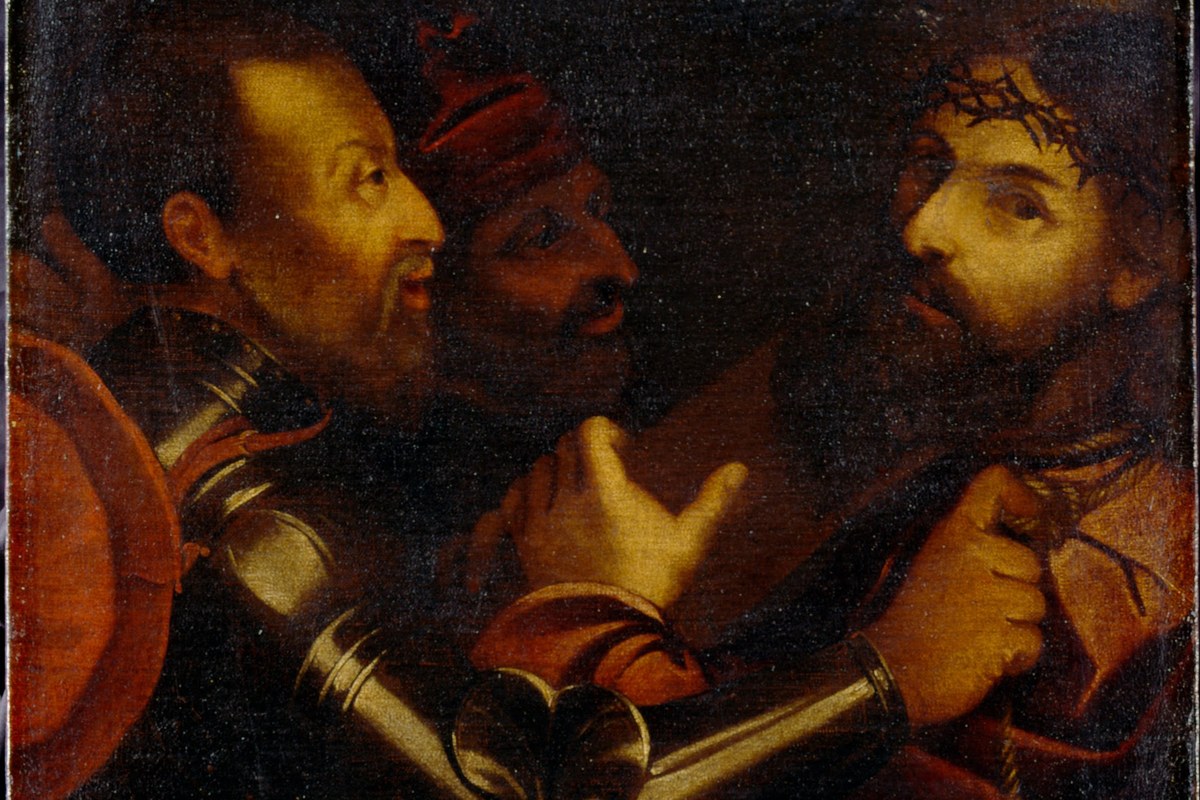
The irony deepens a few hours later. After the crowd rejects him and Pilate hands Jesus over for the carrying of the cross, Roman soldiers dress him in a purple robe, press a crown of thorns onto his head, and mockingly hail him as "King of the Jews" — a taunt meant to humiliate him. Pilate then has that same title, "Jesus of Nazareth, King of the Jews," nailed above his head on the cross itself, written in Hebrew, Latin, and Greek so that everyone passing by could read it. What was intended as mockery ends up standing, quite literally, over the scene of his death — the very claim the soldiers meant as ridicule becomes, in Christian reading, a plain statement of fact.
A kingship recognized by wise men and rejected by a ruler
Even before his trial, Jesus's kingship had already unsettled earthly power. When the Adoration of the Magi brought foreign visitors to Bethlehem asking where the newborn "king of the Jews" could be found, it was King Herod, not any religious authority, who reacted with alarm and ordered the death of infant boys in the region to eliminate the perceived threat. From his first days to his last, the pattern repeats: those holding worldly power sense something in Jesus's kingship worth fearing, even while Jesus himself makes no move to seize a throne, raise an army, or claim territory of any kind.
A pope responding to a world in pieces
Nineteen centuries later, Pope Pius XI looked out at a Europe reshaped by the First World War — empires collapsed, secularism rising, and nationalism hardening into the ideologies that would eventually produce a second world war. In his 1925 encyclical Quas Primas, he argued that many of the era's evils traced back to a simple cause: societies and individuals alike had pushed Christ's authority out of both their private lives and their politics, leaving no higher claim to answer to than the state or the nation itself.
Pius XI was writing barely three years after Mussolini's rise to power in Italy and amid a broader European climate where fascism, communism, and aggressive nationalism were each, in different ways, claiming a total and exclusive hold on the loyalty of citizens. Quas Primas argued that once Christ's kingship was pushed out of public life, something else would inevitably rush in to fill the vacuum — and that the resulting disorder, wars, and cruelty of the era were not accidents but a predictable consequence. The feast wasn't meant only as a private devotion; Pius XI explicitly hoped it would remind rulers and nations, not just individuals, that their authority was never final or unaccountable.
A feast placed deliberately at the calendar's edge
His response was to institute the Feast of Christ the King, originally observed on the last Sunday of October, just before All Saints' Day. In 1970, the feast's observance shifted to the final Sunday of the Church's liturgical year — a deliberate placement, closing out an entire annual cycle of readings and celebrations with a return to the same claim Jesus made under interrogation two thousand years earlier: a kingdom real enough to be worth acknowledging, built on nothing the state can grant or take away.
An old image given new emphasis
The idea of Christ as king was never new to Christian art or worship — early Byzantine mosaics had depicted him enthroned in majesty, Christ Pantocrator, "ruler of all," for well over a millennium before Pius XI's encyclical, and mystical writers had used royal language about Christ since the earliest centuries of the Church. What the 1925 feast did was give an ancient image a fixed date, a formal liturgy, and a deliberately public purpose in a century that needed the reminder as much as any that came before it. Related depictions of Christ's divine authority — including Christ Pantocrator and Jesus Christ the High Priest — draw on the same underlying conviction from different angles: that the man who stood silently before Pilate holds an authority no earthly court ever had the power to grant or revoke.
Trivia
What did Jesus actually say about being a king at his trial?
How did Pilate respond, and what did Jesus say next?
Why did Pope Pius XI create the Feast of Christ the King in 1925?
When is the feast celebrated?
Related Reading