The Adoration of the Magi

Visitors who unsettled a king before they ever reached a child
Matthew introduces the Magi with almost no background: "magi from the east arrived in Jerusalem" asking, "Where is the newborn king of the Jews? We saw his star at its rising and have come to do him homage" (Matthew 2:1-2, NABRE). The word "magi" points to a class of Persian or Babylonian scholars associated with astrology and the interpretation of celestial signs — foreigners, and almost certainly not Jewish. Their question lands like a threat rather than a curiosity: Herod, the reigning king, is "greatly troubled," and so, Matthew adds, is "all Jerusalem with him" (Matthew 2:3, NABRE). A rival king, however small, was not welcome news in Herod's court.
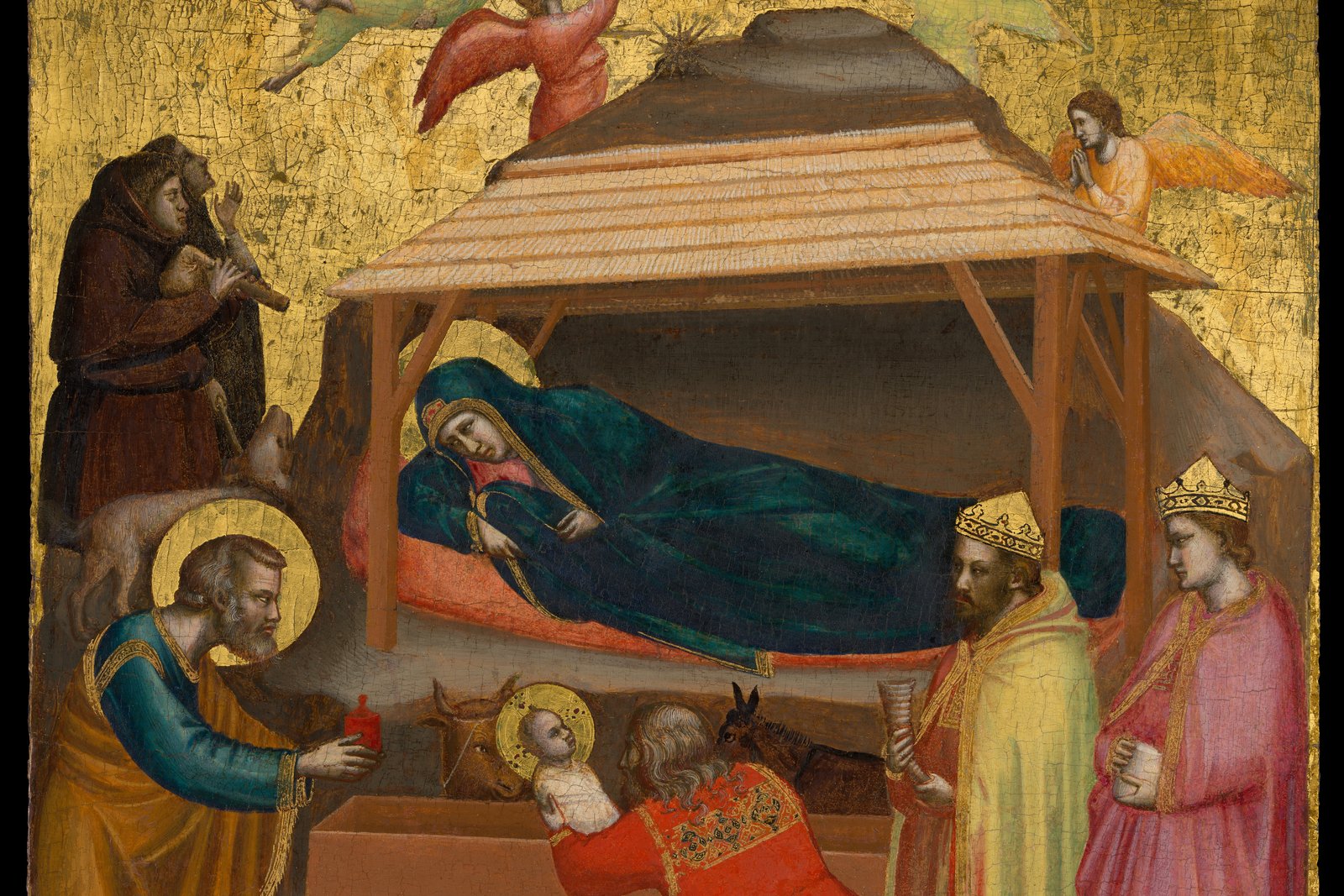
Giotto di Bondone, "The Adoration of the Magi," c. 1320, The Metropolitan Museum of Art. Public domain.
A secret meeting and a borrowed prophecy
Herod doesn't dismiss the Magi's question — he takes it seriously enough to consult his own religious scholars, who point him to a prophecy naming Bethlehem as the birthplace of Israel's promised ruler (Matthew 2:4-6, NABRE, citing Micah 5:1). He then meets the Magi "secretly," extracting the precise timing of the star's appearance before sending them onward with an order dressed up as piety: find the child, then report back so that Herod, too, can "do him homage" (Matthew 2:7-8, NABRE). Nothing in the text suggests the Magi immediately suspect his real intention.
A house, not a stable
By the time the star leads them to their destination, the setting has changed from the manger of Luke's birth narrative. Matthew specifies that "on entering the house they saw the child with Mary his mother" (Matthew 2:11, NABRE) — a house, implying the family had settled somewhere more permanent in Bethlehem, and a "child" rather than an infant, a detail consistent with some time having passed since the birth. The Magi's response is immediate and physical: they "prostrated themselves and did him homage" before opening their gifts (Matthew 2:11, NABRE).
Gold, frankincense, and myrrh
The three gifts are named plainly: "gold, frankincense, and myrrh" (Matthew 2:11, NABRE). Matthew doesn't explain their significance, but Christian tradition — developing over the centuries that followed — read symbolic weight into each one: gold as tribute fit for a king, frankincense (a resin burned as temple incense) as an acknowledgment of divinity, and myrrh, an embalming spice, as an early, unsettling foreshadowing of the death this same child would eventually die. This traditional reading is a matter of long-standing devotional interpretation, not a claim the Gospel text makes explicitly.
A warning, a massacre, and a flight to Egypt
The story doesn't end with worship. "Having been warned in a dream not to return to Herod," the Magi leave for home by a different route (Matthew 2:12, NABRE), and Herod's fury at being outmaneuvered leads directly to one of the darkest passages in the infancy narrative — an order to kill every boy two years old and under in and around Bethlehem (Matthew 2:16, NABRE), an event the Church commemorates as the Holy Innocents. Joseph, warned in a separate dream, has already fled with Mary and Jesus to Egypt by the time the order is carried out (Matthew 2:13-14, NABRE). The feast of the Epiphany, celebrated January 6, commemorates the Magi's visit specifically as the revelation of Christ to the Gentile world beyond Israel.
Where the names and the crowns came from
Nowhere does Matthew call the visitors kings, name them, or count them. Those familiar details all developed later, through centuries of devotional tradition rather than scriptural record. The idea that they were kings likely grew out of Old Testament passages such as Psalm 72, which speaks of foreign kings bringing tribute and bowing before Israel's ruler, and Isaiah 60, which describes nations arriving with "gold and frankincense" (Isaiah 60:6) — verses early Christian readers connected to this scene. The names most familiar in the West today — Caspar, Melchior, and Balthasar — don't appear in any text before roughly the sixth century, and different Christian traditions around the world have preserved different names and even different numbers of visitors entirely; some Eastern traditions describe twelve. By the Middle Ages, the Western image of three crowned kings, each representing one of the three gifts and sometimes one of the three known continents of the ancient world, had become fixed in art and popular devotion — which is the image most people picture today, even though it reflects centuries of layered tradition built on top of Matthew's much sparser original account.
A star that puzzled astronomers long before it puzzled theologians
The star itself has drawn attention from astronomers as much as theologians, with proposed explanations ranging from a nova or comet recorded in ancient Chinese or Korean court records, to a rare conjunction of the planets Jupiter and Saturn in the constellation Pisces around 7-6 BC, a date some scholars connect to a more likely historical window for Jesus's birth given that Herod the Great died in 4 BC. None of these theories can be confirmed with certainty, and the Gospel itself treats the star less as an astronomical puzzle to solve than as a sign meant to be followed — guiding foreign scholars, who read the sky for a living, to recognize something in it worth risking a long journey for. That detail alone carries theological weight regardless of the star's precise physical explanation: Matthew presents the first people to recognize and worship the newborn king as complete outsiders to Israel's own religious tradition, a detail the Church has long read as an early sign that the good news announced at Bethlehem was never meant for one nation alone.
Trivia
Does Matthew's Gospel say there were three Magi?
What exactly did the Magi tell King Herod they were looking for?
Where did the Magi actually find the child?
What is the traditional symbolic meaning of the three gifts?
Why didn't the Magi return to tell Herod what they found?
Related Reading