Our Lady of Loreto


A house that supposedly flew
The Basilica della Santa Casa sits on a hilltop in the Italian region of the Marche, its dome visible for miles across the surrounding countryside. Inside, behind an elaborate marble screen carved with scenes from Mary's life, stands something startlingly plain by comparison: a small rectangular room built of rough, undressed stone, roughly thirty feet long, without any of the polish one might expect at the heart of a major shrine. Tradition holds this humble structure is the very house in Nazareth where Mary was born, raised, and received the angel Gabriel's announcement that she would bear the Son of God — and that it arrived at its present location not by cart or ship in the conventional sense, but carried, according to popular legend, by angels.
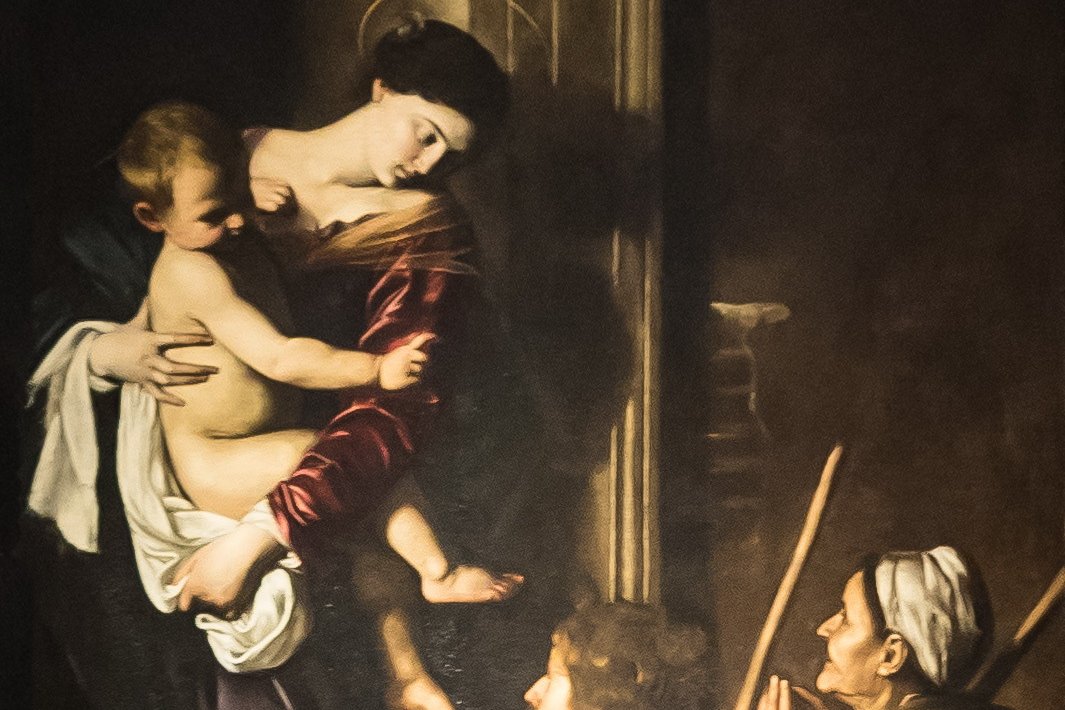
Caravaggio, Madonna di Loreto (Madonna dei Pellegrini), c. 1604–1606, Sant'Agostino, Rome. Photo by Peter1936F, Wikimedia Commons — CC BY-SA 4.0.
It's a claim that invites skepticism, and the Church has never required Catholics to accept the literal airborne journey as a matter of faith. What isn't in dispute is that devotion to this house is genuinely ancient, that pilgrims have venerated it on this Italian hillside since at least the late 13th century, and that it remains one of the most visited Marian shrines anywhere in the world.
From Nazareth to the Adriatic coast
According to the tradition that developed around the shrine, the house first appeared in the region of Trsat, in modern Croatia, in 1291, before moving again in 1294 to a laurel grove near the Italian port town that gave the shrine its name — Loreto derives from lauretum, Latin for a grove of laurel trees. Local chronicles from the period record popular devotion to the house springing up almost immediately, with pilgrims arriving to venerate it well before the Church had investigated or formally endorsed any explanation for its presence.
Historians researching the shrine in more recent centuries have proposed a less miraculous, though still remarkable, explanation: that a noble Byzantine family, the Angeli — whose surname, notably, means "angels" in Greek — may have arranged for stones from a Nazareth structure associated with Mary's home to be transported by sea to Italy during the turbulent years following the fall of the Crusader states in the Holy Land, when Christian holy places there faced destruction. Under this theory, the legend of angelic transport may have grown, over generations of retelling, from the very human name of the family responsible for the real journey. The Church has taken no official position affirming either the miraculous account or the historical theory over the other, treating the house's precise mode of transport as a matter of pious tradition rather than defined doctrine — the sort of distinction between dogma and legend this blog draws elsewhere, including in the article on the Immaculate Conception.
Building a basilica around a house
Once devotion to the Holy House was firmly established, the challenge facing Church authorities was practical: how do you honor and protect a freestanding stone structure that predates any building erected around it? The solution, developed over more than a century starting in the late 1400s, was to construct an entire basilica enclosing the house itself, with the original stone walls left largely untouched inside a lavish marble reliquary-screen commissioned under several Renaissance popes and, in part, designed with contributions from the architect Donato Bramante, better known for his work on the plans for St. Peter's Basilica in Rome. The result is unusual among Catholic shrines: visitors walk through a fully developed Renaissance and Baroque basilica only to find, at its heart, something deliberately left plain and unrefined — a reminder, many pilgrims note, that the house's significance lies in what it represents rather than in any architectural grandeur of its own. For another example of a modest structure enshrined for its association with a Marian apparition, see this blog's article on the Grotto of Massabielle at Lourdes.
Patroness of the air
Among the more distinctive developments in devotion to Our Lady of Loreto came in the 20th century, when aviation was still a young and dangerous enterprise. In 1920, Pope Benedict XV formally declared Our Lady of Loreto the patroness of aviators and, by extension, of air travelers generally — a designation that draws directly on the legend of the house's own airborne journey. It's a patronage many find fitting: whatever one makes of the historical debate over how the house actually arrived in Italy, the tradition surrounding it has made Mary, under this title, a natural intercessor for anyone leaving the ground. Airports and military aviation chapels around the world are named in her honor, and pilots in several countries still invoke her protection before flight.
An official feast at last
For centuries, devotion to Our Lady of Loreto existed primarily at the local and regional level, celebrated with particular intensity in Italy but without a formal place on the universal Church calendar. That changed in 2019, when Pope Francis added the optional memorial of Our Lady of Loreto to the General Roman Calendar, assigning it to December 10th — the traditional date associated with the house's final arrival at its Italian hilltop in 1294. In announcing the addition, the Vatican noted the shrine's long history as a site of pilgrimage and prayer, particularly for families, and its symbolic connection to the mystery of the Incarnation: the house, after all, is venerated as the very place where the Word became flesh in Mary's womb.
A shrine that keeps drawing pilgrims
Nearly every pope of the modern era has visited Loreto, and the shrine continues to draw millions of pilgrims annually, from Italian families making a regional devotion to travelers arriving from across the globe. Whatever the precise historical mechanics behind the house's journey, what has endured for more than seven centuries is the devotion itself — the simple, persistent conviction among generations of the faithful that this plain stone room, wherever it truly began, still marks a place where heaven and ordinary domestic life met.
Trivia
What does the title 'Our Lady of Loreto' refer to?
How is the Holy House said to have reached Italy?
Is devotion to the Holy House an official feast on the Catholic calendar?
Why is Our Lady of Loreto the patroness of aviators?
What is inside the Basilica della Santa Casa today?
Related Reading