The Nativity of the Blessed Virgin Mary

A silence the Gospels leave open
The New Testament's near-total silence about Mary's origins stands in notable contrast to the considerable attention the Gospels give to other aspects of her life: the Annunciation, the Visitation to Elizabeth, the birth of Jesus, and her presence at the foot of the cross are all recorded in some detail. Yet nothing in Matthew, Mark, Luke, or John tells readers who her parents were, where she was born, or what her childhood looked like before Gabriel's announcement in Luke's Gospel introduces her as already a young woman betrothed to Joseph.
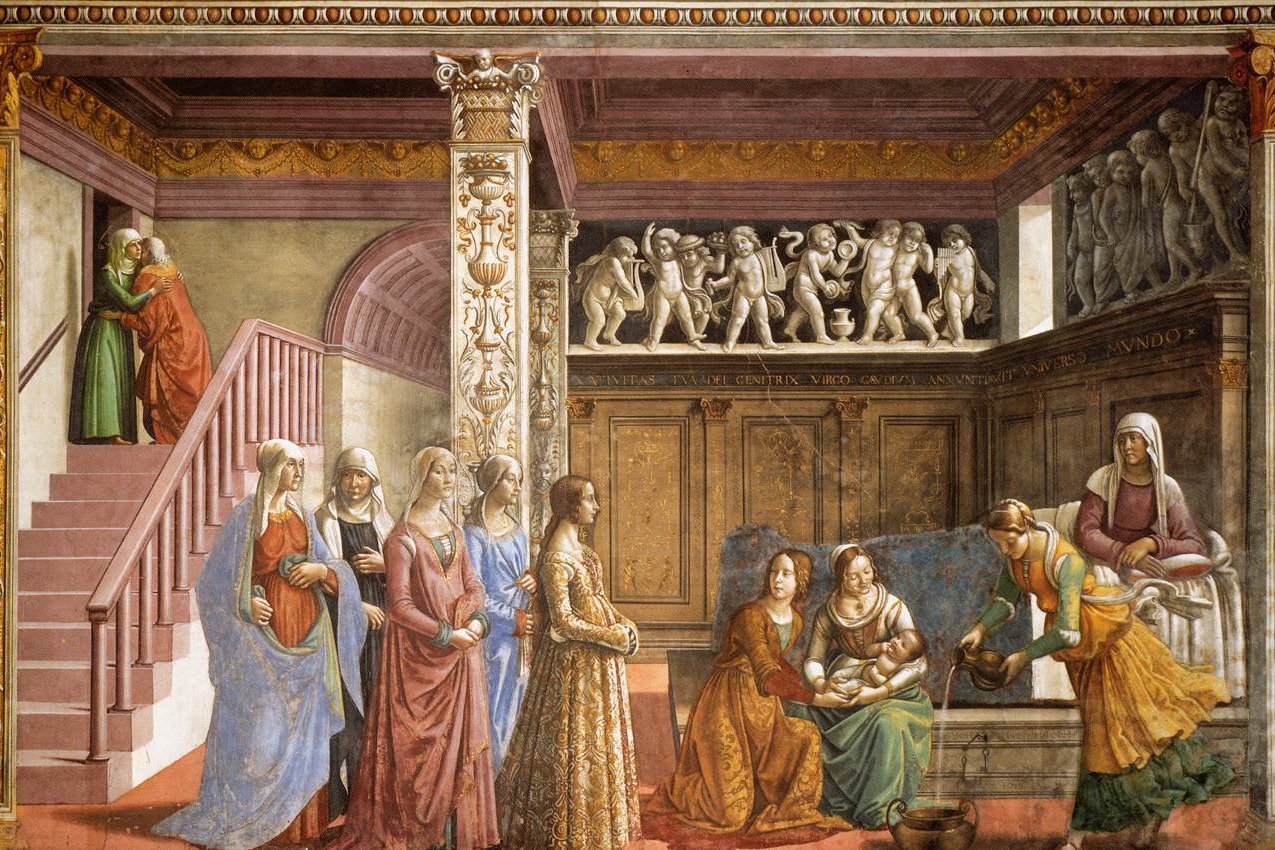
Domenico Ghirlandaio, The Birth of the Virgin, 1485 — public domain.
That gap left an evident hunger among early Christians eager to know more about the woman chosen to be the mother of the Messiah, a hunger that produced, within a century or two of the apostolic age, a body of extra-biblical literature attempting to fill in exactly these missing details. The most influential of these texts by far was the Protoevangelium of James, likely composed in the second century, a narrative that, while never accepted into the canon of Scripture recognized by the Church, nonetheless exercised enormous influence over Christian art, devotion, and liturgical tradition for the many centuries that followed.
Joachim, Anne, and a promise after years of waiting
The Protoevangelium of James names Mary's parents as Joachim and Anne, describing them as a devout, comfortably established Jewish couple whose deep sorrow was a long, painful childlessness, a condition carrying particular social and religious weight in the ancient Jewish context the text imagines, similar in shape to the biblical stories of other long-barren women such as Sarah, Hannah, and Elizabeth. According to the narrative, Joachim, humiliated at having his offering refused in the Temple because he had no children, withdrew to the wilderness to fast and pray, while Anne, left behind, grieved and prayed in turn, until both received angelic assurance that they would be given a daughter.
That daughter, born in answer to prayer after such a long and painful wait, was Mary, and the story's emphasis on the couple's advanced age and prior childlessness deliberately echoes familiar biblical patterns in which a significant figure's birth is marked as a special gift from God rather than an ordinary occurrence, underscoring Mary's importance from the very moment of her conception, well before the angel Gabriel ever appeared to her in adulthood. While the Church has never treated this narrative as historically verified fact in the way it treats the canonical Gospels, the names Joachim and Anne became firmly fixed in Christian tradition, devotional practice, and art across both the Eastern and Western Church for the many centuries since, with both eventually receiving their own feast days as well.
A feast that began in Jerusalem
The origins of a specific liturgical feast honoring Mary's birth trace to Jerusalem, where by around the fifth or sixth century a church had been built on a site tradition identified as the location of Mary's family home, near the pool of Bethesda. The dedication of that church appears to have anchored an annual liturgical commemoration of Mary's birth, which then spread outward from Jerusalem into the wider Byzantine liturgical tradition and, by the seventh century, into Rome and the Western Church as well, carried in part by Eastern Christian influence on the Roman liturgy during that period.
By the early medieval period, the feast was firmly established across both East and West, one of a small number of Marian feasts, alongside the Annunciation, the Purification, and the Assumption, that had achieved genuinely universal observance in the Christian world well before the doctrinal definitions of the modern era gave some of those same feasts a more precise theological formulation.
Why September 8
The date of September 8 for the feast follows directly from December 8, the date on which the Church celebrates the Immaculate Conception, marking the very beginning of Mary's existence in her mother's womb. Nine months later, in the ordinary course of pregnancy, comes her birth, and the Church's liturgical calendar reflects that same nine-month interval by placing her Nativity precisely nine months after the earlier feast. It is worth noting that the December 8 date and its association with the Immaculate Conception in the calendar long predates that doctrine's formal definition as dogma in 1854, meaning the liturgical logic connecting the two dates developed organically over centuries of tradition rather than being constructed after the fact to fit a later theological decision.
Tradition honored, not treated as Scripture
The Catholic Church has always been careful to distinguish between the pious tradition preserved in texts like the Protoevangelium of James and the binding teaching found in Scripture and formal dogmatic definition. The names Joachim and Anne, and the specific narrative details surrounding Mary's birth, belong to the category of long-standing devotional tradition rather than confirmed historical record or required belief, a distinction the Church maintains consistently even while continuing to keep the feast itself, and even while numerous churches and religious communities around the world remain dedicated to Saints Joachim and Anne under those very names. The same Protoevangelium later recounts Mary's presentation at the Temple as a young child. The feast of the Nativity of Mary, kept on September 8, celebrates the deeper theological point beneath the traditional narrative: that Mary's birth marks a decisive, hope-filled turning point in salvation history, the arrival of the woman through whom the Church believes the long-awaited redemption of the world would ultimately come.
Trivia
Is the birth of Mary described in the Bible?
Who are Mary's parents according to Christian tradition?
When did the feast of the Nativity of Mary begin to be celebrated?
Why is the Nativity of Mary celebrated on September 8?
Does the Church treat the story of Joachim and Anne as historical fact?
Related Reading