The Assumption of the Blessed Virgin Mary

A belief older than its definition
Long before any pope declared the Assumption a formal dogma, the belief that Mary had been taken bodily into heaven at the end of her life was already deeply woven into Christian devotion, East and West alike. Apocryphal narratives describing the event, sometimes called Transitus Mariae texts, circulated as early as the fifth and sixth centuries, and by that same period, feasts commemorating Mary's departure from earthly life were already being celebrated in various forms across the Christian world, particularly in the East, where the event came to be known as the Dormition, her falling asleep.
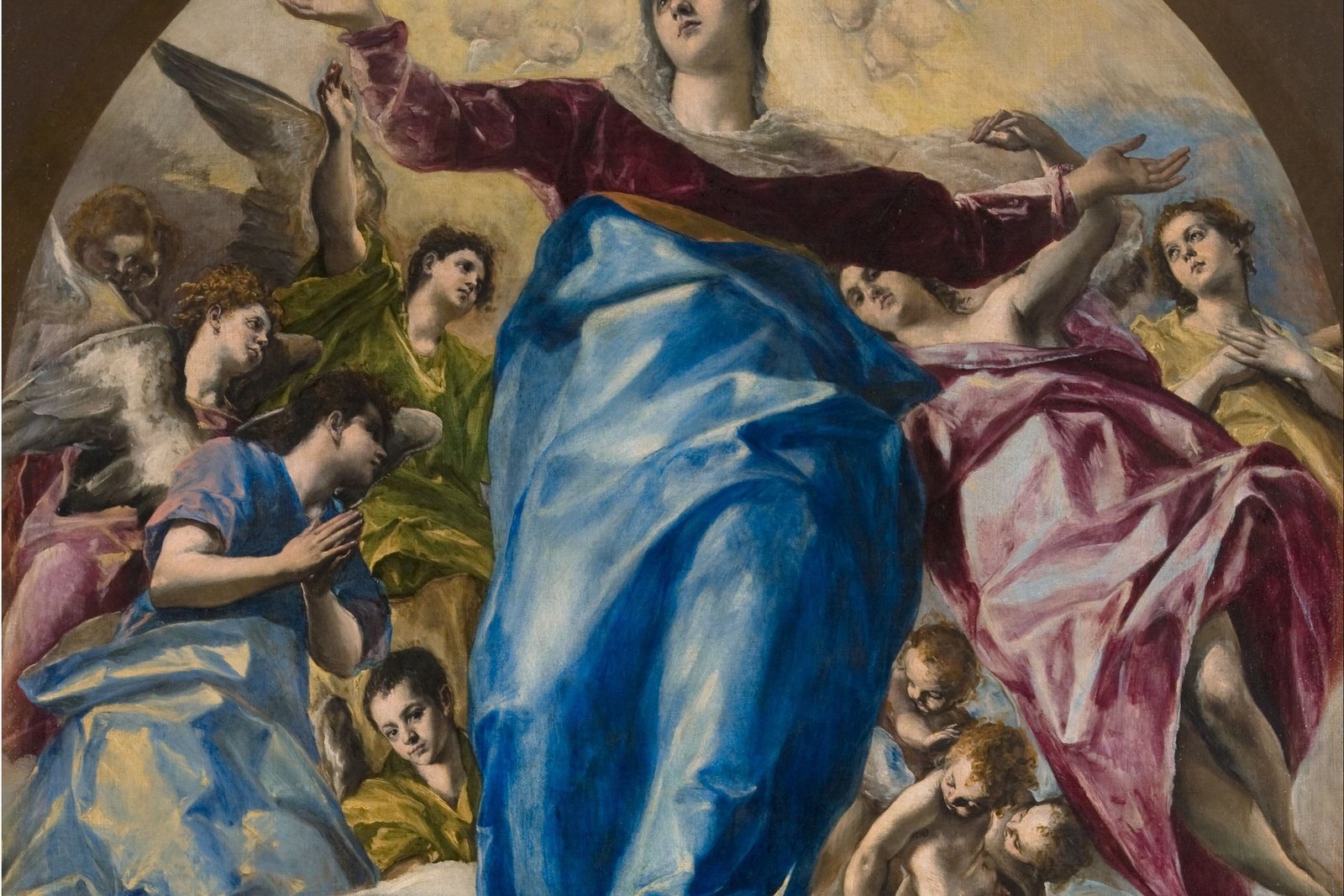
El Greco, The Assumption of the Virgin, 1577–1579 — public domain.
What makes the belief historically distinctive is less any single ancient text describing it than a persistent, notable silence in the historical record on the opposite question: no city in the ancient Christian world ever claimed to possess Mary's bodily remains, and no tradition of a grave being venerated as her burial site ever took root in the way it did for the apostles and other early saints, whose tombs became major pilgrimage centers within a few generations of their deaths. Early Christian writers occasionally pointed to that silence as itself a kind of evidence, an absence that a well-connected, memory-conscious ancient Church would have been unlikely to allow if an ordinary grave had in fact existed.
From devotion to definition
The feast of Mary's Assumption spread across both the Eastern and Western Church over the following centuries, becoming firmly established in Rome by the seventh century, and by the Middle Ages the doctrine, though not yet formally defined, was essentially universal in Catholic devotional and theological life. Major medieval theologians, including Saint Thomas Aquinas, wrote about it as an accepted truth even without a formal papal definition compelling belief in it.
The push toward an official dogmatic definition gathered real momentum in the nineteenth and twentieth centuries, following the 1854 definition of the Immaculate Conception, Mary's own freedom from original sin from the moment of her conception. Petitions to Rome asking for a formal definition of the Assumption arrived from bishops, religious communities, and lay Catholics in growing numbers over subsequent decades, especially after the visions reported at Lourdes in 1858 and later at Fatima in 1917 intensified popular Marian devotion across the Catholic world.
Munificentissimus Deus
Pope Pius XII, after consulting the world's Catholic bishops on the question and receiving an overwhelmingly favorable response, formally defined the Assumption as dogma on November 1, 1950, in the apostolic constitution Munificentissimus Deus, "The Most Bountiful God." The ceremony took place before a vast crowd gathered in Saint Peter's Square, one of the largest and most solemn papal acts of the twentieth century.
The definition itself is carefully, even deliberately, restrained on certain details. It declares that Mary, "having completed the course of her earthly life, was assumed body and soul into heavenly glory," but stops short of specifying whether Mary actually died before this assumption took place, leaving that particular question open to theological discussion rather than settling it dogmatically. This is notably significant because it was the first time in the history of the Church that a pope invoked the specific power of papal infallibility as it had been formally defined at the First Vatican Council in 1870, a power that requires a pope to be speaking deliberately and formally on a matter of faith or morals binding on the whole Church, and it remains, to date, the only time that precise power has been exercised.
Theological grounding, not biblical proof-text
Because no biblical passage describes the Assumption directly, Catholic theologians have generally grounded the doctrine not in an explicit scriptural narrative but in the broader logic of Mary's unique place within the story of salvation. Her freedom from original sin, defined in the Immaculate Conception, meant she was also free from the consequence of sin that Scripture associates with bodily corruption after death. Her assumption is understood, in this light, as an anticipation, granted to her alone among ordinary human beings, of the bodily resurrection that all Christians are taught to await at the end of time, a doctrine expressed in the Book of Revelation's imagery of a woman clothed with the sun, an image the Church has long applied to Mary in a devotional, though not strictly exegetical, sense.
Eastern Christian traditions, including the Orthodox churches, which never adopted the specific Catholic dogmatic language of Munificentissimus Deus, nonetheless share a strikingly similar belief in the Dormition, generally holding more explicitly that Mary did first die before being taken into heavenly glory, a nuance of emphasis that distinguishes Eastern and Western tradition even as both affirm the same essential event.
A major feast across the calendar
The feast of the Assumption, kept on August 15, ranks among the most solemn feasts of the Catholic year and remains a holy day of obligation in numerous countries, including the United States, where Catholics are required to attend Mass on the day even when it falls outside a Sunday. In many historically Catholic nations, the feast is also a public holiday, marked by processions, pilgrimages, and regional festivals that long predate the 1950 dogmatic definition and continue to draw enormous crowds each year, a living reminder of how much devotional life had already grown up around this belief centuries before Rome ever formally declared it.
Trivia
What is the Assumption of the Blessed Virgin Mary?
When was the Assumption officially declared Church dogma?
Does the Assumption say whether Mary died before being taken into heaven?
Is the Assumption found explicitly in the Bible?
When is the feast of the Assumption celebrated, and is it a holy day of obligation?
Related Reading