The Queenship of the Blessed Virgin Mary

An image older than the feast
Long before any pope formally established a feast for it, the image of Mary as a crowned queen had already saturated Christian art and devotion for well over a thousand years. Early Byzantine mosaics depicted her enthroned in imperial dress, drawing directly on the visual language of Roman and later Byzantine court ceremony to convey her exalted status as Mother of God. Medieval European art continued the tradition extensively, and by the high Middle Ages, images of the coronation of the Virgin, showing Christ or the Trinity placing a crown on Mary's head, had become one of the most common subjects in Western religious painting and sculpture.
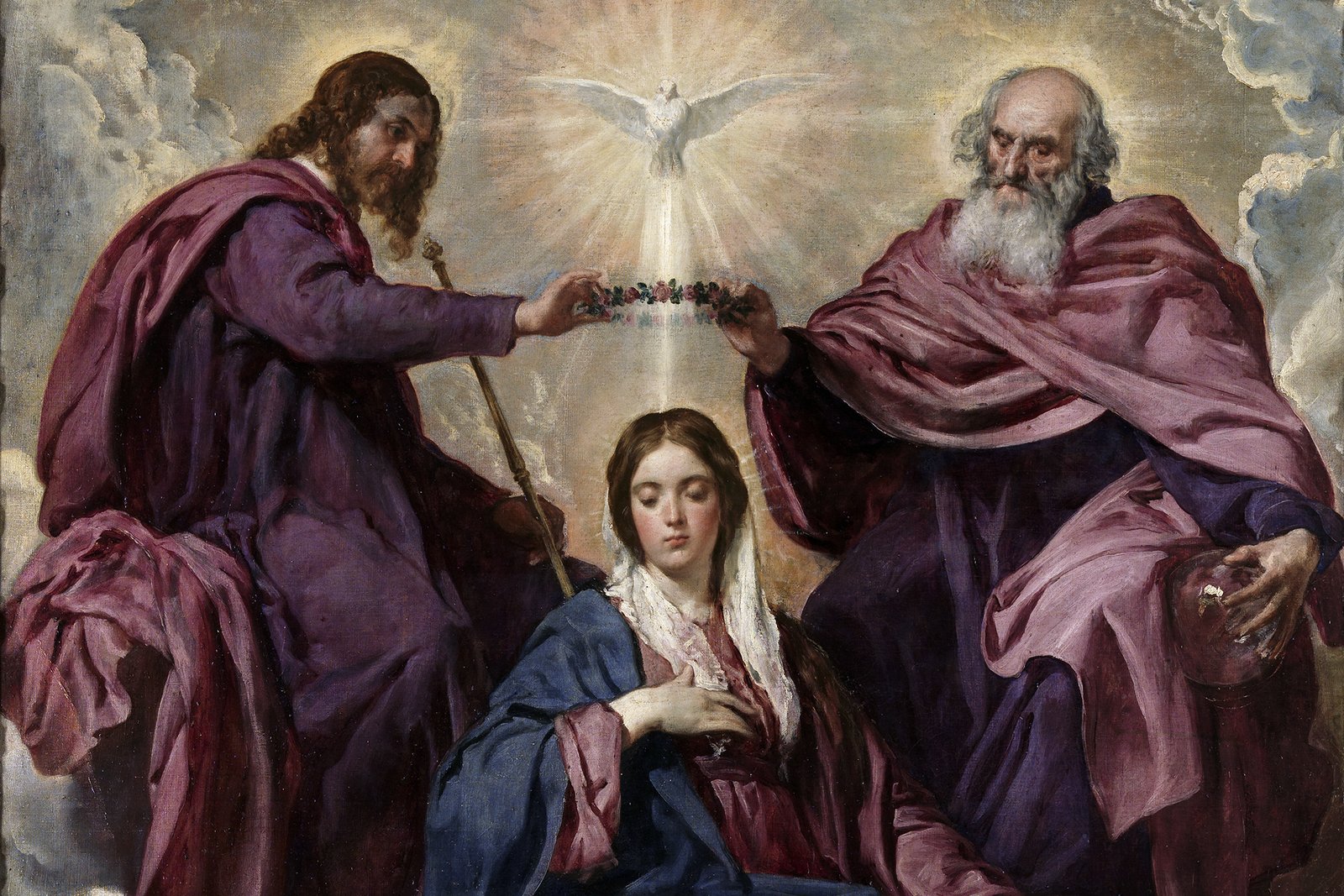
Diego Velázquez, The Coronation of the Virgin, 1635–1636 — public domain.
The rosary itself, in its traditional form, closes its final set of mysteries with the Coronation of Mary as Queen of Heaven and Earth, a devotional practice that predates any formal Church teaching defining the title with theological precision. Popular hymns addressing Mary as queen, including the ancient Regina Caeli sung during the Easter season, had likewise been part of ordinary Catholic worship for centuries. In this sense, the twentieth-century definition of Mary's queenship did not introduce a new idea so much as give formal theological shape and a fixed liturgical date to a title the faithful had already been using in prayer and art for the better part of Christian history.
Ad Caeli Reginam
Pope Pius XII, who had defined the Assumption of Mary as dogma in 1950, returned to Marian doctrine again in 1954, issuing the encyclical Ad Caeli Reginam, "To the Queen of Heaven," which formally established the feast of the Queenship of Mary and laid out the theological reasoning behind the title in systematic form. The timing was deliberate: 1954 marked the centenary of the definition of the Immaculate Conception, and Pius XII framed the new encyclical explicitly as building on that earlier Marian teaching, along with the Assumption defined four years before it.
The encyclical grounds Mary's queenship in her unique relationship to Christ, described throughout Scripture and Christian tradition as King, arguing that just as an earthly king's mother traditionally held an honored, though subordinate, position at court, so Mary holds an honored position in relation to her son's eternal kingship. Pius XII was careful throughout to specify that Mary's queenly role is entirely derivative of Christ's own kingship, not an independent authority of her own, a distinction the Church has consistently maintained in order to keep Marian devotion clearly subordinate to the worship due to God alone.
The queen mother of ancient Israel
Among the biblical foundations cited for the title, one of the more historically interesting is the ancient Israelite institution of the gebirah, the queen mother, a position of real influence at the royal court of Judah, distinct from any of the king's wives. Old Testament passages describing kings such as Solomon receiving his mother Bathsheba with a bow and seating her at his right hand are cited by Catholic theologians as an illustrative Old Testament pattern that finds a fuller, typological echo in Mary's relationship to Christ, the definitive Son of David.
The angel Gabriel's announcement to Mary in the Gospel of Luke, that her son would be given the throne of his father David and would reign over the house of Jacob forever, is likewise read by Catholic tradition as implying, though not stating outright, an honored place for the mother of that eternal king. The Book of Revelation's vision of a woman clothed with the sun and crowned with twelve stars, while primarily understood by many Scripture scholars as a symbol of the Church or of Israel, has also long been applied by Catholic devotional and homiletic tradition to Mary, reinforcing the same royal imagery, even though this reading is more devotional than a matter of strict biblical exegesis.
A feast tied to the Assumption
When the feast was first established in 1954, Pius XII assigned it to May 31, then the final day of the month of May traditionally devoted to Marian devotion in Catholic practice. Following the liturgical calendar reforms after the Second Vatican Council, the feast was moved to August 22, deliberately placed as the octave day, the eighth day, of the Assumption on August 15.
That placement was not incidental. By setting the Queenship feast exactly one week after the Assumption, the reformed calendar draws a direct and intentional theological line between the two: Mary's queenship is presented as flowing from, and following immediately upon, her bodily glorification in heaven celebrated at the Assumption. The two feasts, taken together, form a single connected statement about Mary's ultimate destiny as understood in Catholic teaching, her body raised to heavenly glory and her role as queen honored in relation to the eternal kingship of her son.
A title shared across traditions
The image of Mary crowned as queen is not unique to the Roman Catholic Church; Eastern Orthodox and Eastern Catholic churches have long addressed her with comparable titles in their own liturgical traditions, even without a formally defined feast matching the Western calendar's August date. The akathist hymn, one of the most treasured pieces of Byzantine Marian devotion, repeatedly hails Mary in language of royal honor, and Orthodox iconography developed its own visual conventions for depicting her heavenly glory centuries before Western artists settled on the coronation scene as a standard subject. This shared instinct across otherwise distinct liturgical traditions is part of what Pius XII pointed to in Ad Caeli Reginam as evidence that the title reflected something the whole Christian East and West had recognized in different forms, rather than a purely Western Catholic innovation of the twentieth century.
Praying the title today
In ordinary Catholic devotional life, the Queenship of Mary shows up most often not in the August feast itself but in prayers recited far more frequently: the Hail Holy Queen, prayed at the close of the rosary and traditionally after low Mass for centuries before the Second Vatican Council, addresses her directly as "our life, our sweetness, and our hope," and the Litany of Loreto repeats the title "queen" more than a dozen times across its various invocations, queen of angels, queen of patriarchs, queen of all saints, queen of peace. For most Catholics, then, the formal theology laid out in a mid-twentieth-century papal encyclical simply gave precise doctrinal shape to language they were already praying, week in and week out, without necessarily pausing to ask where the title came from or what, exactly, the Church meant in using it.
Trivia
What is the Queenship of the Blessed Virgin Mary?
When did the Church formally establish the feast of the Queenship of Mary?
What biblical basis does the Church give for calling Mary a queen?
Is Mary's queenship the same kind of authority as Christ's kingship?
When is the feast of the Queenship of Mary celebrated today?
Related Reading