The Great Catch of Fish


A teacher borrows a boat as a pulpit
Luke sets this scene at the start of Jesus's public ministry in Galilee, with a crowd pressing so close along the shore of the lake to hear him teach "the word of God" that he needed room to speak. "While the crowd was pressing in on Jesus and listening to the word of God, he was standing by the Lake of Gennesaret. He saw two boats there alongside the lake; the fishermen had disembarked and were washing their nets. Getting into one of the boats, the one belonging to Simon, he asked him to put out a short distance from the shore. Then he sat down and taught the crowds from the boat." (Luke 5:1-3). It's a practical solution to a crowd problem — a slight distance from shore lets sound carry over water and keeps the crowd from crushing in — but it also puts Jesus directly in Simon's boat, with Simon as an audience of one for what happens next.
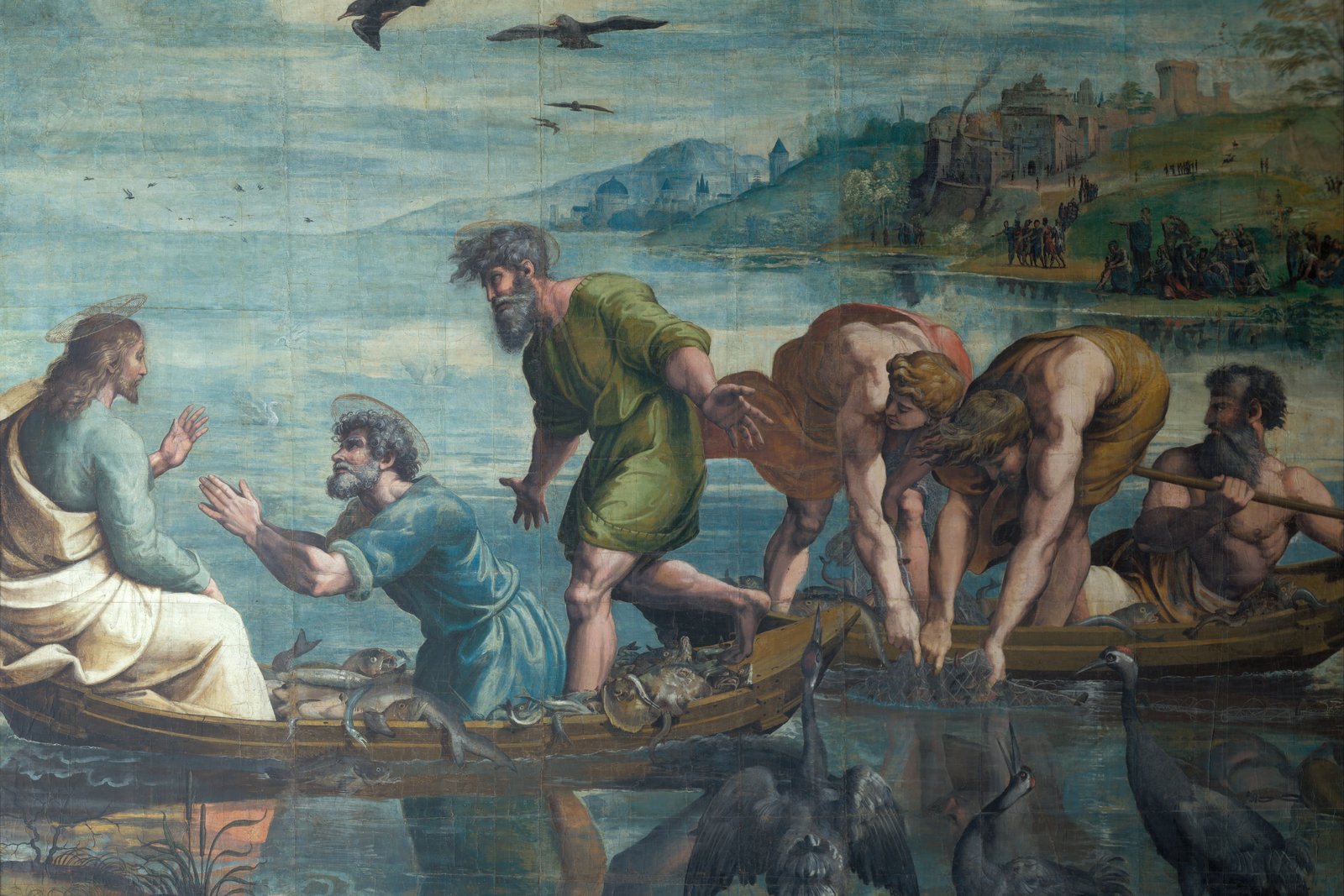
Raphael, "The Miraculous Draught of Fishes," 1515-16, Victoria and Albert Museum, London. Public domain.
"We have worked hard all night and have caught nothing"
Once he finishes teaching, Jesus turns the conversation from preaching to fishing, and gives Simon an order that runs directly against his professional judgment: "Put out into deep water and lower your nets for a catch" (Luke 5:4). Simon's reply carries the weariness of a man who has already put in a full night's failed labor: "Master, we have worked hard all night and have caught nothing" (Luke 5:5). Night fishing was the normal, more productive practice on the Sea of Galilee at the time — daylight fishing in deep water, with fish able to see the nets, was widely understood to be far less effective. Simon knows this better than anyone in the boat. And yet: "at your command I will lower the nets" (Luke 5:5) — reluctant compliance, not enthusiasm, but compliance all the same.
Nets tearing, boats sinking
What happens next overwhelms every expectation Simon brought into the moment: "When they had done this, they caught a great number of fish and their nets were tearing" (Luke 5:6). This isn't a modest, encouraging catch — it's so large that Simon's own crew can't manage it alone. "They signaled to their partners in the other boat to come to help them. They came and filled both boats so that they were in danger of sinking" (Luke 5:7). Two working fishing boats, crewed by experienced men, loaded past the point of safety by a catch that came from water they'd already fished all night without success.
"Depart from me, Lord, for I am a sinful man"
Simon's reaction isn't joy at the size of the haul — it's something closer to fear. "When Simon Peter saw this, he fell at the knees of Jesus and said, 'Depart from me, Lord, for I am a sinful man'" (Luke 5:8), and Luke explains why: "astonishment at the catch of fish they had made seized him and all those with him" (Luke 5:9). It's a strange, very human response — the natural instinct when confronted with something that reveals itself as more than ordinary is not always gratitude, but a kind of unworthiness. Simon's request that Jesus leave him doesn't come from rejecting what just happened; it comes from suddenly understanding, in a visceral way, exactly who was sitting in his boat.
From fisherman to "fishers of men"
Jesus's answer reframes the whole moment: "Do not be afraid; from now on you will be catching men" (Luke 5:10). It's a call built directly out of Simon's own trade — the skill of reading water, patience, and knowing how to bring in a catch repurposed as a metaphor for what Simon's life is about to become. Luke names James and John, "the sons of Zebedee, who were partners of Simon," as present for this too (Luke 5:10), meaning the miracle and the calling reach more than one future apostle at once. The response from all of them is immediate and total: "When they brought their boats to the shore, they left everything and followed him" (Luke 5:11) — abandoning, in that moment, the largest catch of their working lives, still sitting in the boats on the beach.
Not the only miraculous catch in the Gospels
This isn't the sole appearance of a miraculous catch of fish in the New Testament — John's Gospel records a strikingly similar event after the resurrection, when the risen Jesus appears on the shore and tells a group of discouraged, empty-handed disciples to cast their net on the other side of the boat, resulting in a catch of exactly 153 large fish that the net still somehow doesn't tear (John 21:1-11). Scholars have long debated whether Luke and John describe the same underlying event placed at different points in the story or two distinct miracles that echo each other deliberately — either way, the pairing bookends Peter's apostleship with the same image: nets that shouldn't be full, filled anyway, at Jesus's word. For a fuller picture of how Peter's story develops from this point forward, see our guide to the life of Saint Peter, from fisherman to pope.
Raphael's cartoon, and its long afterlife
The image illustrating this article is one of Raphael's most famous compositions — not a painting on canvas originally, but a large-scale cartoon (a full-size preparatory design) created in 1515-16 for a set of tapestries commissioned by Pope Leo X to hang in the Sistine Chapel. Raphael crowds both boats with strain and motion: Peter kneeling in the foreground even as the catch is still being hauled aboard, other figures leaning hard against the weight of the nets, herons standing unbothered at the water's edge. The cartoons themselves — among the few Raphael originals to survive largely intact — have been held by the British Royal Collection and displayed at the Victoria and Albert Museum for centuries, making this one of the most widely reproduced depictions of any Gospel miracle in Western art.
Obedience before understanding
What holds this story together, more than the size of the miracle itself, is the order in which things happen: Simon obeys before he has any reason to expect success, and only afterward does the significance of what he's just witnessed become clear to him. It's a pattern that recurs across the calling of several apostles — action and trust preceding full comprehension, rather than following it. Read alongside stories like the paralytic lowered through a roof or the centurion's plea for his servant, it's part of a broader thread running through the Gospels: faith, in these stories, tends to look less like certainty and more like willingness to act on someone else's word before your own experience has caught up.
Trivia
Where did the miraculous catch of fish take place?
Why was Simon reluctant to lower his nets again?
How large was the catch of fish?
How did Peter react to the size of the catch?
What did Jesus tell Peter after the catch?
Related Reading