The Last Supper — Institution of the Eucharist

A Passover meal reframed
Luke's Gospel identifies the Last Supper explicitly as a Passover meal, the annual commemoration of Israel's deliverance from slavery in Egypt. At that meal, Jesus set the ancient feast in an entirely new context: "Then he took the bread, said the blessing, broke it, and gave it to them, saying, 'This is my body, which will be given for you; do this in memory of me.' And likewise the cup after they had eaten, saying, 'This cup is the new covenant in my blood, which will be shed for you'" (Luke 22:19-20, NABRE). The Passover's deliverance finds a new meaning here, sealed not in the blood of a sacrificial lamb but in Jesus's own.
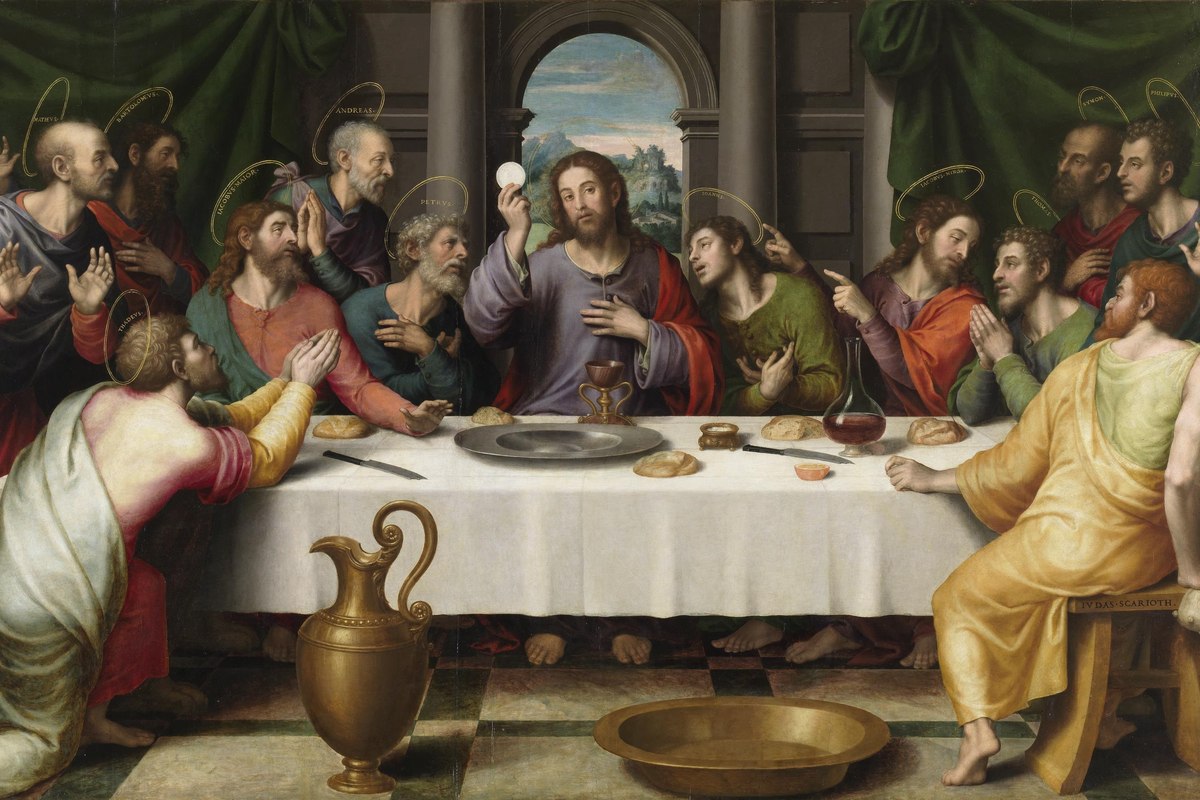
Traditional depiction of the Last Supper, public domain.
The Passover meal itself was already thick with symbolism long before Jesus reinterpreted it. Every element on the table — unleavened bread, bitter herbs, a roasted lamb — recalled a specific detail of Israel's escape from Egypt, and the meal followed a fixed liturgical order, with set moments for blessing, questions, and explanation. Jesus wasn't improvising a new ritual out of nothing; he was taking hold of a ceremony every person at that table had grown up performing, at that exact point in its familiar structure, and redirecting its central meaning toward himself. For anyone raised on that meal, the change in wording would have landed with the full weight of everything Passover already meant.
A tradition Paul says he received directly
The earliest written account of this moment doesn't come from the Gospels at all — it comes from Paul's letter to the Corinthians, written years before any Gospel was composed. Paul is explicit about where he got it: "For I received from the Lord what I also delivered to you, that the Lord Jesus on the night when he was betrayed took bread, and when he had given thanks, he broke it, and said, 'This is my body which is for you. Do this in remembrance of me.' In the same way also the cup, after supper, saying, 'This cup is the new covenant in my blood. Do this, as often as you drink it, in remembrance of me'" (1 Corinthians 11:23-25, RSV-CE).
Paul's letter is generally dated to the early 50s AD, likely two decades or so before the earliest written Gospel — meaning this account predates any of the four Gospel narratives of the same event by a wide margin. That timing matters for how the tradition is understood: rather than a story that developed gradually over generations, the core words of institution appear to have been fixed, and treated as something received rather than composed, within a couple of decades of the event itself. Paul goes on to warn the Corinthians severely about receiving the bread and cup "in an unworthy manner" (1 Corinthians 11:27, RSV-CE), treating the meal as something carrying real weight, not merely a symbolic gesture of remembrance among friends.
A command meant to be repeated
"Do this in remembrance of me" isn't phrased as a single instruction for that one evening. The underlying Greek carries the sense of an ongoing, repeated act — something the community was meant to keep doing, again and again, specifically so it would remain mindful of Jesus and what his death meant. Paul makes that continuing purpose explicit: "For as often as you eat this bread and drink the cup, you proclaim the Lord's death until he comes" (1 Corinthians 11:26, RSV-CE).
A new covenant sealed like the old one
The invocation of covenant language is deliberate. Israel's old covenant, at Sinai, had been sealed with the blood of sacrificed animals. By describing the cup as "the new covenant in my blood," Jesus draws a direct parallel — announcing a covenant that both fulfills and supersedes the old one, sealed not with an animal's blood but with his own, at a meal that had, for centuries, already been about deliverance.
The meal that precedes the agony
The Last Supper doesn't end at the table. John's Gospel records Jesus washing his disciples' feet before the meal concludes, and immediately afterward, all four Gospels have Jesus and the remaining eleven leaving for the Mount of Olives, where the agony in the garden and his arrest follow within hours. The proximity is worth sitting with: the same night Jesus gave his body and blood to his closest followers under the form of bread and wine, he was betrayed by one of them, abandoned by the rest, and arrested. The institution of the Eucharist and the beginning of the Passion are, in the Gospel accounts, not separate episodes but a single unbroken night.
A practice the Church has kept ever since
What began at that table has been repeated by Christians at every Mass since, according to Catholic teaching, with the same words at its center. The Catechism of the Catholic Church teaches that the bread and wine truly become the body and blood of Christ at the moment of consecration — a doctrine known as transubstantiation, formally articulated by the Fourth Lateran Council in 1215 and reaffirmed at the Council of Trent, though rooted in a belief the Church holds to trace back to this very meal. It's why the Eucharist holds the place it does in Catholic worship: not a symbolic reenactment staged from memory, but the same gift, the Church teaches, given at the same table, extended forward to every generation that gathers at the altar since.
Trivia
What did Jesus say when he instituted the Eucharist?
How does Paul's account in 1 Corinthians describe the same moment?
What meal was the Last Supper, and why does that matter?
What does 'do this in remembrance of me' mean?
Related Reading