Zacchaeus in the Tree: A Short Man's Big Change of Heart

A man nobody would let through
Luke's Gospel introduces Zacchaeus with three details, stacked deliberately: he was a chief tax collector, he was wealthy, and he was short (Luke 19:2-3). The first two details are connected — chief tax collectors in Roman-occupied Judea supervised other tax collectors and often profited by charging more than what was owed, which made them wealthy and, almost universally, despised by their own communities as collaborators and extortionists. The third detail, his height, is what actually drives the scene: when Jesus passed through Jericho surrounded by a crowd, Zacchaeus "could not see him because of the crowd" (Luke 19:3), and nothing suggests the crowd was in any hurry to help a man like him get a better view.
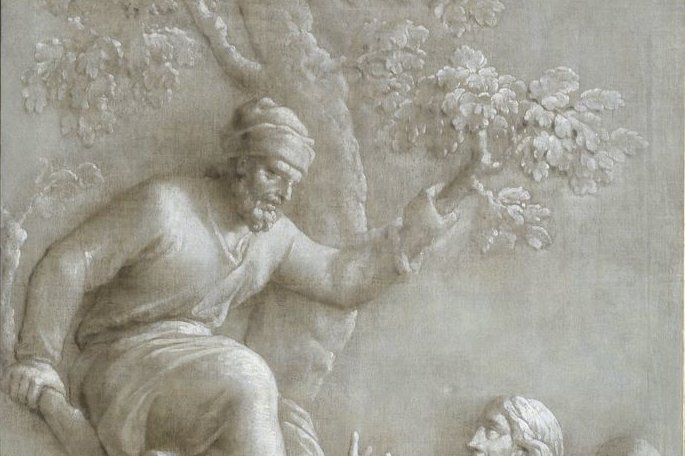
James Tissot, Zacchaeus in the Sycamore Awaiting the Passage of Jesus (c. 1886-94, Brooklyn Museum) - Wikimedia Commons, public domain
So Zacchaeus does something undignified for a wealthy adult man in his social position: he runs ahead of the crowd and climbs a sycamore tree, positioning himself where Jesus was expected to pass (Luke 19:4). It's a small, almost comic detail — a rich man perched in a tree like a child — but it signals something important about him. Whatever his profession had made of his reputation, his desire to see Jesus was strong enough to override his dignity.
The sycamore itself is worth pausing on. The tree Luke names, a sycamore-fig common in the region, was known for wide, low branches that made it relatively easy to climb even in the long robes typical of the period — a practical detail that suggests Luke, or whoever passed the story down to him, had genuine local knowledge of the setting rather than simply inventing a convenient prop. Jericho sat along a well-traveled route, and a man determined enough to scout ahead of a moving crowd for exactly the right vantage point shows a level of planning that goes beyond a passing whim.
"I must stay at your house"
Jesus looks up and does something Zacchaeus surely wasn't expecting: he calls him by name, without any introduction recorded in the text, and invites himself over. "Zacchaeus, come down quickly, for today I must stay at your house" (Luke 19:5). Zacchaeus, Luke says, "came down quickly and received him with joy" (Luke 19:6) — the speed and the joy both mattered, a stark contrast to how the watching crowd receives the news.
That crowd's reaction is immediate and unsurprising given the social context: "He has gone to stay at the house of a sinner" (Luke 19:7). It's not an unreasonable objection by the standards of the day — tax collectors were categorized alongside sinners and outcasts throughout the Gospels, and a respected rabbi choosing to lodge with one would have looked, to onlookers, like an endorsement of his conduct.
A response bigger than what was asked
What happens inside Zacchaeus's house isn't narrated directly — Luke cuts straight to Zacchaeus standing up, apparently before the assembled crowd, and making an unprompted declaration: "Behold, half of my possessions, Lord, I shall give to the poor, and if I have extorted anything from anyone I shall repay it four times over" (Luke 19:8). Nobody demanded this of him. Jesus hadn't laid out terms or conditions for the visit. The fourfold restitution he offers echoes a penalty found in Mosaic law for certain categories of theft (Exodus 22:1) — Zacchaeus is holding himself to a standard well beyond simple correction, an act of genuine, voluntary conversion rather than damage control.
"Salvation has come to this house"
Jesus's response reframes the whole episode. "Today salvation has come to this house because this man too is a descendant of Abraham. For the Son of Man has come to seek and to save what was lost" (Luke 19:9-10). The phrase "this man too" matters — it's a direct answer to the crowd's grumbling, restoring Zacchaeus's status as a full member of the people of Israel, not an outsider Jesus has scandalously associated with. And the closing line — "to seek and to save what was lost" — functions almost as a mission statement for Luke's entire Gospel, which repeatedly centers stories of outcasts, sinners, and the socially despised finding welcome from Jesus.
Why the story still lands
Zacchaeus's account is often remembered, especially by children, mainly for the tree — but the tree is only the setup. What Luke is actually telling is a compact story of encounter and conversion: a man defined publicly by greed and complicity in an unjust system meets Jesus, is seen and named before he says a word, and responds not with a private change of heart kept quiet, but with a public, costly, concrete act of restitution. It's held up in Catholic tradition less as a story about Jesus loving the marginalized in the abstract, and more as a portrait of what real repentance looks like when it's given room to happen — not vague remorse, but action that costs something.
Luke places this episode immediately before Jesus's final approach to Jerusalem, right after the healing of a blind beggar also outside Jericho and just before the parable of the ten minas. That placement isn't accidental. Together the surrounding stories build toward the same theme Luke returns to again and again across his Gospel: sight given to those who can't see, welcome extended to those everyone else has written off, and the persistent claim that Jesus came looking specifically for people the rest of society had already decided weren't worth the trouble. Readers interested in how Luke handles similar reversals elsewhere may also want to look at this blog's article on the parable of the Prodigal Son, another story unique to Luke's Gospel built around the theme of the lost being found.
There's also something quietly instructive in what Jesus doesn't do. He doesn't demand an accounting of Zacchaeus's past dealings before agreeing to eat with him, doesn't require proof of changed behavior first, and doesn't wait for the crowd's approval. The invitation comes first, unconditionally; the transformation follows from it. That order — welcome preceding worthiness — is part of why this short episode has remained one of the most frequently cited conversion stories in the entire New Testament.
Trivia
Why did Zacchaeus climb a tree to see Jesus?
What did Jesus say when he saw Zacchaeus in the tree?
How did the crowd react to Jesus going to Zacchaeus's house?
What did Zacchaeus promise Jesus?
What did Jesus say about Zacchaeus's salvation?
You May Also Like
Related Reading