The Woman Caught in Adultery — John 8 Explained

A trap set in the temple courtyard
John places this scene early in the morning, right after Jesus has spent the night on the Mount of Olives. He returns to the temple area, and "all the people started coming to him, and he sat down and taught them" (John 8:2, NABRE) — an ordinary morning of teaching, interrupted the moment the scribes and Pharisees arrive with their prisoner. They "brought a woman who had been caught in adultery and made her stand in the middle" (John 8:3, NABRE). The staging matters: she's placed at the center of a circle, on display, with no one at her side.
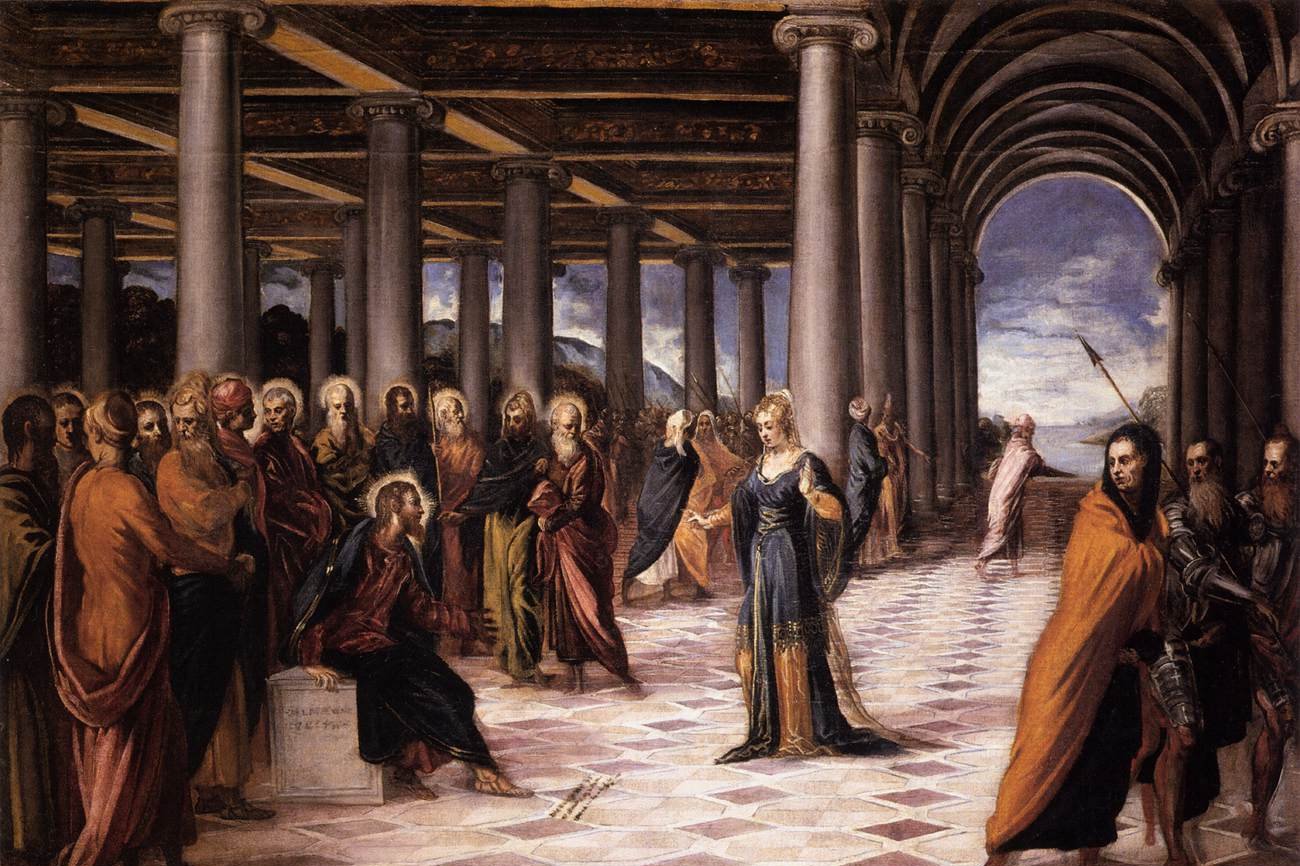
Jacopo Tintoretto, Christ and the Woman Taken in Adultery, c. 1546-1548 — public domain.
Their opening statement is designed to sound like simple legal fact-finding: "Teacher, this woman was caught in the very act of committing adultery. Now in the law, Moses commanded us to stone such women. So what do you say?" (John 8:4-5, NABRE). John doesn't leave any ambiguity about their real motive. "They said this to test him, so that they could have some charge to bring against him" (John 8:6, NABRE). If Jesus said to release her, he could be accused of overturning the Law of Moses. If he said to stone her, he would be undermining his own reputation for mercy toward sinners, and possibly running afoul of Roman authorities, who alone held the legal right to carry out executions in occupied Judea. Either answer was supposed to trap him.
An unanswered question, and a missing man
One detail in the accusation goes unremarked by the crowd but hasn't gone unnoticed by readers ever since: Mosaic law, in passages like Leviticus 20 and Deuteronomy 22, called for both people involved in adultery to face judgment, not just the woman. If she was truly caught "in the very act," the man she was with should have been standing beside her. He isn't mentioned again in the passage at all. Whatever exactly happened in the moments before she was dragged to the temple, the scene the Pharisees have staged is already selective — a legal case built to look airtight while quietly leaving out half the people the law would actually apply to.
Silence, and a single sentence
Jesus's first response to the accusation isn't a word — "Jesus bent down and began to write on the ground with his finger" (John 8:6, NABRE). John never explains what he wrote, and readers have guessed for two thousand years without any way to confirm it — a common guess is that he listed the specific sins of the men standing over him, but that's tradition and speculation, not something the text itself says, and it deserves to be labeled as such rather than repeated as fact.
When the crowd keeps pressing him for an answer, Jesus finally straightens up and delivers the line the whole passage turns on: "Let the one among you who is without sin be the first to throw a stone at her" (John 8:7, NABRE). He doesn't dispute that she broke the law. He doesn't say the law is wrong. He reframes the entire scene by turning the question back on the men holding the stones — not "is she guilty," but "who among you is qualified to be her judge and executioner." Then he "bent down and wrote on the ground" a second time (John 8:8, NABRE), as if the sentence had already done its work and needed no follow-up.
The crowd disperses, oldest first
What happens next is one of the quieter, more remarkable details in the Gospels: "in response, they went away one by one, beginning with the elders" (John 8:9, NABRE). No one argues back. No one claims to be without sin and throws a stone. The men who arrived as a unified prosecution leave individually, and the text's specific note that the elders go first is worth sitting with — the oldest men in the group, presumably with the longest lives and the most accumulated occasions for sin behind them, are the first to recognize they can't meet the standard Jesus just set.
By the end, "he was left alone with the woman before him" (John 8:9, NABRE). The trap the Pharisees built has collapsed entirely, but John doesn't let the scene end on their failure — it ends on hers, and on what Jesus chooses to do with her once no one else is left to judge her.
"Neither do I condemn you"
Jesus straightens up one more time and asks her directly, "Woman, where are they? Has no one condemned you?" She answers plainly: "No one, sir" (John 8:10-11, NABRE). His response is the line the whole episode has been building toward: "Neither do I condemn you. Go, [and] from now on do not sin any more" (John 8:11, NABRE).
It's worth reading that sentence as a single unit rather than two separate halves. Jesus doesn't minimize what she did — he explicitly tells her to stop sinning, which only makes sense if he takes the sin seriously. But he refuses to let condemnation be the final word over her, even though, as the one man in that courtyard who genuinely could have claimed to be without sin, he would have been the only person there with any real standing to throw the first stone. He has both the authority to condemn her and the authority to forgive her, and Catholic tradition has long read this scene as one of the clearest Gospel illustrations of mercy that doesn't cancel out justice, but holds both together — grace extended without pretending the sin never happened.
A famously debated passage — and why that's not a problem
It's honest to note something scholars have long flagged about this story: in the oldest surviving Greek manuscripts of John's Gospel, this passage is missing, and in some later manuscripts it appears elsewhere — sometimes after John 7:36, sometimes at the end of the Gospel of Luke. This is why translations like the NABRE print the passage in brackets, a scholarly convention marking uncertain manuscript placement rather than any judgment about historical authenticity. The Catholic Church has long received this account as authoritative Scripture regardless of its manuscript history, and its portrait of Jesus — merciful without being permissive, willing to stop violence with a single unanswerable sentence — fits seamlessly with how he's shown treating people throughout the rest of the Gospels.
Why the story still lands
Part of what makes this passage endure, retold in sermons and Sunday school lessons for two thousand years, is how completely it avoids taking the easy route. Jesus doesn't rewrite the law, doesn't excuse the woman's actions, and doesn't publicly shame the men who tried to use her as a weapon against him. He simply exposes, with one sentence, the gap between the standard the crowd wanted to enforce and the standard they themselves could actually meet — and then extends to the one person left standing in the circle exactly the kind of mercy none of her accusers were prepared to offer each other.
Trivia
Where in the Bible is the story of the woman caught in adultery found?
What does Jesus actually say to the accusers?
Where was the man she was caught with?
What does Jesus write on the ground?
What does Jesus say to the woman at the end?
Related Reading