The Woman at the Well: A Conversation That Changed a Town

A well with history already attached
John sets the scene with specific geography: Jesus, traveling from Judea back to Galilee, passes through Samaria and stops at a town called Sychar, "near the plot of land that Jacob had given to his son Joseph. Jacob's well was there" (John 4:5-6). The location isn't incidental — this is patriarchal ground, tied to Israel's own ancestral story, even though by Jesus's time Jews and Samaritans had been divided for centuries over religious and ethnic differences going back to the period after the Assyrian conquest of the northern kingdom.
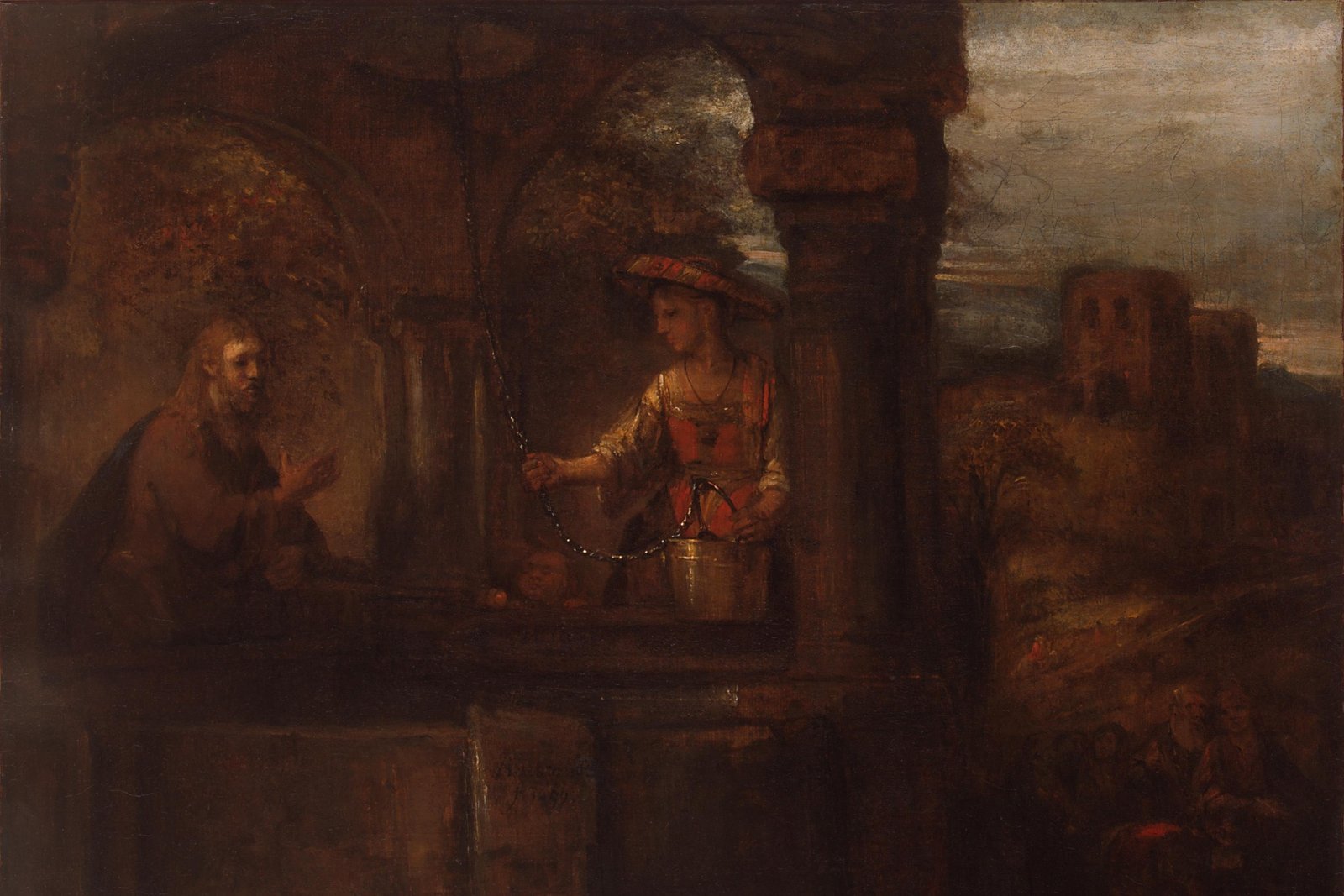
Rembrandt van Rijn, Christ and the Samaritan Woman, 1659. Public domain, The Hermitage, Wikimedia Commons.
Jesus arrives tired from the journey and sits by the well "about noon" (John 4:6) — the hottest part of the day, and an unusual hour for anyone to be drawing water, since most people came in the cooler morning or evening. That a woman shows up alone at noon is often read as a quiet signal that she may have been avoiding the crowd, and the conversation that follows makes clear why.
"Give me a drink"
Jesus opens with a simple request: "Give me a drink." The woman's surprised response spells out exactly what social boundary he's crossing: "How can you, a Jew, ask me, a Samaritan woman, for a drink?" John adds his own explanatory aside for readers unfamiliar with the tension: "Jews use nothing in common with Samaritans" (John 4:9). It's a small opening line carrying real weight — a Jewish teacher speaking directly and respectfully to a Samaritan woman, alone, at a well, defied at least two social conventions of the day at once.
Jesus redirects the conversation almost immediately, offering something more than the woman expected: "If you knew the gift of God and who is saying to you, 'Give me a drink,' you would have asked him and he would have given you living water" (John 4:10). She takes this literally at first — he has no bucket, the well is deep, how could he possibly give her better water than the well Jacob himself had used? Jesus clarifies: "whoever drinks the water I shall give will never thirst; the water I shall give will become in him a spring of water welling up to eternal life" (John 4:13-14).
"You are right in saying, 'I do not have a husband'"
The woman, still thinking practically, asks for this water so she won't have to keep returning to draw more. Jesus's next move shifts the conversation entirely: "Go call your husband and come back." She answers simply that she has no husband — technically true, and Jesus tells her so, while revealing he already knows far more than she's said: "You are right in saying, 'I do not have a husband.' For you have had five husbands, and the one you have now is not your husband. What you have said is true" (John 4:16-18).
John doesn't explain the circumstances behind her five marriages, and the text notably doesn't moralize or condemn her for them — ancient marriage and widowhood carried complications (death, divorce, levirate obligations) that the passage simply leaves unaddressed. What matters for the story is her reaction: she recognizes, from this knowledge of her private life, that she's talking to no ordinary traveler. "Sir, I can see that you are a prophet" (John 4:19).
Worship beyond a single mountain
She raises, almost as a deflection, one of the standing disputes between Jews and Samaritans: whether the proper place of worship was Mount Gerizim, where her ancestors worshiped, or Jerusalem, as Jewish tradition held. Jesus doesn't simply pick a side. He tells her the question itself is about to become obsolete: "the hour is coming, and is now here, when true worshipers will worship the Father in Spirit and truth; and indeed the Father seeks such people to worship him. God is Spirit, and those who worship him must worship in Spirit and truth" (John 4:23-24).
When she mentions that she knows the Messiah is coming, Jesus responds with one of the most direct self-identifications in any Gospel: "I am he, the one who is speaking with you" (John 4:26).
She left her water jar behind
The disciples return at that exact moment, John notes, "amazed that he was talking with a woman" — though none of them dared ask why (John 4:27). The woman, meanwhile, does something telling: she leaves her water jar at the well — the very thing she'd come for — and runs back into town. "Come see a man who told me everything I have done. Could he possibly be the Messiah?" (John 4:28-29). Her testimony, offered as a question rather than a proclamation, was enough to draw the townspeople out to see Jesus for themselves, and John records that many of them came to believe both because of her word and because of what they heard directly from Jesus during the two days he stayed among them.
Catholic tradition has long treated this account as one of the clearest Gospel portraits of both evangelization and the universality of the Gospel's reach — a woman living on the margins of respectability, from a people considered religious outsiders, becomes the first person in John's Gospel to carry Jesus's message to an entire town — a pattern of faith kindled through personal encounter with Jesus that the same Gospel repeats later in the raising of Lazarus. Eastern Christian tradition names her Saint Photina and venerates her as a martyr and evangelist, though this identification developed through later tradition rather than being stated in the biblical text itself.
Trivia
Why was it unusual for Jesus to speak to the Samaritan woman?
What did Jesus mean by "living water"?
Why does Jesus bring up the woman's husbands?
What does Jesus mean by worshiping "in Spirit and truth"?
What did the woman do after talking with Jesus?
You May Also Like
Related Reading