The Rose in Marian Art

A flower with its own title
Among the many flowers that appear in Christian sacred art, the rose holds a distinction most others don't: it isn't just a symbol attached to Mary, it's one of her actual titles, recited by name in one of the Church's oldest and most widely prayed litanies. That formal status is part of why roses appear so constantly in Marian painting — not as generic garden decoration, but as a direct visual translation of language the Church already used to address her.
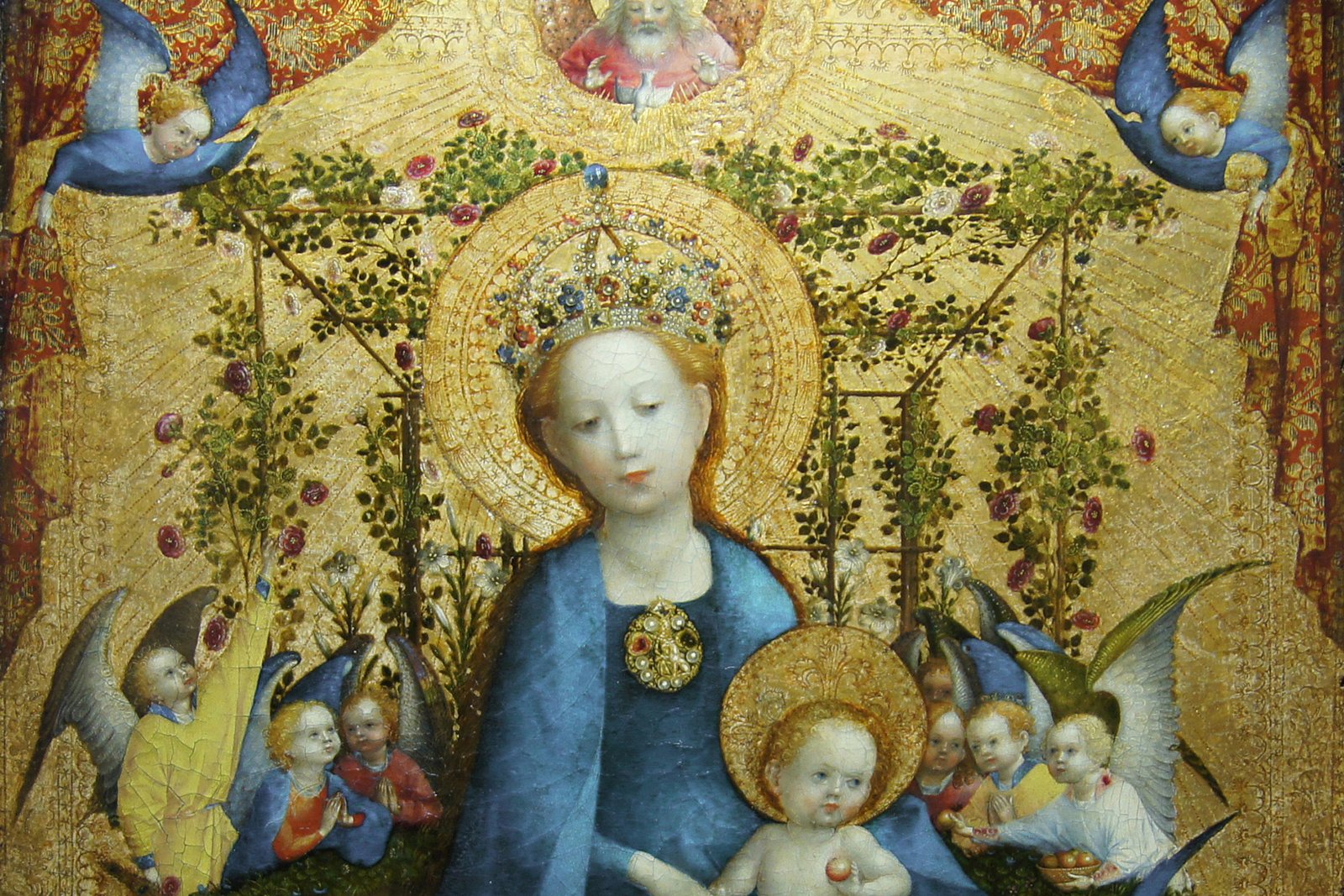
Stefan Lochner, "Madonna of the Rose Bower," c. 1440-1442, Wallraf-Richartz Museum, Cologne — public domain.
Mystical Rose: a title from the litany
The Litany of Loreto, a traditional sequence of invocations to Mary that has been prayed in its core form since at least the sixteenth century, includes the title Rosa Mystica — "Mystical Rose." Like the litany's other floral and botanical titles, it draws on the rose's long-established cultural associations with beauty, exceptional value, and perfected love, applying those qualities to Mary as the most exalted of God's creatures short of Christ himself. Painters working in the medieval and early Renaissance periods translated that title directly into image: Stefan Lochner's Madonna of the Rose Bower, shown above, surrounds an enthroned Mary and the Christ Child with a dense trellis of red and white roses, gold-ground and glowing, turning the litany's title into an entire enclosed garden built specifically around her.
The enclosed garden
That rose-covered setting Lochner paints — a small, walled or trellised garden holding Mary and her child apart from the wider world — belongs to a broader medieval tradition called the hortus conclusus, or "enclosed garden," itself drawn from a phrase in the Song of Songs describing a sealed, private garden read allegorically as a figure for Mary's virginity. Roses were the natural flower to fill such a garden, given their established symbolic weight, and painters frequently combined them with lilies — covered in more detail in The Lily in Religious Art — to layer purity and perfected love into a single enclosed setting, Mary seated at its center as though the garden itself existed to frame her.
Roses on a hillside in Mexico
The rose's association with Mary took a dramatically different, and far more historically recent, form in the story of Our Lady of Guadalupe. According to the tradition recorded after the reported 1531 apparitions near Mexico City, Mary instructed the visionary Juan Diego to climb a barren, rocky hilltop in December and gather flowers there as a sign to bring to the local bishop, who had doubted his account of the apparitions. Juan Diego found Castilian roses growing on the hillside — a flower not native to the region and entirely out of season in winter — gathered them in his cloak, and when he let them fall before the bishop, Mary's image was found miraculously imprinted on the fabric beneath. Unlike the more purely symbolic roses of medieval European painting, the Guadalupe roses function as a reported historical sign within the apparition account itself, which is part of why roses remain a recurring visual element in art depicting Our Lady of Guadalupe specifically, distinct from the more general Marian rose symbolism found in earlier European traditions.
A rose for every prayer
Mary's connection to the rose extends into one of Catholicism's most repeated devotional practices: praying the rosary. The word itself comes from the Latin rosarium, meaning "rose garden" or "garland of roses," reflecting a medieval custom in which offering a string of prayers to Mary was imagined as offering her a garland made of roses, each individual prayer standing in for a single flower woven into the whole. That etymology helps explain why rose imagery appears so often on rosary beads, prayer cards, and devotional art connected to the rosary's mysteries — the flower isn't a decorative afterthought but built into the prayer's own name and self-understanding, offered one bead, one rose, at a time.
A garden that outgrew its walls
By the time the rose bower composition reached its fullest development in the fifteenth century, the enclosed garden had become one of the most recognizable settings in Northern European Marian painting, appearing not only in large altarpieces but in smaller devotional panels meant for private prayer at home. Painters varied the density and arrangement of the roses considerably — some crowded every inch of the background with blossoms, as Lochner does, while others scattered a handful of flowers more sparingly around a simpler throne — but the underlying idea held steady across all these variations: Mary set apart in a space defined, quite literally, by roses grown for her alone. That consistency across regions and generations of painters is part of what makes the rose bower motif still recognizable today, even to viewers who've never encountered the Litany of Loreto or the hortus conclusus tradition it grew from.
Two colors, one meaning held together
When artists paint roses around Mary, they rarely restrict themselves to a single color, and red and white roses typically appear together rather than in competition. White carries the more familiar association with purity, echoing the lily's meaning discussed elsewhere in Marian symbolism, while red carries associations with love, and — particularly in later art emphasizing Mary's sorrows — with suffering and sacrifice offered alongside her son's. Painted together, as they are in Lochner's rose bower and countless works that followed it, the two colors let a single garden hold both halves of how Christian tradition has understood her: perfectly pure, and perfectly loving even through sorrow.
Trivia
Why is Mary called the Mystical Rose?
What is the connection between the rose and the rosary?
What is the story of the roses and Our Lady of Guadalupe?
Do red and white roses mean different things in Marian art?
Related Reading