The Ecce Homo Motif in Art

Two words, one Gospel, centuries of paintings
The phrase "Ecce Homo" comes from a single verse in John's Gospel. After Roman soldiers scourge Jesus and dress him in a purple robe and a crown of thorns as a cruel mockery of kingship, Pilate brings him out before the crowd gathered outside the praetorium and says, according to the Vulgate translation long used in the Latin Church, "Ecce homo" — "Behold, the man!" (John 19:5, RSV-CE). The other three Gospels describe Pilate's interrogation of Jesus and the crowd's demand for crucifixion in some detail, but this specific staged presentation, and the phrase itself, belong to John alone.
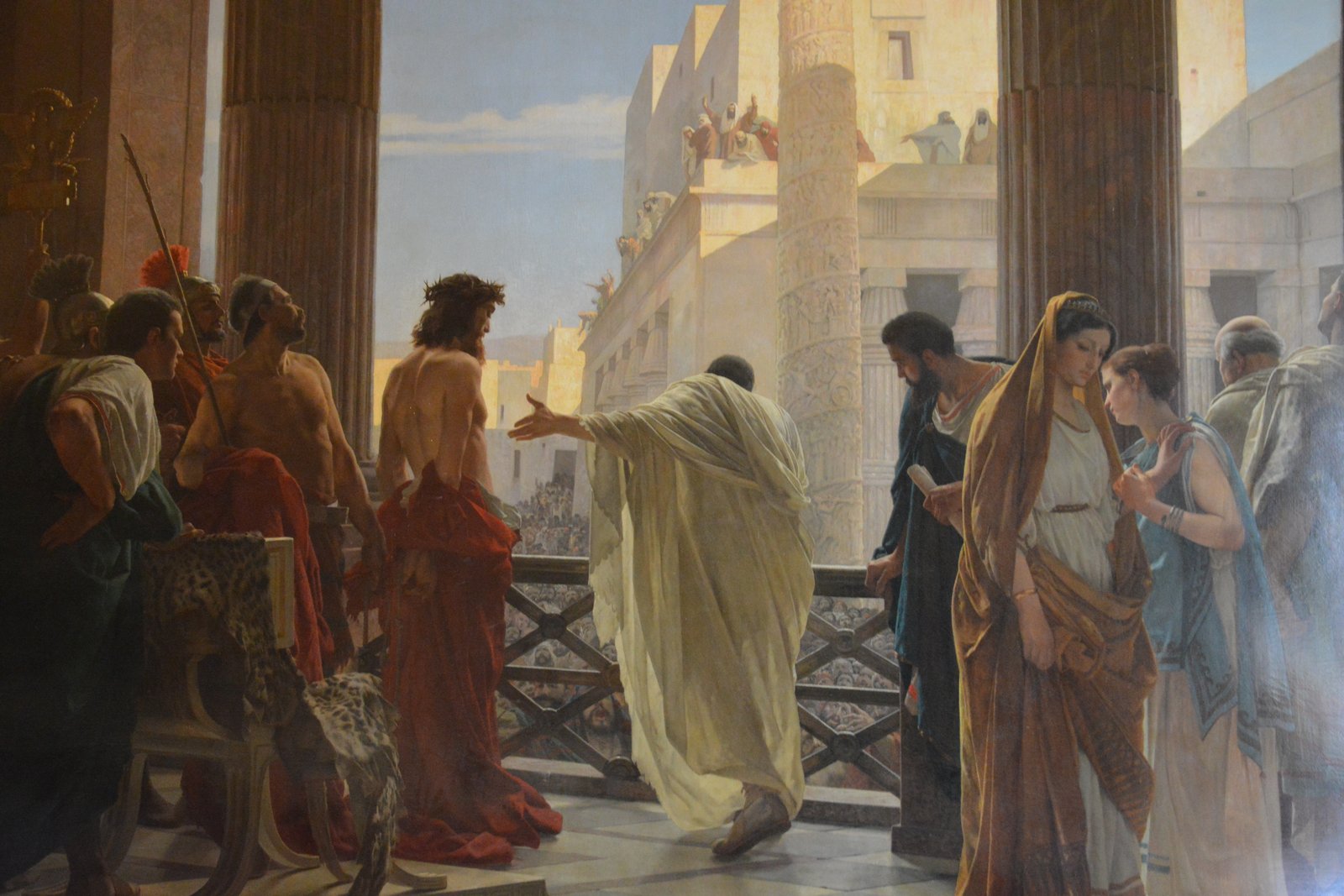
Antonio Ciseri, "Ecce Homo," 1871, Galleria d'Arte Moderna, Palazzo Pitti, Florence — public domain.
That narrow textual foundation didn't limit the scene's appeal to artists — if anything, it seems to have concentrated it. Because John gives painters a single, sharply defined moment — a bound, suffering figure displayed before a hostile crowd by the man who holds the power to save or condemn him — the Ecce Homo became one of the most frequently revisited subjects in the entire history of the Passion in art, distinct in feeling from the Crucifixion itself or the Carrying of the Cross: a moment of judgment and public spectacle rather than physical suffering alone.
Bosch: a crowd that becomes the subject
Hieronymus Bosch's Ecce Homo paintings, produced in the late fifteenth century, treat Pilate and Christ almost as secondary figures within an enormous, jeering crowd rendered with Bosch's characteristic taste for grotesque, individualized faces. The crowd isn't a passive backdrop; it's aggressively present, shouting, gesturing, some figures caricatured to the point of near-monstrousness. Bosch's version emphasizes collective cruelty and mob psychology as much as, or more than, Christ's individual suffering — the viewer is confronted less with a devotional image of Christ and more with an unsettling portrait of humanity at its worst, actively choosing condemnation.
Titian's Venetian grandeur
Titian's Ecce Homo, painted in 1543 for a Venetian patron, takes an almost opposite approach, staging the scene as a large, theatrically composed public spectacle set against grand classical architecture, with Christ, Pilate, and an elaborately dressed crowd arranged across a wide, stage-like space. Some art historians read the painting as carrying a specific contemporary political charge, given ongoing tensions in sixteenth-century Venice between different factions and the presence of what appears to be a portrait of the Ottoman Sultan Suleiman the Magnificent among the onlookers — a detail that has fueled long-running scholarly debate over the painting's precise contemporary meaning, though its central devotional subject remains unmistakable regardless of that debate.
Caravaggio: the scene stripped down
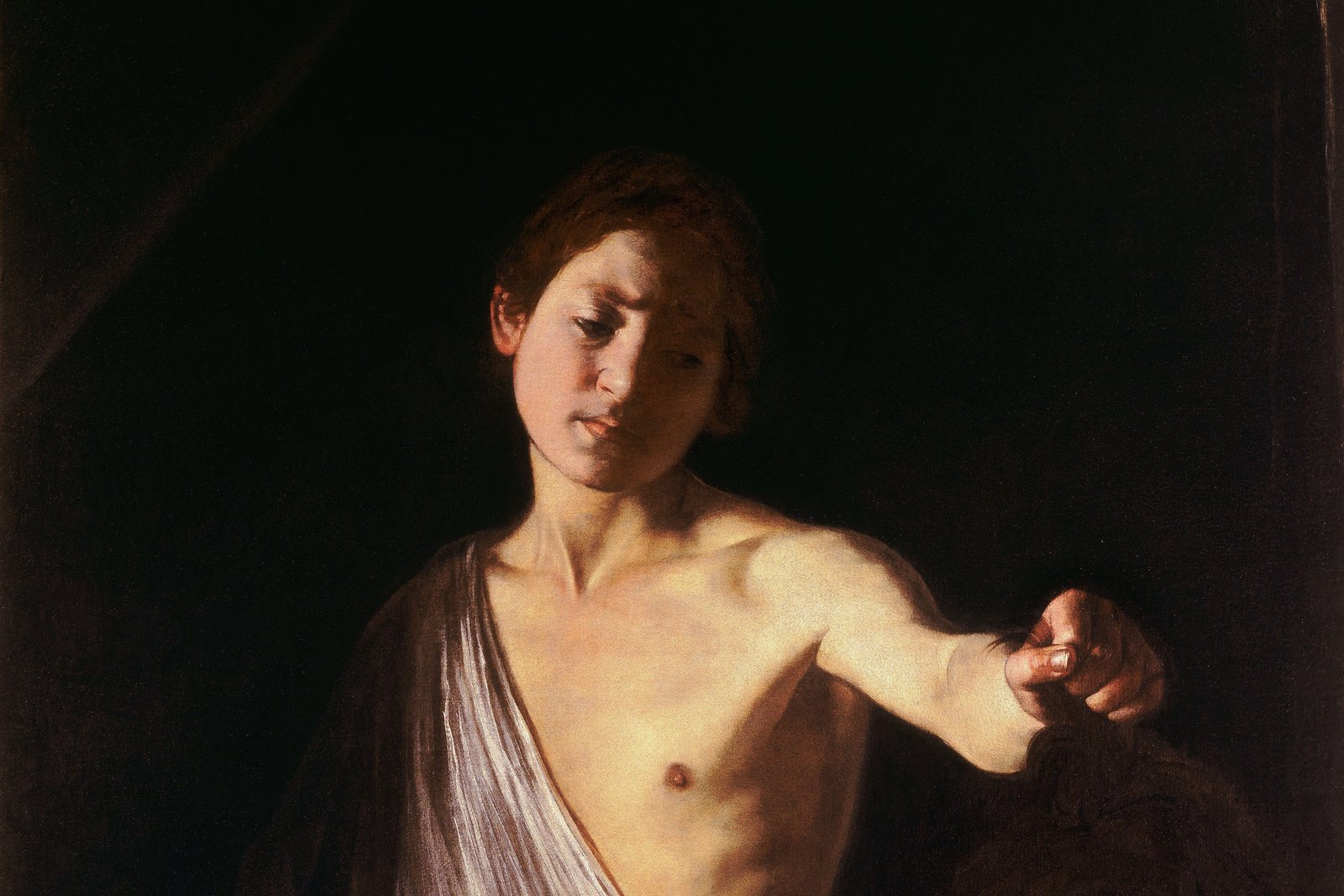
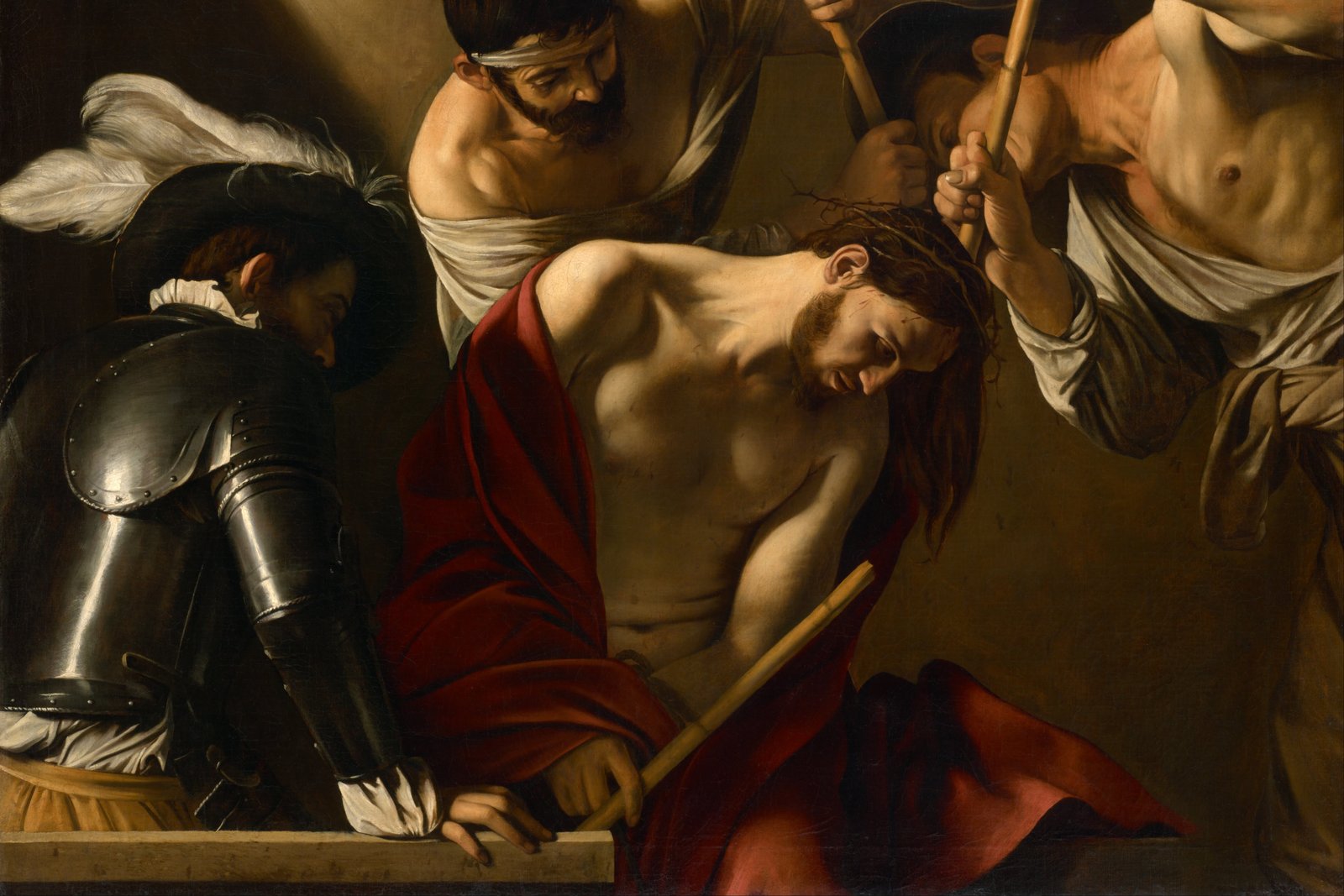
True to the tenebrist style that defines his approach across Baroque religious painting, Caravaggio's 1605 Ecce Homo removes almost the entire crowd, focusing tightly on three figures — Christ, Pilate, and a single soldier — set against Caravaggio's characteristic near-total darkness. The intimacy is deliberate: rather than showing a spectacle happening at a distance, Caravaggio brings the viewer close enough to see Christ's exhaustion and Pilate's ambiguous, unreadable expression at close range, collapsing the public scale of the Gospel scene into something closer to a private, uncomfortable confrontation.
Ciseri: the viewer stands where Pilate stands
Antonio Ciseri's 1871 Ecce Homo, the painting used as this article's hero image, takes a compositional approach that became one of the most widely reproduced versions of the subject in the nineteenth century. Rather than facing Christ directly, Ciseri positions the viewer behind Pilate, looking out over his shoulder toward Christ and the crowd assembled in the courtyard below. Christ's face is turned away, largely hidden from the viewer; instead, the composition emphasizes Pilate's posture — his outstretched arm presenting Christ, his back turned to the viewer, his own face likewise obscured.
This unusual choice effectively places the viewer in Pilate's position, facing the same crowd and implicitly forced to consider the same decision Pilate is making. Rather than offering a purely devotional image of Christ's suffering to contemplate from a comfortable distance, Ciseri's composition draws the viewer into complicity with the scene's central moral crisis — a compositional strategy quite different from the emotionally direct, close-up approach of Caravaggio's version two and a half centuries earlier.
Why one Gospel verse produced so many paintings
Part of the Ecce Homo motif's enduring appeal lies in its dramatic flexibility. Unlike the Crucifixion, which has a fixed, essential visual core — Christ on the cross — the Ecce Homo scene involves at least three distinct parties whose relative emphasis a painter can freely adjust: the suffering, humiliated Christ; the politically compromised, hand-washing Pilate; and the crowd, whose collective judgment ultimately seals Christ's fate. A painter emphasizing the crowd, as Bosch does, produces a very different meditation than one emphasizing Pilate's private ambivalence, as Ciseri does, even though both are working from the identical single verse in John's Gospel.
That flexibility has kept the subject alive across five centuries of dramatically different artistic movements, from Bosch's late-medieval grotesquerie to Ciseri's nineteenth-century academic realism, each generation finding in Pilate's two Latin words a fresh way to ask the same uncomfortable question the scene has always posed: who, exactly, is responsible for what happens next.
Trivia
What does Ecce Homo mean and where does the phrase come from?
Is the Ecce Homo scene described in all four Gospels?
Who are some of the most famous painters of the Ecce Homo scene?
Why do some Ecce Homo paintings show the scene from behind Pilate rather than facing Christ?
What is the theological significance of the Ecce Homo scene?
Related Reading