Raphael's Transfiguration: His Final, Unfinished Masterpiece

The painting that stood over Raphael's coffin
Giorgio Vasari, writing biographies of Renaissance artists a generation later, recorded that the still-unfinished Transfiguration was placed above Raphael's body as he lay in state, and that the sight of it moved everyone who saw the pairing of the newly dead painter beneath his own last, most ambitious work. Whether every detail of Vasari's account is precisely accurate, the broader fact isn't disputed: Raphael was still working on this altarpiece when he died suddenly on Good Friday, 1520, and his workshop, led by his talented assistant Giulio Romano, finished the remaining sections using Raphael's own designs.
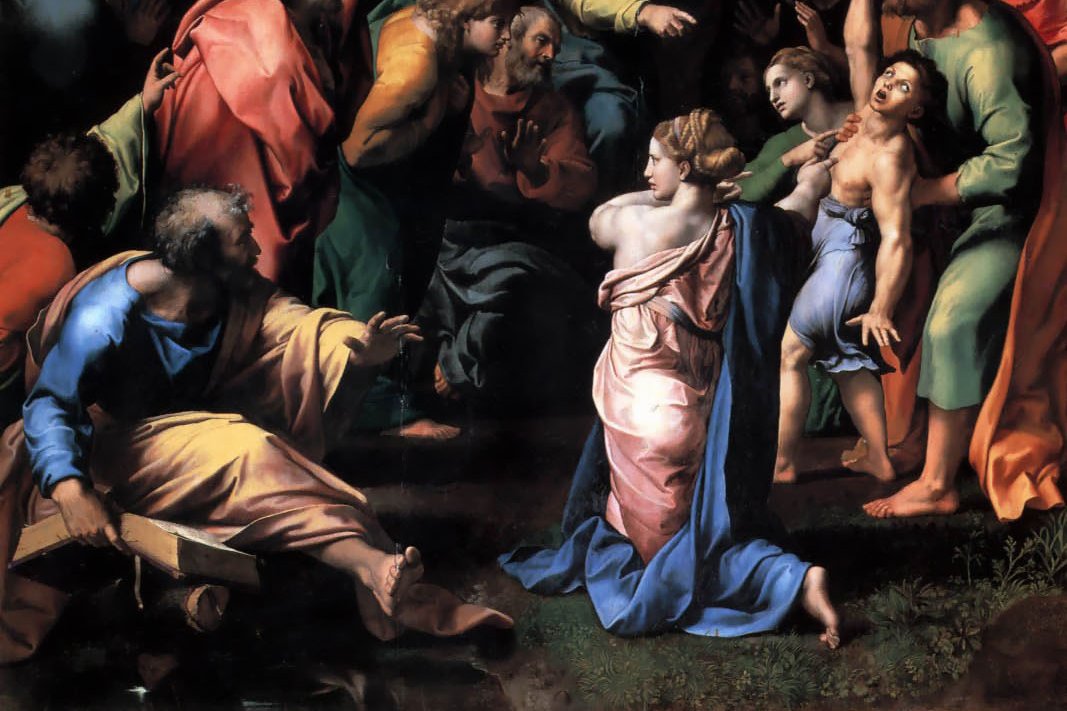
Raphael, "The Transfiguration," 1516-1520, Pinacoteca Vaticana, Vatican City — public domain.
Two scenes, one canvas
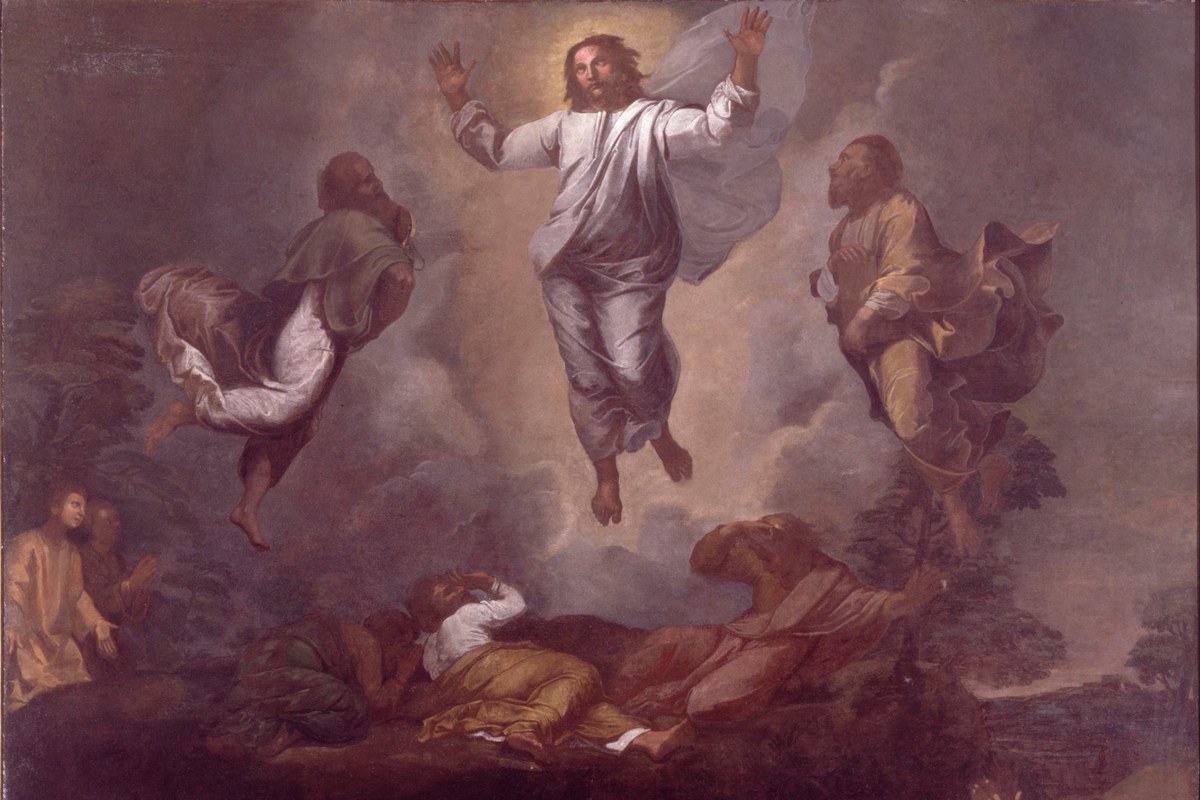
The composition splits into two halves that, at first glance, seem to belong to different paintings entirely. Above, Christ hovers in radiant white light on Mount Tabor, flanked by the prophets Moses and Elijah, while the apostles Peter, James, and John shield their eyes or fall back in awe below him — the moment recorded in the Gospels when Christ's appearance was transfigured before his closest disciples. Below, in a scene the Gospels place immediately afterward, a crowd surrounds a possessed boy whom the remaining apostles, waiting at the base of the mountain, have failed to heal; a woman gestures urgently, figures reach and point, the whole lower half filled with motion, frustration, and unanswered need. Raphael painted the two scenes with different qualities of light — the upper half bathed in an unearthly glow, the lower half lit by ordinary daylight — reinforcing the contrast between divine power made visible and human limitation left exposed.
Why the pairing works theologically
At first the combination can look like two separate stories awkwardly forced together, but the Gospels themselves place these two episodes back to back, and generations of readers and theologians have drawn a connection between them: the same apostles who witness Christ's glory on the mountain are, moments later and a short distance away, unable to perform a healing because, as Christ later tells them, of their little faith. Raphael's single canvas holds that tension visually — glory above, struggle below, separated by nothing but the mountain slope itself — making the painting less a straightforward Transfiguration scene and more a meditation on the gap between divine revelation and human weakness. Readers can find the biblical account of the Transfiguration on Mount Tabor covered in full elsewhere on this site.
Raphael's final years and working method
By 1516, when Cardinal Giulio de' Medici commissioned this altarpiece, Raphael was one of the most sought-after painters in Rome, running a large workshop that handled everything from Vatican fresco cycles to architectural commissions after the death of Bramante. The Transfiguration was originally intended for the Cathedral of Narbonne in France, but it never left Rome; whether by the cardinal's choice or simple circumstance, it stayed in the city and eventually entered the Vatican's own collection. Raphael worked on it during the same years he was overseeing major projects at the Vatican, and its scale and ambition — combining two distinct narrative moments, an unusually large cast of figures, and a dramatic contrast of light — reflect an artist working at the furthest reach of his abilities just before his unexpected death.
A deliberate rival to Michelangelo
Art historians have long noted that Sebastiano del Piombo, working from designs by Michelangelo, was completing his own large altarpiece — The Raising of Lazarus — for the same Narbonne commission at roughly the same time, and that the two works were quietly understood as a competition between Raphael and Michelangelo's circle. Raphael's response was to push his composition toward greater drama and complexity than anything he had attempted before, a departure from the calm, balanced compositions of his earlier Roman period and a sign of how the two rival masters continued to push each other even without working side by side.
The identity of the possessed boy's family
Among the crowd gathered in the lower half of the painting, art historians have long puzzled over exactly who several of the gesturing figures are meant to represent, since the Gospel accounts name only the boy's father, not the surrounding onlookers. Some interpreters read the anguished woman kneeling at the center of the lower group, pointing toward the boy, as the mother, an addition not explicit in the biblical text but consistent with how Renaissance painters often expanded a spare Gospel narrative into a fuller, more emotionally legible crowd scene. That interpretive freedom is part of what makes the lower half feel less like an illustration of a specific verse and more like a general, universal image of human need and confusion confronting divine power that has, for the moment, stepped back out of reach.
Its legacy in the Vatican collection
The Transfiguration eventually settled into the Pinacoteca Vaticana, where it remains one of the most studied paintings in the Vatican Museums' collection, admired equally for its ambitious theology and for what it reveals about workshop practice in the final months of a master's life. Later artists studied its compositional daring for centuries, and its combination of radiant glory and earthly chaos in a single frame remains one of the most striking visual arguments in Renaissance religious art for holding transcendence and human struggle together, rather than apart.
Trivia
Where is Raphael's Transfiguration displayed today?
Was Raphael's Transfiguration actually finished when he died?
Why does Raphael's Transfiguration show two different scenes in one painting?
What Gospel passage does the Transfiguration depict?
Who commissioned Raphael's Transfiguration?
You May Also Like
Related Reading