The Reliquary as an Art Form: Gold, Gems, and the Bones of Saints

A problem every age of the Church had to solve
Every relic, from the earliest bone fragment pulled from a Roman catacomb to the latest theca sealed for a saint canonized this decade, has needed something to sit inside. That practical need — a box, a case, a frame — turned out to be one of the most fertile sources of artistic ambition in the whole history of Christian art. This article isn't about any single relic housed in any single container; several of those are covered elsewhere on this site, including the Shroud of Turin, fragments of the True Cross, the Holy Nails, and the Shrine of the Three Kings at Cologne. This is about the reliquary itself — the genre of object, across roughly fifteen centuries, built specifically to hold things like these.
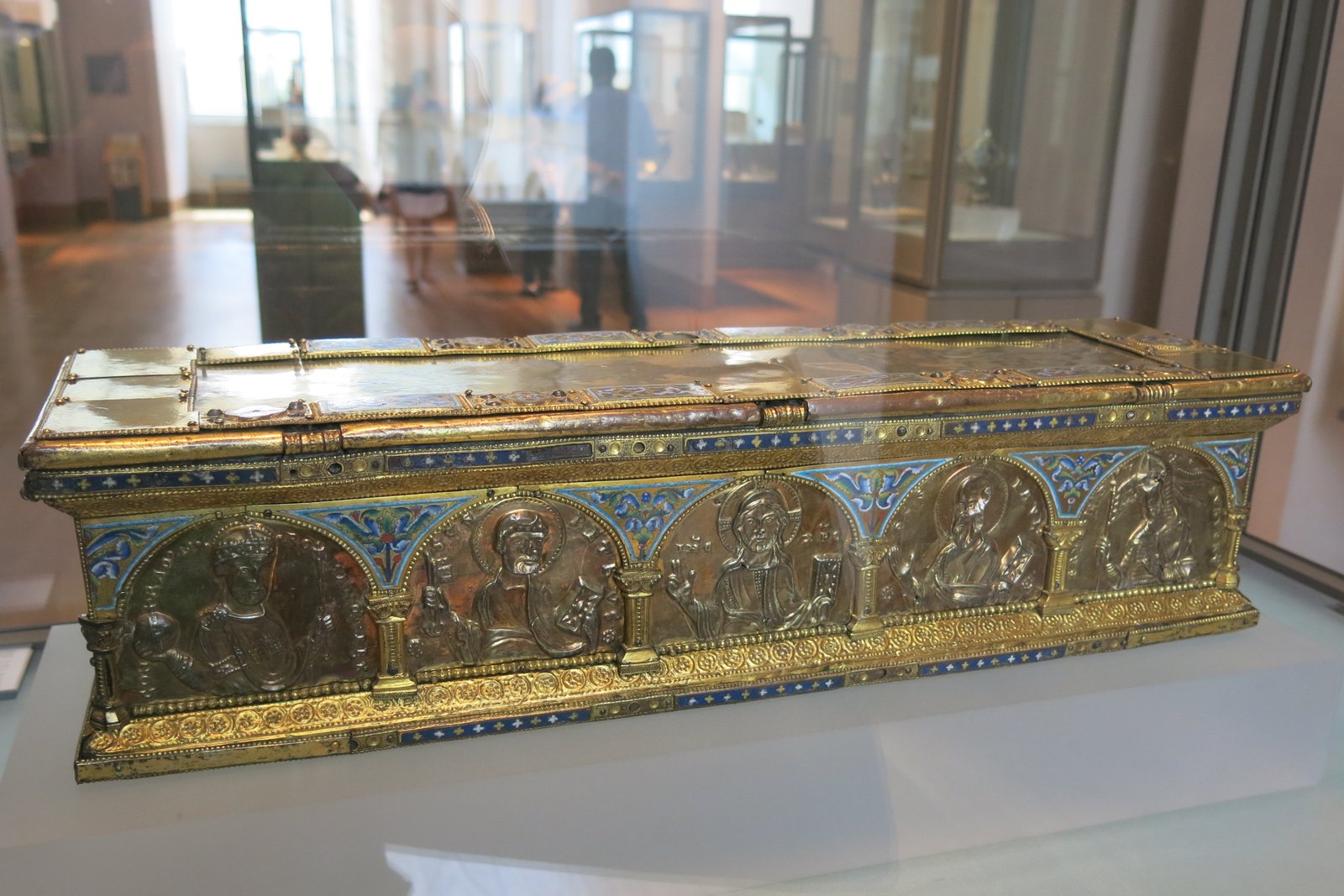
Tangopaso, photograph of the Reliquary of the Arm of Charlemagne, Musée du Louvre (MR 347). Public domain, via Wikimedia Commons.
Why bother building something beautiful around a bone
The theological reasoning here isn't incidental decoration bolted onto relic veneration after the fact — it's close to the center of why the Church ever allowed the practice at all. The Catechism of the Catholic Church places "the veneration of relics" among the recognized expressions of popular piety that "extend the liturgical life of the Church" (CCC 1674), and the broader logic behind venerating any physical object connected to a saint rests on a distinction the Church has insisted on since at least the Second Council of Nicaea in 787: honor given to an image or relic passes through the object to the person it represents, not to the object's own material substance (CCC 2131, discussing the council's ruling in favor of icons). A relic is honored because of the holiness of the person it once belonged to — which means the container built around it was never in competition with the relic for veneration. Its entire purpose was to say, as loudly as gold and enamel and gemstones could say it, that what sat inside mattered enormously.
That's a very different logic from simple status-display, even though reliquaries obviously also served as prestige objects for the bishops, abbeys, and kings who commissioned them. A chest covered in gold leaf, rock crystal, and antique cameos wasn't vanity for its own sake in the medieval mind — it was the most honest material response available to the claim that this box held a piece of someone already believed to be standing in the presence of God.
The earliest shapes: boxes, flasks, and gabled shrines
The Catholic Encyclopedia's 1911 survey of the subject makes clear that reliquaries, in the broad sense of "any box, casket, or shrine destined for the reception of relics," existed almost from the beginning of Christianity, though almost nothing specific can be said about their construction in the very earliest centuries. Early containers borrowed generic names — capsa, theca, pyxis, arca — shared with vessels used for the Eucharist and holy oils, which makes some surviving examples (like a well-known early ivory box in Berlin) genuinely hard to classify with confidence as relic containers rather than something else.
Clearer evidence appears by the fifth and sixth centuries: silver boxes found at Grado in 1871, inscribed with saints' names; a famous little gold cross (an encolpion) still kept in the treasury at Monza, believed to be a gift Pope Gregory the Great sent to the Lombard queen Theodolinda, and described in his own letter as containing a fragment of the True Cross. By the seventh and eighth centuries, larger "gabled" shrines — rectangular caskets with a peaked roof, not unlike a child's toy ark — had become, in the Catholic Encyclopedia's words, "the favourite type for reliquaries of importance" throughout the early Middle Ages. Byzantine workshops in the same centuries were producing their own parallel tradition: small, often cross-shaped boxes called staurothekes, built specifically to hold fragments of the True Cross, frequently finished in enamel and set with gems around a hinged compartment barely large enough for a splinter of wood.
The body made visible: bust, arm, and "speaking" reliquaries
Starting around the twelfth century, goldsmiths across Western Europe developed a more startling solution to the same underlying design problem: instead of a generic box, build the container in the literal shape of the body part it was believed to hold. Art historians now call these "speaking reliquaries" — a bust-shaped case topped with a sculpted head and shoulders for a skull fragment, an upright arm shaped exactly like a human forearm, hand raised in the gesture of blessing, for an arm bone. The reliquary of Charlemagne's arm, pictured above and now held by the Louvre, is one of the most striking surviving examples: a gilded silver-and-gold forearm, fingers permanently fixed in benediction, built to house bones taken from Charlemagne's own remains at Aachen Cathedral centuries after his death. The Catholic Encyclopedia lists similarly shaped reliquaries among the oldest known of their kind, pointing to an early bust reliquary preserved at the treasury of St. Maurice in the Valais, and to the later, still-famous head reliquaries of Saints Peter and Paul at the Lateran and of St. Januarius in Naples.
The appeal of the form was partly practical. Where an inscription required a literate viewer, a reliquary shaped like an arm or a head communicated what it held instantly, to anyone at all — which mattered enormously for objects often carried in public processions through crowds who couldn't read Latin captions even if they'd wanted to.
Shrines as architecture: Cologne, Aachen, and the Gothic reliquary-cathedral
The gabled-shrine tradition didn't disappear once speaking reliquaries became fashionable — it grew, in some cases, to an almost architectural scale. The single most celebrated example, according to the Catholic Encyclopedia, is the Shrine of the Three Kings in the treasury of Cologne Cathedral: a silver casket nearly six feet long and four and a half feet high, built to resemble "a church with a nave and two aisles," constructed after the relics said to be those of the Magi were brought to Cologne following the fall of Milan in 1162. A related, slightly earlier shrine at Aachen, traditionally connected with the name of Charlemagne, uses the same gabled form but adds a profusion of enamel and set gems across its surface. The Ursula Shrine at St. John's Hospital in Bruges keeps the same basic architecture, but its decoration takes an entirely different route — a cycle of narrative panel paintings by the Flemish master Hans Memling, wrapped around the reliquary's outer walls like a miniature altarpiece. By this point in the genre's development, a reliquary of real importance wasn't simply a box with decoration added — it was a complete, self-contained work of architecture and painting in miniature, scaled down to the size of a piece of furniture.
Gothic workshops across the thirteenth and fourteenth centuries pushed the same logic further still, adding pinnacles, tracery, and tiny sculpted saints standing in niches across a reliquary's surface — the same visual vocabulary then rising in full-size stone on the cathedrals those reliquaries were kept inside. A reliquary and the building that housed it increasingly looked like scale models of one another.
Baroque drama and the long afterlife of the genre
By the Baroque era, reliquary design had absorbed the same theatrical instincts reshaping Catholic church interiors more broadly: dramatic use of gilt bronze, twisting columns, bursts of rays recalling the sunburst monstrances of the same period (a related but distinct object covered in our article on the history of the monstrance), and sometimes whole skeletal relics of early martyrs, dressed in rich fabric and jewelry, displayed full-length inside glass-fronted cases in churches across Central Europe — a startling, now largely unfamiliar practice to modern eyes, but one that followed the same core conviction driving the whole genre: nothing was considered too costly or too elaborate for what a relic represented.
The craft never belonged to any single named workshop or master for its entire history — reliquary commissions passed through countless regional goldsmiths' guilds across eight centuries — but certain names recur in art-historical accounts of the finest medieval work, among them the twelfth-century Mosan goldsmith Nicholas of Verdun, whose enamel-and-gold work elsewhere in this period set a technical standard reliquary makers across the Rhineland and beyond continued to draw on for generations.
From treasury to museum case
The devotional landscape around reliquaries changed substantially after the Second Vatican Council's liturgical reforms of the 1960s and 1970s. Relic veneration itself was never suppressed — the Catechism still names it among the Church's recognized popular devotions (CCC 1674) — but the reforms loosened earlier strict requirements that every consecrated altar contain a relic, and broader shifts in parish life gradually moved many of the most elaborate historic reliquaries out of active daily use. Many migrated instead into cathedral treasuries, diocesan museums, and major art museums, where modern conservators now treat them as objects demanding the same careful climate control, handling protocols, and art-historical study given to any other medieval or Renaissance masterwork — a second life as museum pieces, studied today as much for their goldsmithing technique as for their original devotional purpose.
That doesn't mean the underlying need the genre was built to serve ever went away. The Vatican's Congregation for the Causes of Saints still issues formal instructions governing exactly how a first-class relic is to be extracted, authenticated, and sealed into a reliquary — called a theca — before any public veneration can take place, a procedure applied to every saint canonized in the current era. Modern thecae tend to be modest by medieval standards: small round or oval metal cases with a glass window over the relic, often mounted on a simple stand for display at a parish altar. But stripped of the gold leaf and gemstones, the same basic logic survives intact — a container built, with whatever craftsmanship an age can offer, to protect something the Church considers precious and to make it visible to everyone who comes to see it.
Trivia
Why did medieval Catholics spend so much money and skill on reliquary containers?
What is a 'speaking reliquary'?
Is a reliquary itself considered a relic?
Are reliquaries still being made today?
What happened to reliquaries after the Second Vatican Council's liturgical reforms?
Related Reading