Saint Gerard Majella, Patron of Expectant Mothers

A tailor's son who kept trying to join
Gerard Majella was born in 1726 in Muro Lucano, a small town in southern Italy, the son of a tailor. His father died when Gerard was twelve, cutting short any formal schooling and pushing him into an apprenticeship with a tailor to help support his family — a trade he would return to throughout his life, even as a religious brother, sewing and doing manual work for the communities he served.
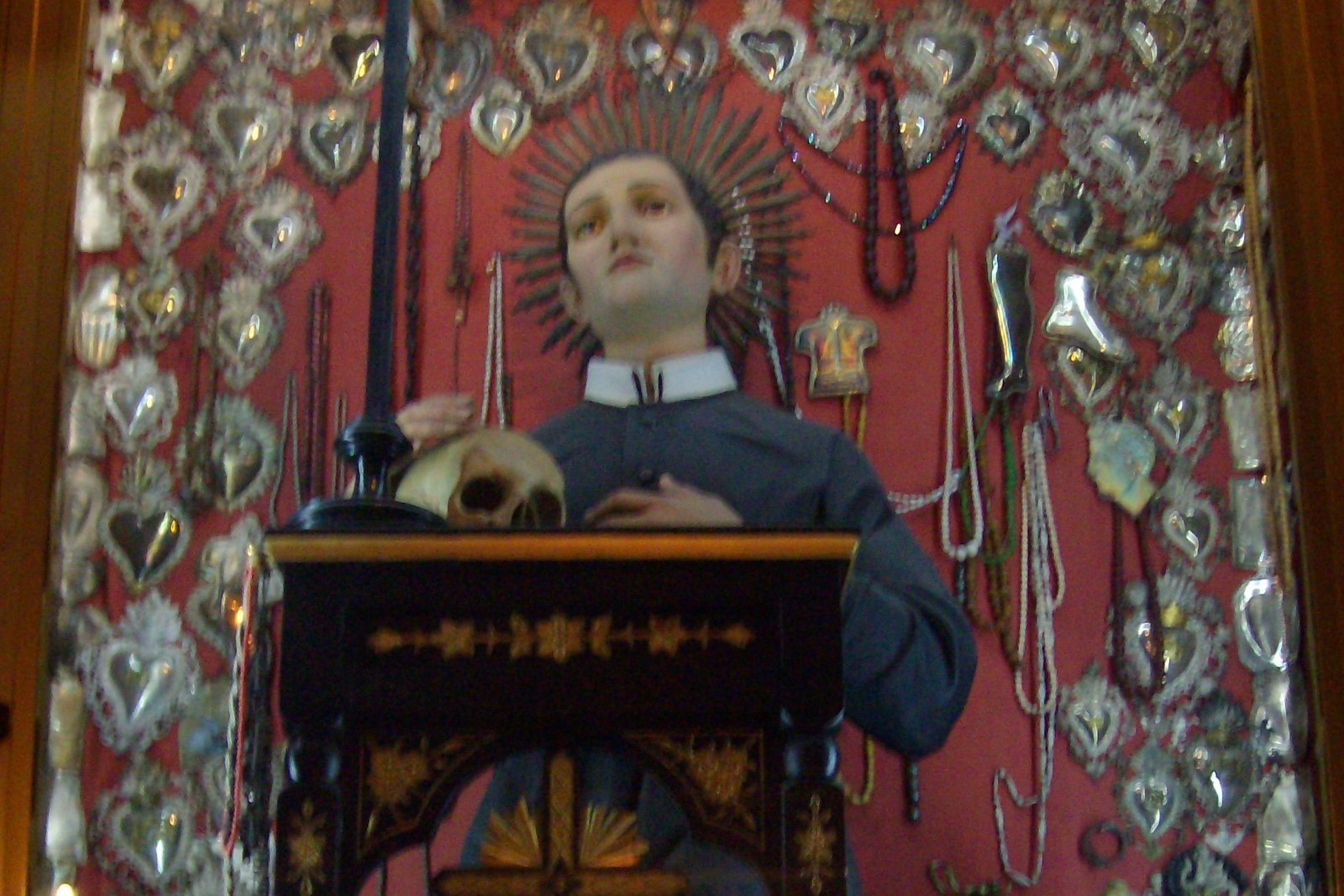
Statue of Saint Gerard Majella, Church of Santa Brigida, Naples, executed before 1905. Public domain (Wikimedia Commons).
His path into religious life wasn't smooth. He tried joining the Capuchin Franciscans as a young man and was turned away, reportedly on account of poor health. He kept working as a tailor and, by several accounts, lived an intensely devout private life even outside any formal religious community — extended fasting, long hours of prayer, and a habit of giving away nearly everything he owned to the poor, to the point that his own family worried about him.
Life as a Redemptorist lay brother
In 1749, Gerard successfully joined the Congregation of the Most Holy Redeemer — the Redemptorists, a religious order founded a few decades earlier by Saint Alphonsus Liguori, focused on preaching missions to the rural poor. He entered not as a priest but as a lay brother, taking on manual and support work: tailoring, gardening, managing the practical needs of the community, work he approached with the same intensity that had marked his private devotions before joining.
Accounts from his short life as a Redemptorist — he died at only 29 — describe a wide range of extraordinary phenomena attributed to him: reported instances of bilocation (being seen in two places at once), apparent supernatural knowledge of hidden things, and numerous healings credited to his prayers. These accounts come primarily from testimony gathered during and after his lifetime rather than independently verified contemporary records, and Catholic tradition holds them as pious tradition supporting his eventual canonization rather than defined dogma.
The accusation he refused to answer
The most striking episode of Gerard's life, and the one most often retold, involves a serious false accusation. A woman named Neria Caggiano told his religious superiors that Gerard had behaved improperly with a young woman in a town where he had recently stayed. Rather than deny the charge or offer any explanation, Gerard said nothing at all in his own defense.
Tradition holds that his silence was deliberate — that he was protecting someone else's confidence or reputation and considered breaking that trust, even to clear his own name, worse than enduring false disgrace. Whatever the reason, his superiors, taking the accusation seriously, suspended him from receiving Communion and from his ministry for months, a severe and humiliating penalty within religious community life. Gerard accepted it without protest or bitterness.
Eventually, according to tradition, Caggiano's conscience broke and she confessed to Saint Alphonsus Liguori himself that she had invented the story. Gerard was fully restored, and accounts describe him showing no resentment toward the woman who had nearly destroyed his standing in the order — treating the entire episode, once resolved, as though it had never happened.
Patron of expectant mothers
Gerard's association with childbirth and pregnant women comes from a story tradition tells about a visit he made to a family in Oliveto Citra. Leaving their home, he accidentally left behind a handkerchief; when a family member tried to return it, Gerard reportedly told her to keep it, saying it might be needed one day. Years later, one of the daughters of that household, facing a life-threatening difficult labor, is said to have experienced a vision of Gerard directing her to use the handkerchief — and both mother and baby survived. Whether taken as literal historical fact or understood as devotional legend built around a real and memorable incident, this story is the origin of his enduring popularity as the patron saint invoked by pregnant women and mothers hoping for a safe delivery.
A brother, not a priest
It's worth noting what Gerard was not: he never sought or received ordination as a priest, and his entire religious life was spent as a lay brother, a member of a religious community who takes vows but doesn't receive holy orders, devoting himself instead to manual labor and practical service supporting the community's mission. That distinction mattered to how Gerard understood his own vocation. He reportedly turned down an offer to be trained for the priesthood within the Redemptorists, content instead with tailoring, gardening, and the unglamorous daily upkeep of religious houses — the same kind of humble, hidden service later associated with other beloved lay brothers such as Saint André Bessette in Canada. Gerard's canonization stands as a reminder that the Church has never reserved its highest recognition of holiness for the ordained; some of its most vivid saints spent their whole religious lives doing chores.
Death and canonization
Gerard died of tuberculosis in 1755 at Materdomini, Italy, at just 29 years old. He was beatified in 1893 and canonized by Pope Pius X in 1904. His feast day is celebrated on October 16, and to this day expectant mothers across the Catholic world continue to invoke his intercession — a devotion rooted less in official Church doctrine than in generations of quiet, personal trust passed down through families who turned to him in one of life's most vulnerable moments.
Trivia
Who was Saint Gerard Majella?
Why was Gerard Majella falsely accused, and how did he respond?
How was Gerard Majella eventually cleared of the accusation?
Why is Saint Gerard Majella the patron saint of expectant mothers?
When is Saint Gerard Majella's feast day?
You May Also Like
Related Reading