Saint Anno of Cologne

A capable, ambitious churchman
Anno was born around 1010 into a family of modest Swabian nobility and rose through the ranks of the German church largely on the strength of his own evident administrative talent, eventually being appointed archbishop of Cologne in 1056 — one of the most powerful ecclesiastical positions in the Holy Roman Empire, carrying substantial temporal authority alongside its spiritual role, not unlike the position held a few decades earlier by Saint Bernward of Hildesheim in a neighboring German see.
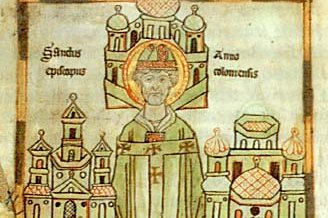
Anonymous, portrait of Saint Anno II of Cologne, c. 1180 medieval manuscript tradition — public domain.
Anno took up his position at a genuinely precarious moment for imperial politics. Emperor Henry III had died in 1056, leaving the throne to his young son Henry IV, still a small child, under the regency of his mother, Empress Agnes of Poitou. A regency headed by a foreign-born empress with limited independent power base among the German nobility created exactly the kind of unstable situation that ambitious churchmen and nobles were inclined to exploit.
The Kaiserswerth coup
Anno exploited it directly. In April 1062, he arranged to meet the eleven-year-old King Henry IV at the imperial residence of Kaiserswerth on the Rhine, reportedly showing the boy a magnificently decorated boat and inviting him aboard for a closer look. Once Henry had boarded, the boat was rowed away from shore, effectively removing the young king from his mother's custody and control. It was a carefully staged, essentially coercive seizure of power dressed up as an innocent excursion, and it succeeded: Empress Agnes's regency effectively collapsed in the aftermath, and Anno, along with a faction of allied nobles and bishops, took control of governing the empire in the young king's name.
Historians have long treated the episode as a striking, almost theatrical example of eleventh-century ecclesiastical power politics — a churchman engineering what amounted to a bloodless coup against an empress, justified publicly as protecting the young king's interests and the stability of the realm, but transparently also serving Anno's own ambitions and those of his allies among the German nobility.
Regent, rival, reformer
Anno did not retain sole control of the regency for long. Other powerful figures, most notably Archbishop Adalbert of Bremen, soon rose to challenge and eventually eclipse Anno's primary influence over the young king, and the years of Henry IV's minority were marked by ongoing rivalry among competing factions of the German high clergy and nobility, each maneuvering for advantage in a political environment that offered few stable footholds.
Anno also became embroiled in wider church politics beyond the imperial court, including involvement in disputes touching on the broader Investiture Controversy then beginning to build between German emperors and the papacy over the right to appoint bishops — the same tension that would dominate German ecclesiastical politics for decades after Anno's own death.
A turn toward penance and reform
In his later years, Anno's energy shifted decisively away from political maneuvering and toward monastic foundation, church reform, and an increasingly austere personal devotional life. He founded several monasteries, including Siegburg Abbey, which he endowed generously and where strict Benedictine observance was emphasized, and he is remembered by later sources as having embraced a severity of personal penance in his final years that struck contemporaries as a marked, deliberate departure from the political ambition of his middle career.
This later turn is central to how the medieval Church came to understand and venerate Anno: not as a man without serious flaws or ambition, but as one whose genuine later penance and religious dedication were considered to outweigh — without erasing — the ruthlessness of his earlier political conduct.
Siegburg and the reform of monastic discipline
Anno's monastic foundations deserve a closer look, because they show a different, less politically self-interested side of his career than the Kaiserswerth coup alone suggests. Siegburg Abbey, which he founded in 1064 on a hill overlooking the Rhine near Bonn, became one of the more important centers of the Gorze-influenced reform movement then spreading through German Benedictine monasticism — a movement pushing for stricter adherence to the Rule of Saint Benedict, tighter control over monastic property, and a general tightening of discipline against the laxity that had crept into many older German monasteries during the tenth and eleventh centuries. Anno staffed Siegburg with reform-minded monks and gave the community considerable independence from local secular interference, a pattern of patronage repeated at several of the other religious houses he founded or reformed around Cologne during his archiepiscopate. This reforming energy placed Anno, whatever his earlier political conduct, on the same broad side of eleventh-century church politics as the wider reform movement associated with the papacy of his era — even though, in the looming Investiture Controversy, Anno's own loyalties as a powerful imperial churchman remained considerably more entangled with royal authority than a purely reform-minded bishop's might have been.
Remembered in medieval German literature
Anno's afterlife in medieval culture extended well beyond formal hagiography. Within a generation or two of his death, an anonymous German cleric composed the Annolied ("Song of Anno"), an Early Middle High German poem that combines a biography of Anno with a sweeping account of world and imperial history — one of the earliest substantial works of vernacular German literature to survive from this period, and a text still studied by scholars of medieval German language and literature independently of its subject's own sanctity. That a bishop remembered as much for a political kidnapping as for personal holiness could inspire one of the foundational texts of early German vernacular poetry says a good deal about how central a figure Anno remained in the collective memory of the Rhineland for centuries after his death.
Feast day and legacy
Anno died on December 4, 1075, and was canonized in 1183 by Pope Lucius III. His feast is celebrated on December 4. He remains one of the more genuinely complicated figures among medieval bishop-saints, his sanctity acknowledged by the Church without the political ambition of his career being minimized or erased from the historical record — a useful reminder that medieval hagiography, at its most honest, did not require its subjects to have been flawless from birth.
Readers interested in the broader landscape of politically powerful German prince-bishops of this era may also want to read about Saint Bernward of Hildesheim, whose own episcopate, a few decades earlier, similarly combined substantial worldly authority with a distinctive personal legacy that outlasted the politics of his own time.
Trivia
Who was Saint Anno of Cologne?
What was the Kaiserswerth coup of 1062?
Did Saint Anno govern the empire alone after the Kaiserswerth coup?
Why is Saint Anno venerated as a saint despite his political ambition?
When is the feast of Saint Anno?
You May Also Like

Related Reading