Saint Henry: Henry II, Holy Roman Emperor

A duke's son who became emperor almost by chance
Henry was born in 973, the son of Henry II, Duke of Bavaria, and educated for several years under the bishop of Hildesheim and later at the cathedral school in Regensburg, an unusually thorough clerical education for a young nobleman who was not, at the time, first in line for any major throne. When his father died in 995, Henry inherited the duchy of Bavaria, and it was only in 1002, on the sudden death of his cousin Emperor Otto III without an heir, that Henry pressed his own claim to succeed as King of Germany — a claim contested by rival dukes and secured only through a combination of negotiation, military pressure, and alliance-building across the fractious German nobility of the time.
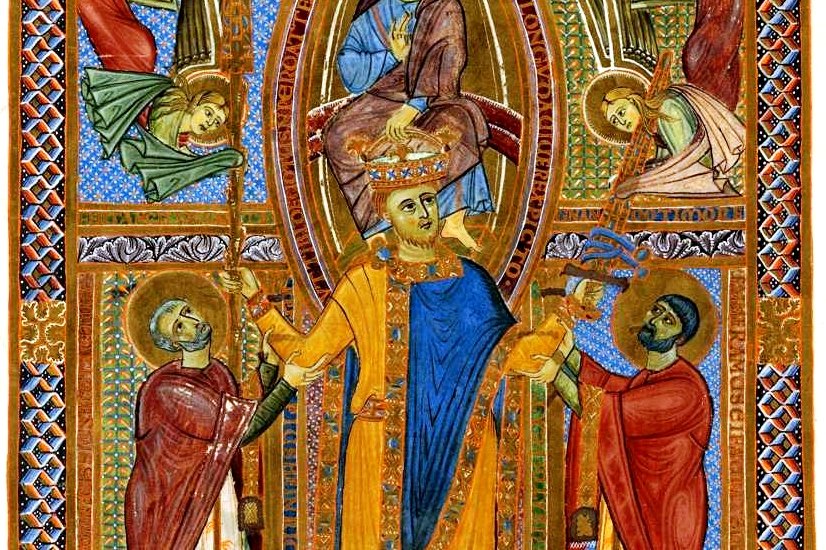
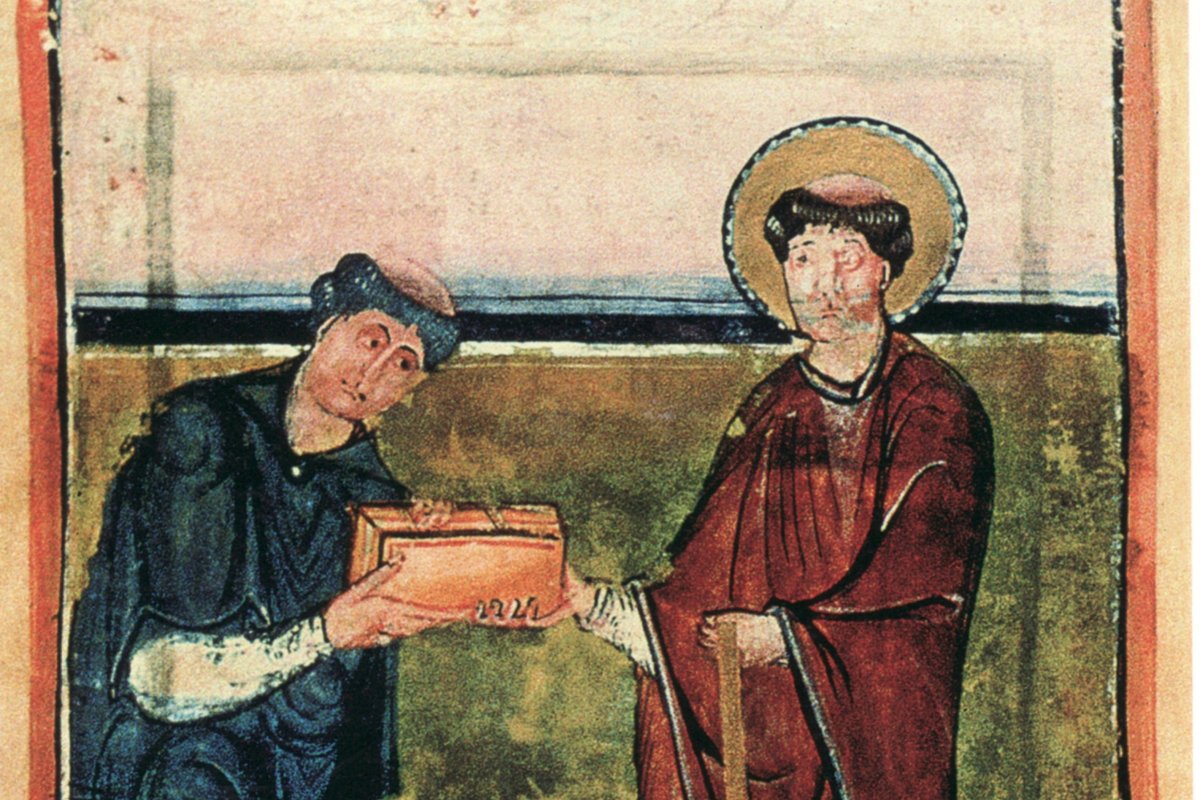
Sacramentary of Henry II, Munich BSB Clm 4456, circa 1002-1014 — Bavarian State Library, public domain.
He was crowned King of Germany in 1002 and, twelve years later, in 1014, was crowned Holy Roman Emperor by Pope Benedict VIII in Rome — the title that placed him, at least in theory, as the temporal head of Western Christendom, protector of the Church and successor to a line of emperors going back to Charlemagne two centuries earlier.
A reign built around reform, not just conquest
Henry's twenty-two years as king and emperor were not without warfare — he fought repeated campaigns to hold his eastern and Italian borders and to put down rebellious nobles who resented the authority he tried to consolidate. But what distinguishes Henry's reign in Church history is not his battles but his systematic, sustained investment in reforming and strengthening the institutional Church across his territories, at a time when many bishoprics and monasteries in the Holy Roman Empire had grown lax, corrupt, or dominated by local noble families treating Church offices as family property.
Henry worked closely with reform-minded monasteries, most notably Cluny in Burgundy, whose model of disciplined, centrally governed monastic life was spreading across Europe during his reign, and he used his authority as emperor to install capable, reform-minded bishops rather than simply rewarding political allies with Church appointments — though, like most rulers of his era, he did not fully escape the entanglement of royal and ecclesiastical power that later reform movements, especially the Gregorian Reform later in the eleventh century, would push much further to disentangle.
Founding a diocese from nothing
Henry's most lasting institutional achievement was the founding of the Diocese of Bamberg in 1007, built around a small town in Franconia that Henry transformed, through his own direct and sustained investment, into a major center of religious life, learning, and art. He endowed Bamberg's cathedral and associated monasteries generously from his own family lands — a genuinely significant personal sacrifice, since Bamberg had been part of his family's private inheritance rather than crown property, meaning Henry effectively gave away his own patrimony to establish the new diocese permanently. He intended Bamberg as a missionary and pastoral base for the evangelization of Slavic peoples along the empire's eastern frontier, as well as a center of reformed religious life within Germany itself, and the cathedral he founded there still stands today as one of the great Romanesque and early Gothic churches of Germany, with Henry and his wife Cunigunde both buried within it.
A marriage remembered as a shared consecration
Henry married Cunigunde of Luxembourg, herself later canonized as a saint, and the couple had no children — a fact that later medieval tradition explained by holding that the two had mutually agreed to live their marriage in perpetual continence, consecrating their union entirely to God rather than to producing an heir. This tradition, prominent in later medieval hagiography, cannot be verified with full historical certainty; some modern historians note that the tradition of a fully celibate "spiritual marriage" developed and was emphasized more heavily in accounts written after both Henry's and Cunigunde's deaths, and that other explanations for the couple's childlessness, including health factors, are equally plausible from the surviving evidence. What can be said with more confidence is that both Henry and Cunigunde were remembered consistently, by contemporaries and later chroniclers alike, for an unusually devout personal piety that shaped how their marriage and their reign together were remembered by the Church.
The absence of an heir did have major political consequences — Henry's death in 1024 ended the Ottonian dynasty that had ruled the Holy Roman Empire for nearly a century, passing the throne to a new line, the Salian dynasty, under Conrad II. In the framework of Church teaching, marriage is understood as a vocation and "an intimate partnership of life and love" ordered toward the good of the spouses and, ordinarily, toward children (CCC 1601, 1652) — but the Church has also long honored a distinct calling to celibacy lived even within marriage, in imitation of a total consecration to God, and it is this second, rarer path that later tradition associated with Henry and Cunigunde's life together.
Canonized more than a century after his death
Henry died on July 13, 1024, without an heir, and was buried at Bamberg Cathedral beside the wife who would eventually be canonized alongside him, decades later, as Saint Cunigunde. It was not until 1146 — more than a hundred years after his death — that Pope Eugene III formally canonized Henry, citing the full record of his reign: his patronage of monastic and clerical reform, his founding and endowment of Bamberg, his personal piety, and the enduring devotion of the German Church to his memory in the intervening century. He remains one of only a small handful of reigning Holy Roman Emperors ever canonized, honored today, on his July 13 feast, less for the crown he wore than for how deliberately he used it in service of the Church he governed alongside — a theme that echoes in the stories of other saint-rulers of the medieval period, such as Saint Elizabeth of Portugal, who likewise used royal authority in the service of reform and charity rather than conquest alone.
Trivia
Who was Saint Henry, and when did he live?
Why was Henry II canonized as a saint?
Did Henry II have children?
What is Henry II's feast day?
What is Saint Henry the patron saint of?
You May Also Like
Related Reading