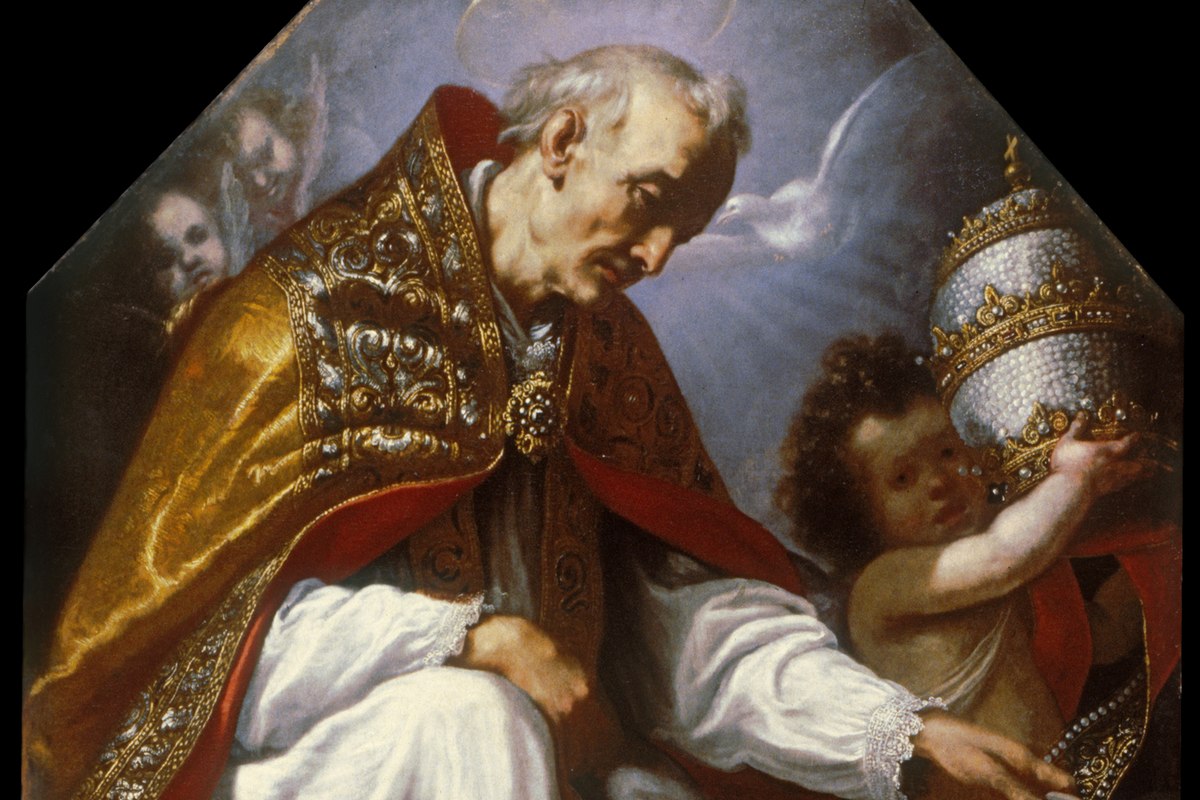
Saint Augustine of Canterbury, Bishop

A monk chosen for a mission he did not seek
Augustine was, before his mission ever began, the prior of the monastery of St. Andrew in Rome, a Benedictine house that Pope Gregory the Great had himself founded on his family's property before becoming pope. Gregory knew Augustine personally and trusted him, and in 596 he chose him to lead a small band of about forty monks on a mission to the Anglo-Saxon kingdoms of Britain — territories that had drifted from the Christianity practiced there under Roman rule centuries earlier, and were by this point largely governed by pagan Germanic peoples: the Angles, Saxons, and Jutes who had settled the island after Rome's withdrawal.
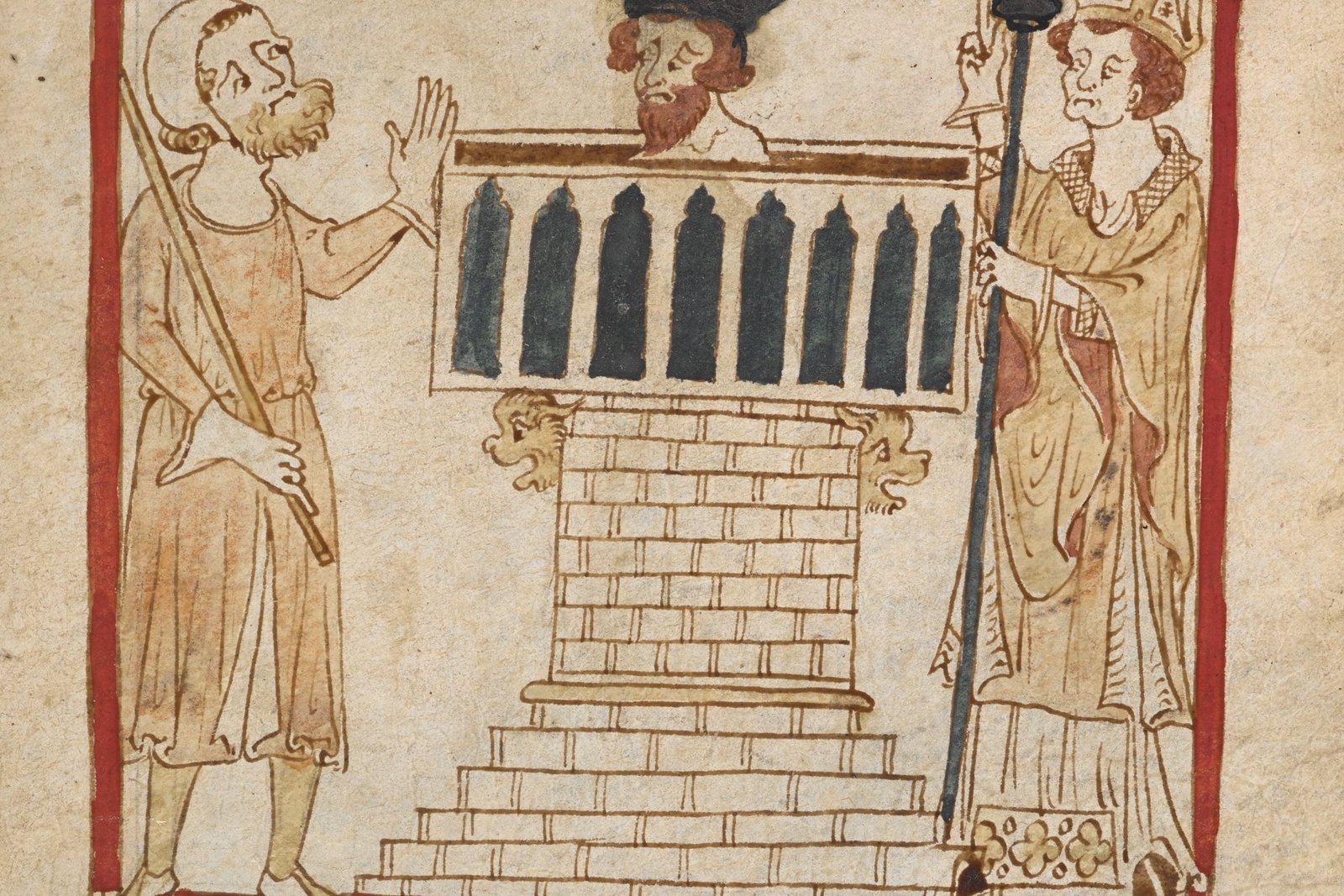
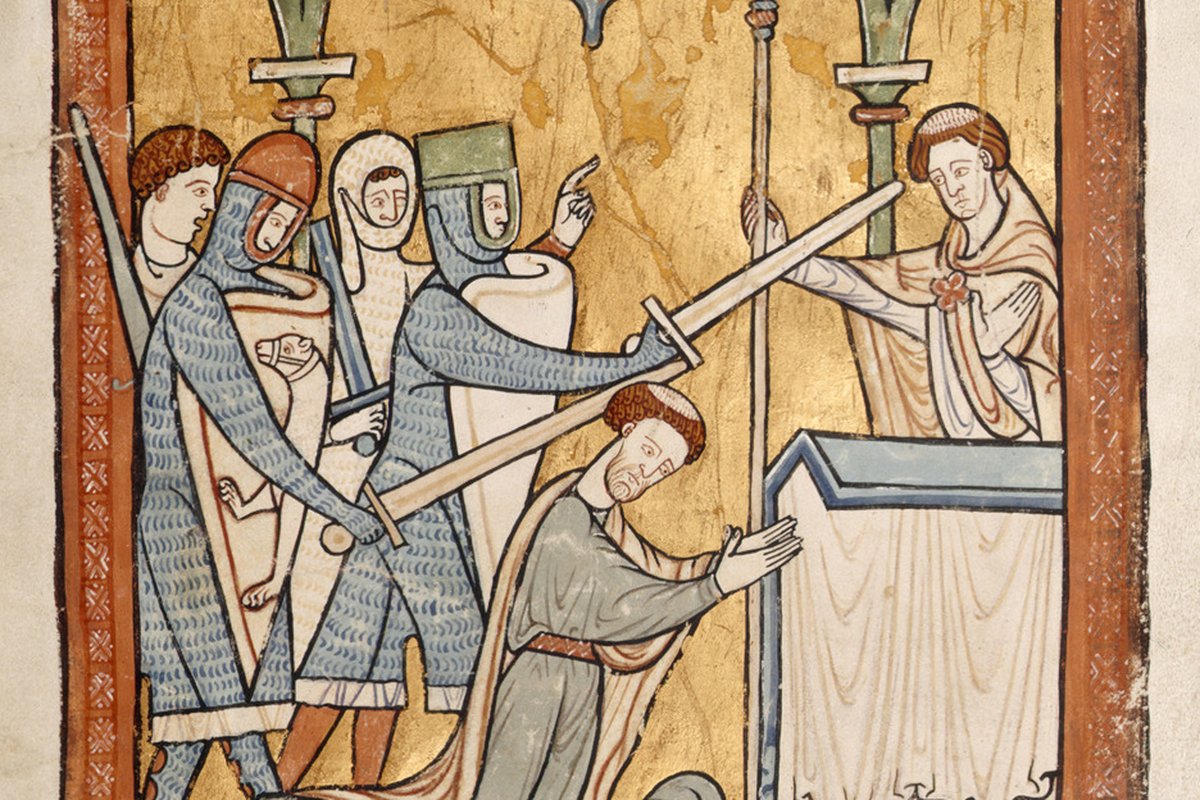
Roman de Brut, BL Egerton MS 3028, f.55r, circa 1325-1350 — British Library, public domain.
According to the account later written by the English monk-historian Bede in his Ecclesiastical History of the English People, the missionaries got only partway through Gaul (modern France) before their courage failed them. Terrified by reports of the "barbarous, fierce, and unbelieving nation" they were being sent to, whose language they did not even speak, the monks sent Augustine back to Rome to ask Gregory to cancel the mission entirely. Gregory's reply, which survives, refused the request but softened it with real compassion: he told them it would have been better never to have begun such a good work than to abandon it partway through, encouraged them to trust in God's help, and sent Augustine back to his brothers with letters of introduction to bishops and rulers along their route. The monks continued on and crossed into Britain in 597.
Landing in Kent
Augustine's party landed on the Isle of Thanet, on the coast of the kingdom of Kent, ruled by King Æthelberht — a choice of destination that was almost certainly not accidental. Æthelberht's wife, Bertha, was a Christian Frankish princess who had brought her own chaplain with her when she married the pagan king, and a small church, St. Martin's in Canterbury (which still stands today as one of the oldest church buildings in continuous use in the English-speaking world), had already been set aside for her worship before Augustine ever arrived. Bede records that Æthelberht, cautious but curious, agreed to meet the missionaries — reportedly insisting the meeting take place outdoors, out of a superstitious fear that magic might be more powerful indoors.
Whatever Æthelberht's initial caution, the king allowed Augustine and his monks to settle in Canterbury and preach freely, and within the year — traditionally dated to Christmas 597 — Æthelberht himself was baptized, followed by thousands of his subjects. Augustine was consecrated a bishop soon afterward, likely in Gaul, and returned to Kent to establish what would become the Archdiocese of Canterbury, still the senior see of the Church of England today, more than fourteen centuries later.
Building a Church almost from nothing
Augustine faced enormous practical challenges in organizing Christianity in a kingdom where almost no ecclesial structure existed. He wrote repeatedly back to Gregory in Rome with detailed, sometimes strikingly specific, pastoral questions — how to handle differences in liturgical practice among the various Christian communities he encountered, what penances to require for particular sins, how bishops should relate to one another, and even questions about ritual purity and marriage customs. Gregory's detailed written answers survive as a document known as the Libellus Responsionum ("Book of Answers"), preserved within Bede's history, and offer a rare, closely detailed window into how a newly planted mission church worked out its practices in real time, guided directly by Rome.
One especially significant, and historically fraught, episode involved Augustine's attempts to reach an agreement with the bishops of the existing British (Celtic) Church — Christian communities that had survived in western Britain since Roman times, independently of Rome, and had developed their own customs, including a different method for calculating the date of Easter. Augustine held at least two conferences with the British bishops seeking unity and cooperation, but the meetings ended without full agreement, a division that would not be substantially resolved until decades after Augustine's death, at the Synod of Whitby in 664. Bede's account, written by a monk loyal to Rome's customs, is admittedly a partial witness to what was likely a more complicated set of tensions — political as well as liturgical — between two Christian traditions that had developed independently for generations.
A mission that outlasted its founder
Augustine established several more dioceses beyond Canterbury before his death, appointing bishops to London and Rochester, and he founded the monastery that would later be known as St. Augustine's Abbey in Canterbury, intended as a burial place for the kings of Kent and the archbishops who followed him. He died around 604 — the exact year is debated among historians — and was buried at the abbey he had founded, later venerated as a saint almost immediately in the young English Church.
His title, "Apostle of the English," reflects the fact that his mission, though limited in its own lifetime largely to the kingdom of Kent, became the formal starting point that the rest of Anglo-Saxon England's conversion was built on over the following century, carried forward by later missionary bishops working among neighboring kingdoms. His story sits naturally alongside other missionary saints who brought Christianity to new peoples at the edges of the old Roman world, such as Saints Cyril and Methodius, who undertook a broadly similar task among the Slavic peoples not many centuries later. Canterbury itself remains, to this day, the seat of the Archbishop who leads the Church of England and the wider Anglican Communion — a direct institutional line running back to the cautious meeting Augustine held with a pagan Kentish king under the open sky in 597.
Trivia
Who was Saint Augustine of Canterbury?
Is Saint Augustine of Canterbury the same person as Saint Augustine of Hippo?
Why is Augustine called the Apostle of the English?
What questions did Augustine send back to Pope Gregory the Great?
What is the feast day of Saint Augustine of Canterbury?
You May Also Like
Related Reading