Saint Bavo of Ghent

A nobleman's ordinary, unremarkable life
Bavo — baptized Allowin, though history remembers him almost exclusively by the religious name Bavo — was born into a wealthy Frankish noble family in the region around Liège, likely in the last years of the sixth century. For much of his adult life, the surviving tradition describes him in fairly unflattering, ordinary terms: a man of considerable means who lived largely for his own comfort and pleasure, married, and gave little apparent thought to a religious vocation of any kind. There's nothing in this early portrait to distinguish him from countless other wealthy landowners of seventh- century Francia.
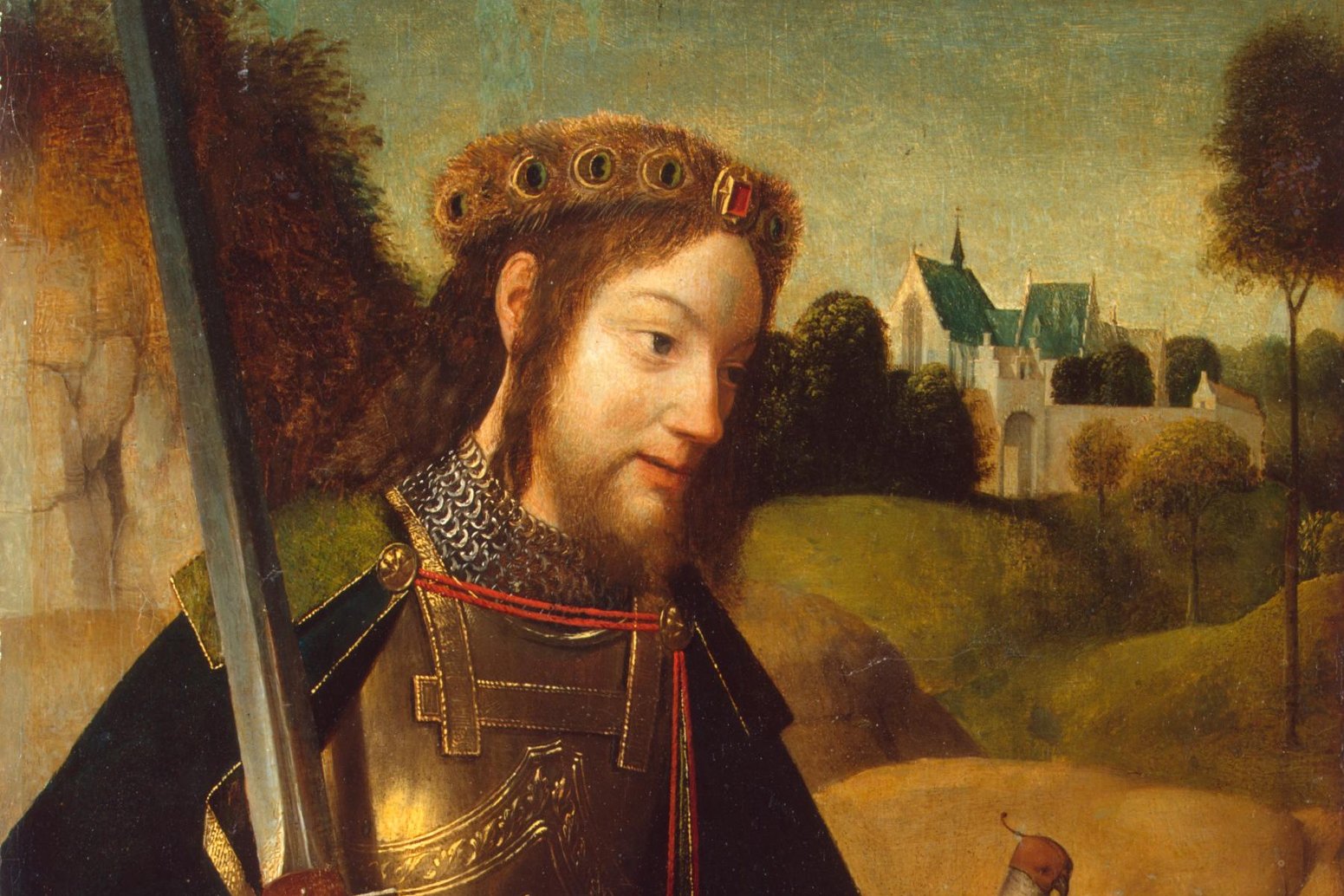
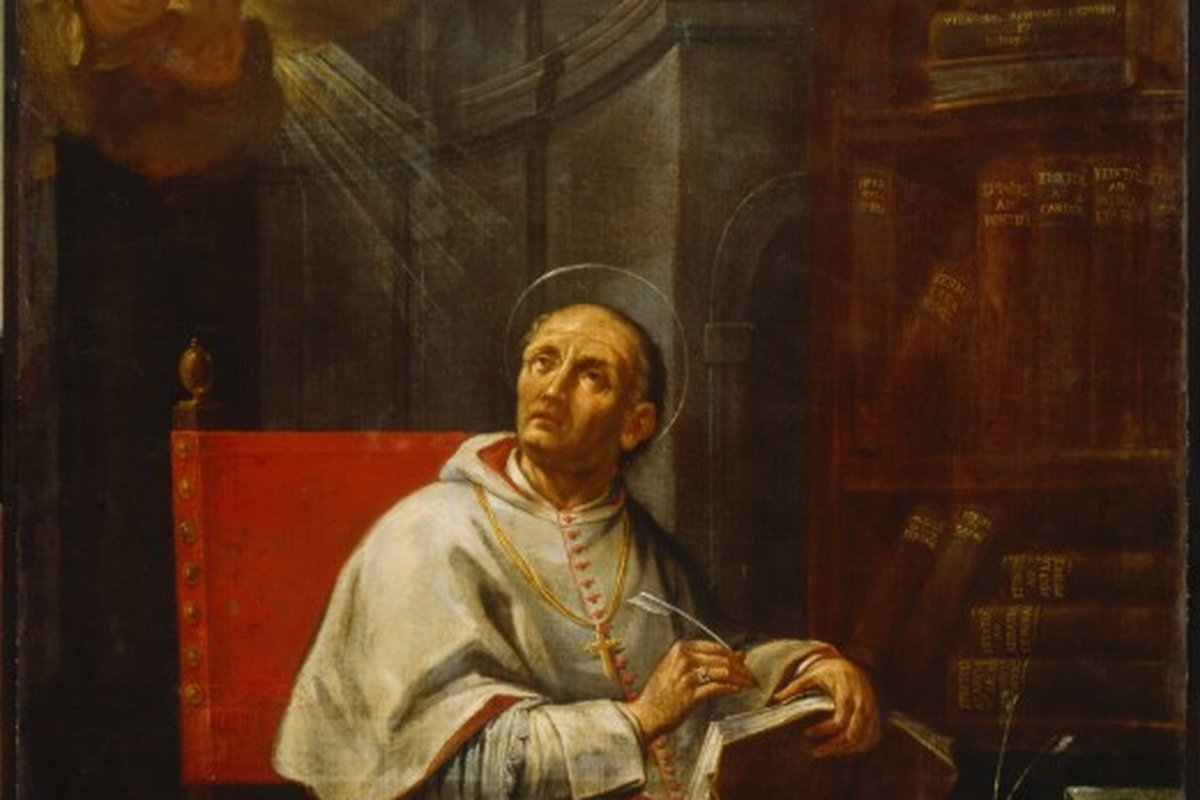
Geertgen tot Sint Jans, The Conversion of Saint Bavo, c. 1480s — public domain.
What changed everything, according to consistent tradition, was the death of his wife. Grief, or perhaps a longer-building dissatisfaction that her death finally brought to the surface, pushed Bavo toward a searching reconsideration of how he had spent his life so far — and that reconsideration led him, eventually, to the missionary bishop Saint Amand, then actively working to evangelize the Scheldt valley region where Bavo's lands lay.
Giving away a fortune and seeking servitude
Bavo's conversion, once it took hold, was thorough and dramatic. He distributed his wealth — some of it to the poor, some reportedly returned to people he had wronged or exploited during his earlier worldly dealings — and undertook an extraordinary act of penance: according to tradition, he sought out a man he had once treated unjustly, possibly someone he had enslaved or otherwise wronged through his earlier position of power, and offered himself to be sold into servitude as restitution. The man is said to have kept him in chains for a period before Amand intervened and arranged Bavo's release, directing him instead toward formal monastic life as a more constructive channel for his evident zeal.
Whatever the precise historical details behind this striking story, its consistent presence across the tradition points to something genuine about how radically and publicly Bavo's contemporaries understood his conversion to have been: not a quiet, private turn toward piety, but a dramatic and visible renunciation meant to be witnessed and remembered.
Monastic life and the hermit in the tree
Under Amand's guidance, Bavo entered monastic life at Ghent, becoming part of the community that grew up around the foundation now known as Saint Bavo's Abbey. He did not remain content, however, with even the disciplined structure of ordinary monastic community life. Seeking a still more austere and solitary existence, Bavo withdrew into the surrounding forest and, according to persistent local tradition, lived for a period inside the hollow trunk of a large tree — an image so striking that it became one of the fixed elements of his later legend, along with the account that a criminal, mistaking him for a fugitive he resembled, later denounced him to authorities, an accusation Bavo is said to have accepted without protest or complaint, in keeping with the spirit of penitential humility that had defined the whole second half of his life.
He died around 653, and was buried at the monastery in Ghent that carried his name.
A recognizable type: the penitent nobleman-saint
Bavo's story fits a recognizable and recurring pattern in early medieval hagiography: the wealthy, worldly layman whose dramatic mid-life conversion becomes, if anything, more central to his sanctity than any quiet lifelong virtue would have been. This narrative shape served a clear pastoral purpose for the audiences who first heard and copied these accounts — it offered proof that even a life spent in comfort, self-interest, and, in Bavo's case, apparently real wrongdoing toward others, was not beyond the reach of genuine repentance. The specific, almost theatrical severity of his penance — seeking out the very person he had wronged and offering his own body into servitude — distinguishes Bavo's story from the more common pattern of penitent nobles who simply retired to a monastery with their wealth intact. Whether every detail happened exactly as later written accounts describe, the tradition consistently emphasizes restitution to a wronged party specifically, not merely private contrition before God, a detail that medieval preachers found especially useful when urging their own wealthy patrons toward similar acts of concrete charity and repair.
The abbey, the cathedral, and the altarpiece
The monastery that grew up around Bavo's tomb, Saint Bavo's Abbey, became one of the wealthiest and most influential religious houses in the medieval county of Flanders, holding substantial land and playing an important role in the region's political as well as religious life for centuries. Ghent's civic identity grew up alongside it, and when the city's principal parish church was elevated to cathedral status in the sixteenth century, it too took Bavo's name. That building's fame today rests substantially on an object with no direct connection to Bavo's own life: the Ghent Altarpiece, also known as The Adoration of the Mystic Lamb, completed around 1432 by Hubert and Jan van Eyck and widely regarded as one of the pivotal works in the history of European oil painting. The altarpiece's presence in Saint Bavo's Cathedral has made the building, and by extension Bavo's own name, a destination for art historians and pilgrims alike, layering Renaissance artistic celebrity onto a much older tradition of local monastic veneration.
Patron of Ghent
Bavo's memory became closely tied to the identity of Ghent itself. The abbey built around his relics grew into one of the most significant religious institutions of the medieval Low Countries, and Ghent's principal medieval church — now Saint Bavo's Cathedral, home to the celebrated Ghent Altarpiece by the van Eyck brothers — carries his name to this day, a testament to how completely his story became woven into the civic and religious identity of the city.
His feast is celebrated on October 1. In art, he is typically depicted as a nobleman-turned-monk, sometimes shown kneeling in confession before an abbot — the moment of his conversion — or accompanied by a falcon, a reference to his earlier life of aristocratic leisure that he renounced so completely. The painting that anchors this article, by the fifteenth-century Netherlandish master Geertgen tot Sint Jans, captures exactly this pivotal scene of confession and conversion.
Readers interested in the broader network of Frankish nobility and clergy reshaping the religious landscape of the Scheldt valley in this period may also want to read about Saint Amand of Maastricht, the missionary bishop whose guidance redirected Bavo's dramatic conversion into a lasting monastic vocation.
Trivia
Who was Saint Bavo of Ghent?
Why did Saint Bavo sell himself into slavery?
What is the connection between Saint Bavo and Saint Amand of Maastricht?
Why did Saint Bavo live inside a hollow tree?
When is the feast of Saint Bavo?
You May Also Like
Related Reading