Saint Clare of Montefalco

A childhood shaped by an older sister's example
Clare was born around 1268 in Montefalco, a hill town in the Umbria region of central Italy, into a family whose exact social standing history has not recorded in detail. What is well documented is that her older sister, Joan, established a small religious community in the town while Clare was still a child, and Clare joined it at around age six, growing up within a community life centered on prayer, penance, and mutual support among a small group of women dedicated to religious life outside any of the larger established orders of the period.
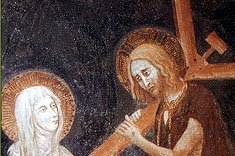
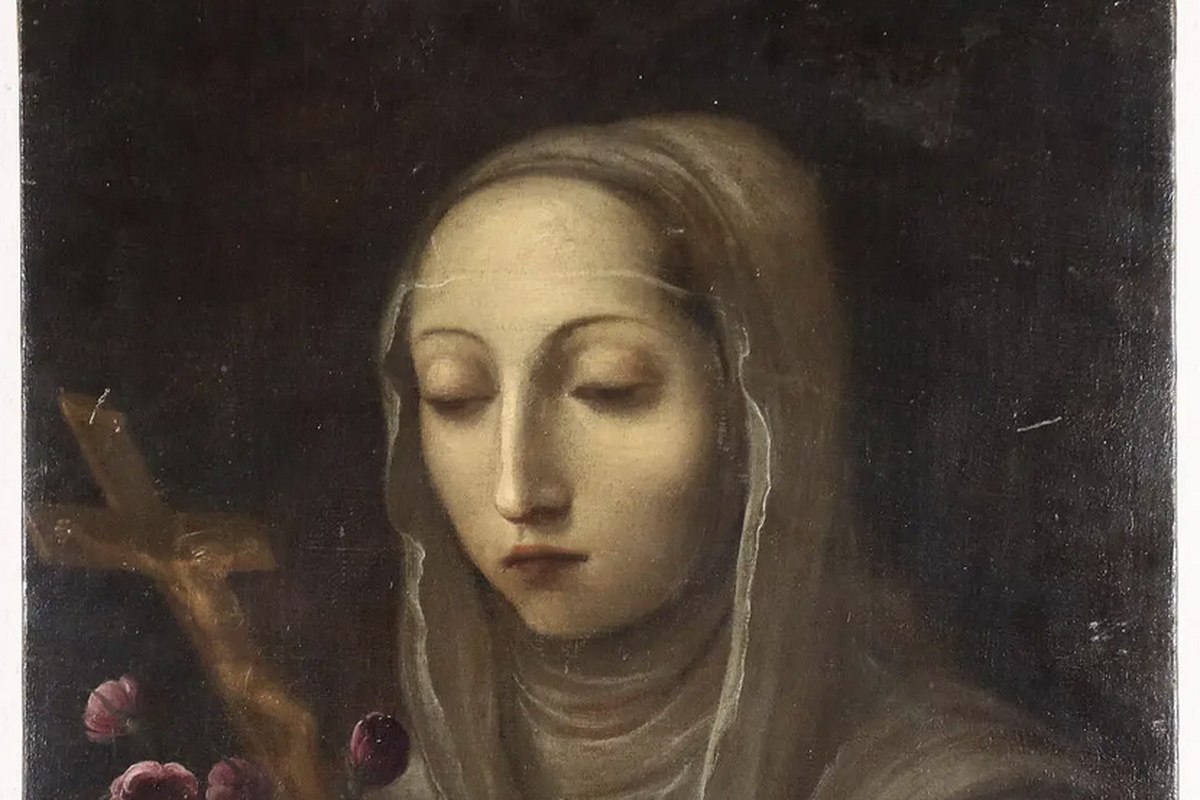
Saint Clare of Montefalco, traditional devotional painting, Wikimedia Commons — public domain.
This small community eventually formalized its status by adopting the Rule of Saint Augustine, becoming an officially recognized Augustinian monastery — the Holy Cross monastery in Montefalco — a step that gave the sisters clearer institutional standing within the wider Church while preserving much of the intense, close-knit spiritual culture Joan had originally built. Clare grew into adulthood almost entirely within this single community, and when her sister Joan died in 1291, the community elected Clare, then still in her early twenties, as the new abbess — a position of real responsibility that she would hold for the rest of her life.
A prayer life centered intensely on the Passion
Clare's religious life, as described by the sisters who lived alongside her for decades and later testified about her to Church investigators, was marked by an unusually sustained and intense devotion to the Passion of Christ — his suffering, crucifixion, and death — a devotional focus shared, in broadly similar form, by other medieval mystics such as Veronica Giuliani several centuries later, whose own reported mystical experiences likewise centered on vivid, physically felt meditation on Christ's suffering. Clare's sisters described her spending long hours in prayer specifically fixed on the Passion narrative, and reported that she spoke of carrying, in some interior sense, the instruments of Christ's suffering within her own heart.
That last detail — offered, by tradition, as something Clare said of herself before her death rather than a claim invented afterward by others — set up what would become the single most debated and examined element of her entire story.
What the sisters said they found
Clare died on August 17, 1308. According to the community's own account, in preparing her body for burial the sisters opened her heart, reportedly acting on instructions Clare herself had given them, and said they discovered within its tissue physical formations that appeared, to those examining it, to resemble a small cross, a scourge or whip, and a crown of thorns — objects directly associated with the instruments of Christ's Passion that had so dominated Clare's own prayer life.
It is important, in keeping with how the Church itself treats such extraordinary physical claims, to be precise about what is and is not established here. The Church's own careful approach to reported phenomena of this kind distinguishes between the historical fact that such a claim was made, examined, and documented by multiple independent witnesses over an extended period — which is genuinely well attested in Clare's case, including formal investigations conducted centuries later using more advanced examination methods — and any theological or scientific certainty about the ultimate cause or meaning of what was found, which the Church has never required the faithful to affirm as binding doctrine. What can be said with confidence is that the claim was taken seriously enough, by both Church and medical authorities across several centuries, to be investigated repeatedly rather than dismissed outright, and that Clare's preserved heart remains on public display and available for study today.
A slow path to canonization
Clare's local reputation for holiness, reinforced dramatically by the discovery at her death, spread quickly through Umbria and drew pilgrims to Montefalco within her own community's living memory. Formal canonization, however, took an extraordinarily long time to arrive — Pope Leo XIII did not canonize her until 1881, well over five and a half centuries after her death in 1308, a gap reflecting how slowly many medieval causes for canonization, particularly those centered on smaller, regionally based communities without powerful institutional advocates in Rome, historically moved through the Church's formal processes.
Her feast is kept on August 17, the anniversary of her death, and her body and heart remain venerated today at the Sanctuary of Santa Chiara in Montefalco, in the same hill town where she spent virtually her entire life — a modest, single-community existence that nonetheless produced one of the more physically and theologically debated relics connected to any canonized medieval mystic.
A small town that became a place of pilgrimage
Montefalco itself never grew into a major city, and Clare's monastery remained, throughout her lifetime and long after, a comparatively small community by the standards of the great Italian religious houses of the period. That relative smallness is part of what makes the durability of devotion to her notable: unlike saints whose causes were pushed forward by powerful religious orders with resources and connections in Rome, Clare's canonization advanced almost entirely on the strength of sustained local devotion and the persistent, well-documented physical evidence her own community had preserved and continued to present to Church authorities across five centuries.
Modern examinations of her preserved heart, conducted using methods unavailable to the sisters who first opened it in 1308, have continued periodically into recent history, keeping Clare's case an active point of reference whenever questions of unusual bodily phenomena connected to reported sanctity come up in Catholic devotional and scholarly discussion alike — a level of sustained scientific attention relatively few medieval relics receive so long after the fact.
Trivia
Who was Saint Clare of Montefalco?
What was found in Clare of Montefalco's heart after she died?
Did the Church investigate the claims about Clare's heart?
What was Clare of Montefalco's role within her religious community?
When was Clare of Montefalco canonized?
You May Also Like
Related Reading