Saint Fridolin of Säckingen

A missionary from the British Isles
Fridolin's story is harder to pin down historically than that of many early medieval saints, and the earliest surviving written account of his life dates from centuries after he supposedly lived — a gap that makes it difficult to separate reliable fact from later monastic storytelling built up around a founder's memory. The tradition holds that he came from Ireland, or possibly Scotland, sometime around the late fifth or early sixth century, part of the broader wave of monks from the British Isles who fanned out across post-Roman Europe seeking both solitude and mission fields. Continental Europe in this period, particularly outside the old Roman heartlands, was religiously and politically unsettled, and Irish and Scottish monks became some of its most energetic evangelizers over the following two centuries.
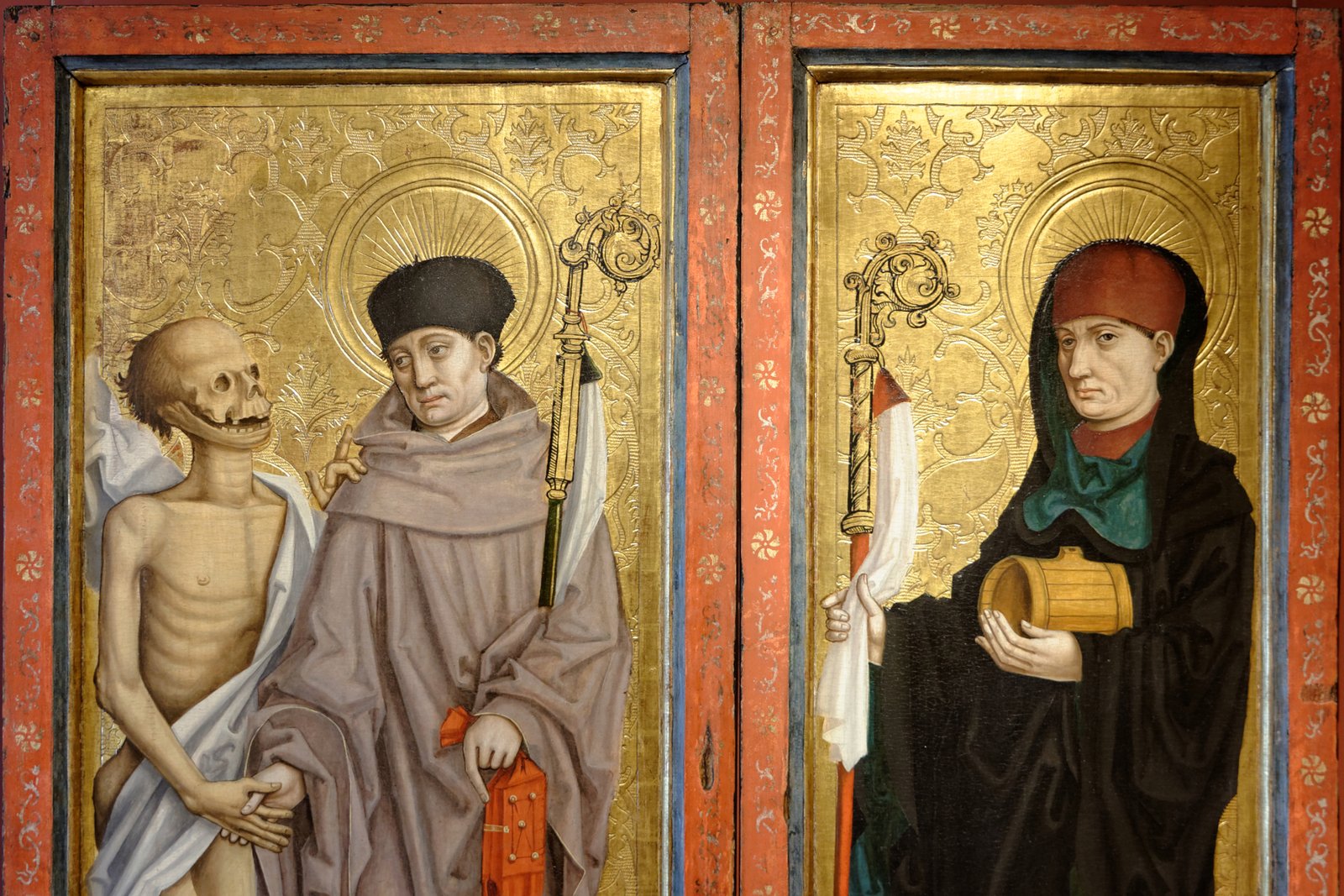
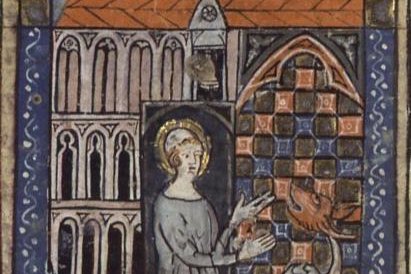
Anonymous, Saint Fridolin with the Man He Raised from the Dead, and Saint Omer, medieval panel, Musée des Beaux-Arts de Dijon — public domain.
According to the traditional account, Fridolin's travels took him first to Poitiers in western Gaul, where he is said to have become associated with the shrine of Saint Hilary, the influential fourth-century bishop and theologian later recognized as a Doctor of the Church. From there, tradition holds, Fridolin set out to search for relics of Hilary that had reportedly been lost or scattered, carrying that search eastward across Gaul and eventually into the Rhineland — a journey that, whatever its precise historical accuracy, reflects the real pattern of relic veneration and pilgrimage that shaped so much of early medieval Christian geography.
Founding a monastery on an island
Fridolin's search is said to have led him to an island in the Rhine near what is now Bad Säckingen, close to the present-day German-Swiss border. There, according to tradition, he founded a monastery dedicated to Saint Hilary, having been guided to the spot — in some versions of the story, through a vision or divine sign — as the intended resting place for the relics he had sought. Whatever the supernatural framing added by later retellings, the monastery itself is historically real: Säckingen developed into an important religious center on the upper Rhine, eventually becoming a community of secular canonesses that endured for many centuries.
The choice of an island site fits a broader pattern common among early medieval monastic founders, who frequently sought out defensible, somewhat isolated locations — river islands, remote valleys, forest clearings — that offered both practical security and a symbolic separation from the surrounding world.
The legend of the resurrected witness
The most famous story attached to Fridolin's name concerns a legal dispute over land. According to the tale, a nobleman named Ursus had promised property to Fridolin's monastery but died before the gift could be formally recorded, leaving his skeptical heir to challenge the claim in court. Unable to produce documentary proof, Fridolin is said to have gone to Ursus's grave and, through prayer, restored him briefly to life. The revived Ursus then appeared before the assembled court, confirmed the terms of his original gift to the stunned heir, and returned peacefully to his grave once his testimony had been given.
This story should be read as pious legend rather than documented history — it belongs to a recognizable medieval genre of "miraculous witness" tales used to reinforce and dramatize monastic land claims, and it appears in similar form attached to other saints across the period. It has nonetheless become the defining image of Fridolin in art for centuries, and it's the scene captured in the medieval panel painting that anchors this article, which shows Fridolin leading the skeletal figure of Ursus by the hand.
A saint documented centuries after the fact
Fridolin presents a particularly clear case of a problem common across early medieval hagiography: the surviving written account of his life, a Vita composed by a monk named Balther of Säckingen, dates from roughly the eleventh century — five hundred years or more after Fridolin supposedly lived. Historians who study the text generally regard it less as a reliable biographical record and more as a work written to serve the monastery's institutional interests at the time it was composed, reinforcing Säckingen's claim to ancient prestige, its connection to the celebrated relics of Saint Hilary, and its property rights (including, quite possibly, the very land-dispute story that later became Fridolin's most famous legend). This does not mean no historical figure named Fridolin existed — early medieval communities rarely invented founder-saints entirely from nothing, and the monastery's own genuine antiquity argues for some real founding figure behind the later legend — but it does mean that nearly every specific biographical detail attached to his name should be read as later reconstruction rather than contemporary record, a caution that applies to a great many early missionary saints whose only surviving accounts were written centuries after their deaths by communities with a clear interest in their founder's reputation.
From monastery to community of canonesses
The religious community Fridolin founded on the Rhine island did not remain a conventional monastery of monks throughout its history. By the high Middle Ages, Säckingen had been reorganized as a community of secular canonesses — women, often drawn from noble families, who lived under a religious rule but without the strict vows of a full monastic order, retaining more personal property and independence than cloistered nuns typically held. This institution, known as the Fridolinsmünster, endured for centuries as an important regional religious and landholding power in the upper Rhine valley, governed by an abbess who held real secular authority over the surrounding territory, until its eventual secularization in the early nineteenth century amid the broader dissolution of religious foundations that swept German-speaking Europe during the Napoleonic era. The town that grew up around it, Bad Säckingen, still bears Fridolin's name and legend at the center of its local identity today.
Patron of Glarus
Fridolin's veneration eventually spread well beyond Säckingen itself, taking particularly strong root in the Swiss canton of Glarus, where he became the region's patron saint. His image — typically shown as a pilgrim-monk, sometimes accompanied by the skeletal figure of Ursus — appears on the coat of arms of Glarus to this day, one of the more visually striking examples of a medieval saint's legend surviving directly into modern civic heraldry.
His feast is kept on March 6. Readers interested in the broader wave of Irish and Scottish missionary monks who shaped the religious landscape of early medieval continental Europe may also want to read about Saint Gall, whose own forest hermitage not far from Fridolin's Rhine monastery grew into one of the most important Benedictine abbeys in the German-speaking world, or Saint Columban, whose journey from Ireland across Gaul and into the Alps helped set the pattern that so many of these later Insular missionaries, Fridolin very likely among them, would go on to follow.
Trivia
Who was Saint Fridolin of Säckingen?
What is the legend of Fridolin raising a man from the dead?
Why is Saint Fridolin associated with Saint Hilary of Poitiers?
Where is Saint Fridolin venerated today?
When is the feast of Saint Fridolin?
You May Also Like
Related Reading