Saint Homobonus, the Merchant Canonized in Record Time

A merchant's son who kept the family trade — and its conscience
Homobonus was born in Cremona sometime in the early or mid-twelfth century, into a merchant family engaged in the cloth and tailoring trade that made the city, like much of northern Italy at the time, a center of textile commerce. He inherited his father's business as an adult and continued it largely unchanged in its outward form: buying, selling, and tailoring cloth in a city whose economy depended on exactly that kind of trade. What set him apart from countless other merchants doing the same work wasn't a change in profession, but a change in how he ran it.
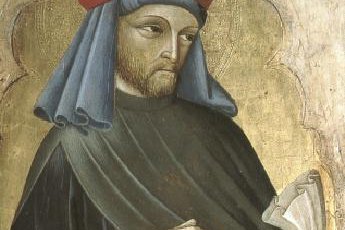
Attributed to a follower of Bartolomeo Vivarini, "Saint Homobonus," 15th century — public domain (Wikimedia Commons).
Contemporary accounts, preserved in the sermons and testimony gathered for his rapid canonization process, describe a man scrupulous almost to a fault about honest dealing — refusing to cheat customers, paying fair wages, and treating commerce as something that could be conducted without compromising the demands of conscience. That in itself would have made him locally respected. What made him something more was where the profits went: substantially toward the poor of Cremona, whom Homobonus supported with a consistency that his neighbors apparently noticed and talked about well before the Church ever got involved.
Holiness that didn't require leaving the marketplace
Twelfth-century Europe already had a well-established idea of what sainthood looked like: martyrs, monks, bishops, and consecrated religious withdrawing from ordinary life to pursue holiness undistracted. Homobonus didn't fit that mold, and his story became notable precisely because of the gap. He was a married layman who never took religious vows, never joined a monastery, and never stopped running a business — and the Church, remarkably fast for the period, decided that none of that disqualified him from sainthood.
This matters for understanding why his cult spread as quickly as it did. Cremona in the late twelfth century was a prosperous commercial city, full of merchants, tradesmen, and craftsmen who lived lives structurally similar to Homobonus's own — buying, selling, managing accounts, employing workers. A saint drawn from exactly that world, who demonstrated that the daily grind of commerce could be conducted honestly and even generously without abandoning it for the cloister, offered those people something no distant martyr or desert hermit quite could: a model of holiness that looked like their own Monday mornings.
Death in the middle of the Gloria
According to the accounts gathered soon after his death, Homobonus's life ended on November 13, 1197, in the Church of Saint Giles (Sant'Egidio) in Cremona, during morning Mass. As the congregation recited the Gloria, Homobonus — described in tradition as praying with his arms outstretched in the form of a cross — collapsed and died. Whether this detail is remembered with complete literal accuracy or has been shaped somewhat by the natural instinct of hagiography to find symbolic closure in a life's final moment, it isn't possible to say with certainty at this historical distance; what's clear is that his contemporaries read enormous meaning into it. A merchant known for weaving prayer and honest labor together throughout his life had, in their eyes, died in the exact posture of that union: at Mass, mid-prayer, in the church of his own city.
A canonization that moved faster than almost any other
News of Homobonus's death and the devotion already surrounding him spread quickly enough that the bishop of Cremona, Sicardus, personally investigated the case and reported it to Rome. Pope Innocent III, one of the most consequential and administratively decisive popes of the medieval Church, formally canonized Homobonus on January 12, 1199 — roughly two years after his death, an extraordinarily short interval by the standards of any era of Church history, before or since.
Innocent III's own canonization bull, "Quia Pietas," praised Homobonus specifically as a layman who had achieved holiness through the ordinary conduct of his life and work rather than through vowed religious life, explicitly holding him up as proof that sanctity was available to people in every state of life, not reserved to clergy and religious. That framing was significant for the wider Church at the time, and it's the theological core of why Homobonus's memory endured: not a single dramatic miracle or martyrdom, but official recognition that consistent, honest, generous ordinary living could itself be the substance of a saint's life.
Patron of the people who keep commerce honest
Homobonus's patronages follow directly and transparently from his own biography: businesspeople, merchants, tailors, shoemakers, and clothworkers all trace their claim on him to the trade he actually practiced. Cremona's cathedral, rebuilt and expanded in the centuries after his death, still honors him as a co-patron of the city alongside the Virgin Mary, and his cult remains especially active among Italian trade guilds and business associations that continue to look to him as a model for conducting commerce without abandoning conscience.
That patronage carries a plain, still-relevant message that doesn't require any theological sophistication to grasp: the marketplace isn't inherently opposed to holiness, and the everyday decisions of pricing fairly, paying honestly, and giving generously are not lesser spiritual work than fasting in a desert cell. Homobonus's canonization, rushed through in barely two years by a pope not known for moving quickly on much else, was the medieval Church's own way of saying exactly that.
A saint without spectacle
Unlike many saints from the same century — crusaders, mystics, founders of new religious orders reshaping the medieval Church — Homobonus left behind no dramatic conflict, no theological treatise, no order bearing his name. What he left was a reputation, built quietly over a working lifetime in one city, for running an honest shop and giving freely to the people who had less than he did. Nine centuries later, that reputation is still essentially the entire content of his sainthood — which may be exactly the point. Not every path to holiness runs through the extraordinary; Homobonus's ran through a cloth stall in Cremona, and the Church decided, remarkably quickly, that this was more than sufficient.
Trivia
Who was Saint Homobonus?
Why was Homobonus canonized so quickly after his death?
What is Saint Homobonus the patron saint of?
Is it true Homobonus died during Mass?
What does the name Homobonus mean?
You May Also Like
Related Reading