Saint Hugh of Lincoln

From the Dauphiné to a Somerset charterhouse
Hugh was born around 1140 in Avalon, in the Dauphiné region of what is now southeastern France, into a noble family. His mother died when he was young, and he was raised largely in a monastery, entering religious life early and eventually joining the Carthusians — one of the most demanding orders in Western monasticism, built around solitary prayer, near-total silence, and a level of austerity most other orders didn't attempt. He rose within the order in France before an unlikely invitation reached him: King Henry II of England, seeking to found the first Carthusian house on English soil as penance connected to the murder of Thomas Becket, wanted an experienced prior to lead it. Hugh crossed to England around 1179 to take charge of the new charterhouse at Witham in Somerset.
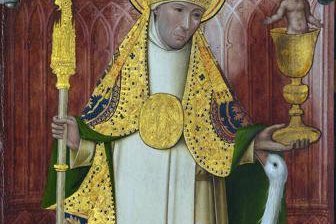
Unknown illuminator, miniature of Saint Hugh of Lincoln, c. 1490–1500 — public domain.
He proved an effective administrator as well as a rigorous monk, and his reputation spread quickly enough that in 1186 Henry II — the same king he would go on to confront repeatedly — nominated him as bishop of Lincoln, then the largest diocese in England, covering much of the Midlands. Hugh accepted only reluctantly, and, characteristically, only after securing real concessions: he insisted the cathedral chapter hold a genuinely free election rather than simply rubber-stamp a royal appointment, a point of principle he clearly meant to establish before he'd take the job at all.
The bishop who told kings no
What makes Hugh's episcopate remembered eight centuries later isn't primarily his administration, impressive as it was, but his willingness to face down the most powerful men in England when he judged them wrong, and to do it without losing their respect or, apparently, their genuine affection. Henry II had a habit of leaving bishoprics and abbacies vacant deliberately, since a vacant see's revenues flowed straight to the royal treasury rather than to a working bishop — a lucrative abuse Hugh openly opposed even as the same king was elevating him. Later, when one of the king's foresters trespassed on land belonging to the diocese, Hugh excommunicated him without hesitation; when royal pressure came to lift the sentence, Hugh held firm until real amends were made.
His confrontations continued under Henry's sons. Hugh reportedly refused Richard I's demand for financial contributions toward the king's continental wars, on the grounds that the diocese of Lincoln owed the crown military service, not cash for wars outside England — a genuinely risky position to take with a king who had just returned from crusade with his authority at its height. He also refused King John's demands on similar grounds later in his life. In each case, remarkably, Hugh managed to hold his ground without permanently rupturing his relationship with the crown; medieval chroniclers record him as someone kings argued with and then, somehow, still wanted at their side — Richard I is said to have kept Hugh close during a serious illness specifically because he trusted him.
A cathedral, a swan, and the sick
Hugh's building project at Lincoln was substantial: after an earthquake damaged the existing cathedral in 1185, he oversaw a major reconstruction in the emerging Gothic style, work that laid the foundation for the cathedral's later fame as one of medieval England's great architectural achievements — its central tower would eventually become, for a time, the tallest structure in the world. Hugh didn't live to see the building finished, but the choir and transepts built under his direction still stand.
He was also known, consistently across the sources close to his own lifetime, for personal care of people with leprosy — visiting leper hospitals, washing sores himself, and eating with patients at a time when the disease carried enough social terror that most people avoided any contact at all. It's the kind of detail biographers of medieval saints sometimes exaggerate for effect, but in Hugh's case it appears repeatedly and specifically enough, across independent near-contemporary accounts, that historians generally treat it as solid rather than embellished.
The best-known lighter story attached to Hugh is the swan of Stow: according to near-contemporary sources, a wild swan at Hugh's manor there attached itself to him with unusual ferocity, tolerating no one else nearby and reportedly keeping watch while he slept. Whatever its literal basis, the swan became a lasting emblem of Hugh in art, similar to how other medieval bishops are often paired with symbolic animals — a detail memorable enough that it outlived most of the more solemn parts of his biography in popular memory.
Death, and a fast canonization
Hugh died in London in November 1200, having traveled there for a royal council despite failing health. His funeral in Lincoln drew an extraordinary gathering, including King John himself among the pallbearers, evidence of the genuine respect Hugh had earned even from the crown he'd so often opposed. He was canonized in 1220, just twenty years after his death — fast by medieval standards, reflecting how widely and quickly his reputation for sanctity had spread. His feast is kept on November 17. Among English medieval bishops who combined real institutional courage with personal, hands-on charity, Hugh of Lincoln remains one of the clearest examples the record actually supports.
Trivia
Who was Saint Hugh of Lincoln?
How did Hugh challenge King Henry II?
What is the story of Hugh and the swan?
What did Hugh do for people with leprosy?
When is Saint Hugh of Lincoln's feast day?
You May Also Like
Related Reading