Saint Lanfranc of Canterbury

A scholar's reputation built in Normandy
Lanfranc was born around 1005 in Pavia, in northern Italy, and trained there in law before traveling north into France, eventually settling in Normandy, where he entered the monastery of Bec around 1042. He quickly became prior of the community and established a school there that grew into one of the most respected centers of theological and legal learning anywhere in Western Europe, drawing students who would themselves go on to major careers — including a future pope, Alexander II, and Anselm, who would later succeed Lanfranc directly as Archbishop of Canterbury. This reputation, built entirely on Lanfranc's own intellectual standing rather than noble birth or political connection, was what first brought him into contact with the young Duke William of Normandy.
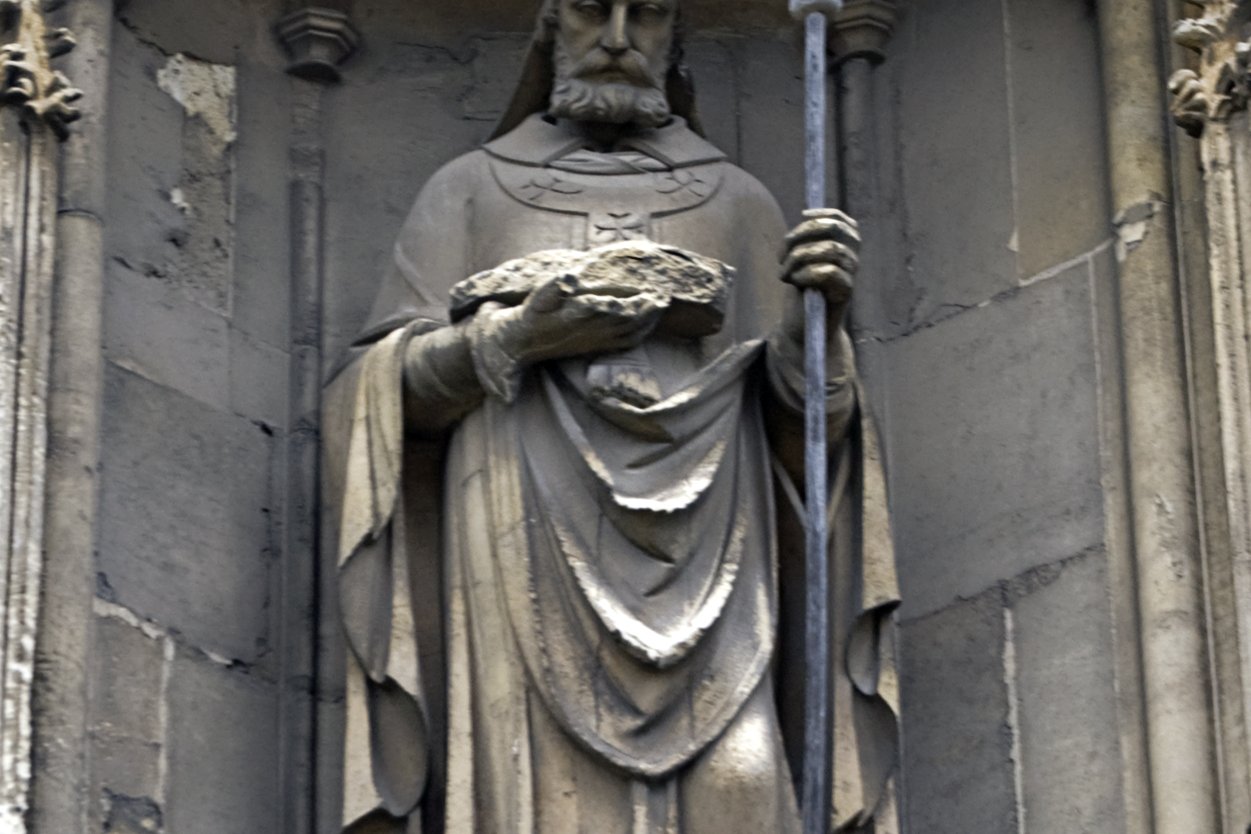
Statue of Lanfranc, Canterbury Cathedral — used under CC BY-SA 3.0, photograph by Ealdgyth.
That contact began, notably, as conflict rather than partnership. When William sought to marry Matilda of Flanders, Lanfranc opposed the match on grounds of prohibited degrees of kinship between the two — a serious canonical objection in the period, not a minor technicality — and the dispute grew heated enough that William reportedly banished Lanfranc from Normandy for a time. The two men eventually reconciled, and Lanfranc, drawing on both his legal training and his ecclesiastical connections, successfully negotiated papal approval for the marriage to proceed. That resolution marked the beginning of a genuinely close working relationship between the two men, one that would prove decisive two decades later.
Rebuilding a Church after conquest
William's invasion and conquest of England in 1066 created an immediate, practical problem well beyond simple military occupation: the English Church, with its own long-established structures, personnel, and traditions, needed to be brought under reliable control if Norman rule was going to hold. William turned to Lanfranc for this task, and in 1070 had him installed as Archbishop of Canterbury, replacing the previous English archbishop, Stigand, who was deposed partly on grounds of irregular appointment.
Lanfranc's tenure at Canterbury, lasting until his death in 1089, amounted to a genuinely comprehensive reorganization of the English Church. He replaced the great majority of English-born bishops and abbots with Norman appointees over the course of his archbishopric — a policy that, whatever one makes of its impact on English ecclesiastical continuity, was carried out with real administrative thoroughness, part of the broader Norman consolidation of power across every level of English institutional life following the conquest. Notably, one of the very few English-born bishops who did keep his position through this entire process was Saint Wulfstan of Worcester, whose reputation for personal holiness made him, even to Lanfranc's reorganizing administration, apparently too valuable to remove.
A jurisdictional victory and a rebuilt cathedral
Lanfranc also pursued, with real persistence, a long-standing dispute over the relative authority of Canterbury and York, the two English archbishoprics — successfully establishing, at least for the duration of his own tenure, Canterbury's claim to primacy over York, a jurisdictional question that mattered considerably for the practical governance of the English Church and that would continue to be contested, on and off, for centuries after Lanfranc's death.
On the physical side of his legacy, Lanfranc rebuilt Canterbury Cathedral itself, largely from the ground up, after the existing Anglo-Saxon building had been severely damaged by fire in 1067, shortly before his own arrival. The new Romanesque cathedral he built set the pattern and scale for the site's continued development over the following centuries — though virtually nothing of Lanfranc's own building survives today, since later medieval rebuilding, especially following a further fire in 1174, replaced most of what he had constructed. Even so, the administrative and institutional framework Lanfranc established for Canterbury as the seat of English ecclesiastical authority proved considerably more durable than his physical building work.
Legal and monastic writing alongside administration
Beyond his administrative reorganization of the English Church, Lanfranc remained an active scholar throughout his time at Canterbury, continuing the theological and legal engagement that had defined his earlier career at Bec. He wrote on the theology of the Eucharist, engaging directly in the eleventh century's significant debates over the nature of Christ's presence in the sacrament, and he compiled a set of monastic constitutions for English Benedictine houses intended to standardize observance across a Church he was simultaneously reshaping at the level of personnel and property. This combination of hands-on administrative reform and sustained scholarly engagement reflects the same range that had originally brought him to William's attention decades earlier at Bec, carried through into a very different, much larger sphere of responsibility.
A legacy in reform rather than in stone
Lanfranc died in 1089, having spent nearly two decades reshaping the English Church into a structure that would remain recognizably in place for generations. He was never formally canonized by the wider Church, and his feast, observed May 28 in some local and monastic calendars connected to Canterbury and to Bec, reflects a more localized veneration rather than universal recognition — a reminder that not every major reforming figure in Church history received the full formal process, even when their practical influence proved considerable and lasting. Lanfranc's real monument is institutional rather than architectural: the reorganized, Normanized structure of the English Church he built in the conquest's immediate aftermath shaped how England's ecclesiastical governance functioned for centuries afterward, and his own former student Anselm, who succeeded him at Canterbury, would go on to an even more prominent theological career built directly on the intellectual foundation Lanfranc had established at Bec decades earlier.
Trivia
Who was Saint Lanfranc of Canterbury?
What was Lanfranc's relationship with William the Conqueror before 1066?
What did Lanfranc do as Archbishop of Canterbury?
What was Lanfranc known for before becoming archbishop?
When is Saint Lanfranc's feast day, and is he formally canonized?
You May Also Like

Related Reading