Saint Notker the Stammerer, the Monk Who Reshaped Church Music

A stammer that gave him his name
Notker was born around 840 near Lake Constance in what is now Switzerland, into a noble family, and entered the Abbey of St. Gall as a child oblate — a common practice in the period, by which families placed young children in monastic care to be raised and educated there. He grew up with a genuine speech impediment, a stammer, which his own community turned into the byname history remembers him by: Balbulus, Latin for "the Stammerer." Far from holding him back, that same monastery gave Notker access to one of the richest intellectual environments in ninth-century Europe. By his own lifetime, St. Gall — founded around the hermitage of the Irish wandering monk Saint Gall two centuries earlier — had grown into a major center of Carolingian learning, its scriptorium producing manuscripts still studied today, and its library eventually becoming one of the oldest monastic libraries in the world to survive substantially intact into the present.
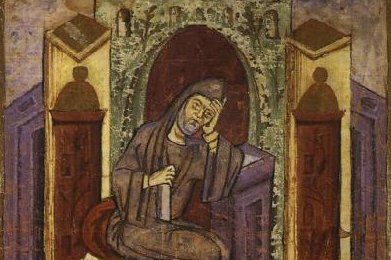
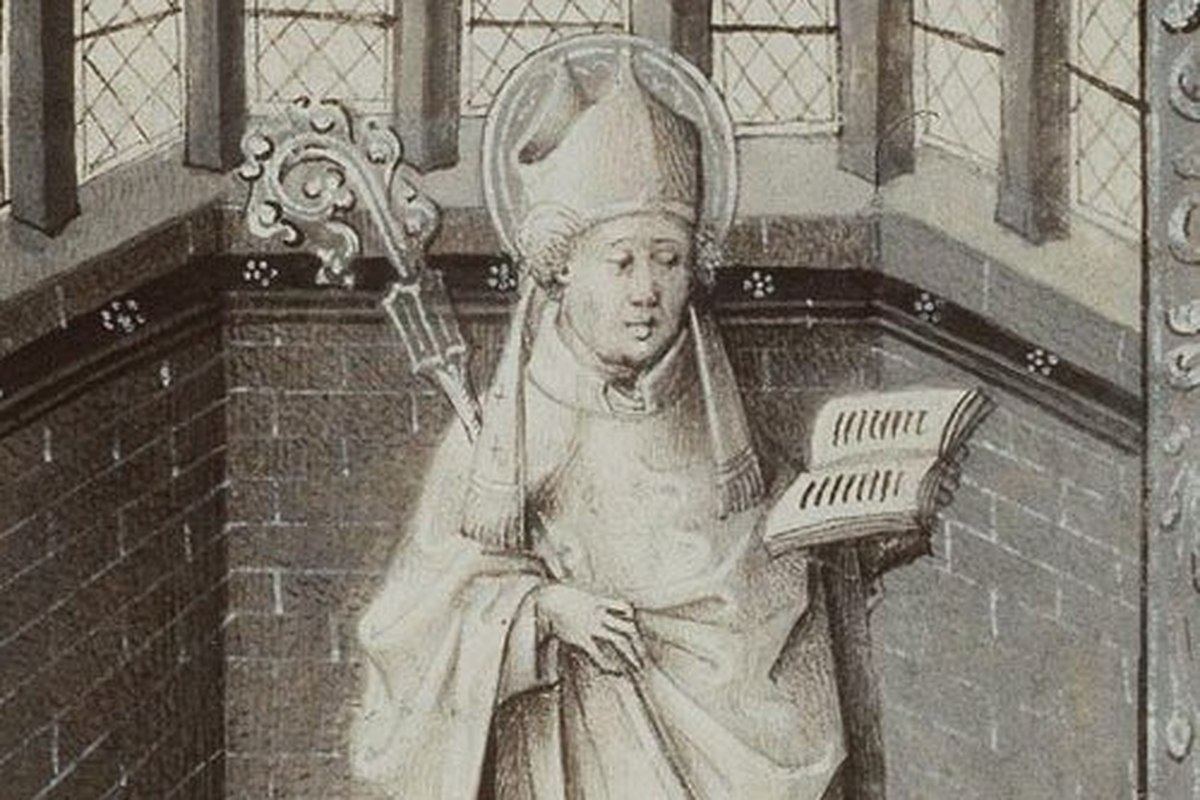
Anonymous illuminator, portrait of Notker Balbulus, 10th-century St. Gall manuscript — public domain.
Setting words to wordless music
Notker's most lasting contribution to Church history concerns a form of liturgical music called the sequence — a chanted text, typically sung in the Mass just after the Alleluia, that grew out of the long, elaborate, wordless melodic flourishes (called melismas) that singers had traditionally added to certain chants. According to Notker's own account, recorded in the preface to his collection of sequences, he learned the technique of fitting new words syllable-by-syllable to these existing melodies from a monk who had fled to St. Gall after Norse raiders destroyed the Abbey of Jumièges in Normandy, bringing the practice with him. Whether or not Notker personally invented the form — historians debate how much credit belongs to him individually versus the broader monastic tradition he inherited and refined — his collection of sequences, the Liber Hymnorum, became hugely influential, and the sequence form he helped establish went on to shape centuries of later Western liturgical music, eventually including famous later examples such as the Dies Irae and Stabat Mater, composed generations after his death.
A biography written for an emperor's descendant
Notker was also a genuine scholar and writer beyond music, and his best-known prose work, the Gesta Karoli Magni — "The Deeds of Charlemagne" — is a biography of the great Carolingian emperor written around 883–887, more than half a century after Charlemagne's own death, at the request of Emperor Charles the Fat, who was himself Charlemagne's great-grandson. The book is not a strictly reliable historical record in the modern sense; it blends genuine historical material, drawn partly from older monks' oral memories at St. Gall, with anecdote, moralizing tales, and outright legend, presenting Charlemagne less as a documented historical figure and more as an idealized model of Christian kingship for Charles the Fat to imitate. Modern historians read it carefully for exactly that reason — not as a precise record of what Charlemagne actually did, but as valuable evidence of how the Carolingian world remembered and mythologized its great founder a century on, filtered through a monastery's own particular perspective and purposes.
A teacher as much as a writer
Beyond his own writing, Notker served St. Gall for decades as a teacher and librarian, helping train the next generation of the abbey's monks in the same scholarly and musical traditions he had inherited. He is associated with a wider circle of St. Gall scholars of his generation, including two other monks confusingly also named Notker, which has occasionally complicated later efforts to sort out exactly which works belong to which man — a genuine source of scholarly debate that readers of older reference works should keep in mind, since some older sources attribute to "Notker" material that modern scholarship has since reassigned among the different St. Gall Notkers. The Notker remembered as Balbulus, however, is consistently credited with the Liber Hymnorum and the Gesta Karoli Magni, the two works that have secured his lasting reputation.
A quiet death, a long influence
Notker died at St. Gall in 912, having spent essentially his entire life within the walls of the one monastery that raised him as a child. His feast is kept on April 6, and while he was never the subject of a grand formal canonization process typical of later centuries, his veneration as a saint developed through the same kind of long, organic local tradition common to many early medieval monastic figures — reinforced over the centuries by the durability of what he actually left behind. Few monks of his era can claim to have shaped an entire genre of Western sacred music while also writing one of the most-read (if least historically precise) portraits of Charlemagne to survive from the Carolingian period — a double legacy remarkable for a monk best known in his own lifetime by a nickname referring to how he spoke.
Trivia
Who was Saint Notker the Stammerer?
What is a “sequence” in church music, and why does Notker matter to it?
What did Notker write besides music?
Where did Notker spend his life, and why was that monastery significant?
When is Saint Notker the Stammerer's feast day?
You May Also Like
Related Reading