Saint Werburgh of Chester

A Mercian princess chooses the cloister
Werburgh was born into one of the most formidable royal houses in seventh-century England. Her father, Wulfhere, was king of Mercia, then the dominant power among the Anglo-Saxon kingdoms, and her mother, Eormenhild, was herself the daughter of a King of Kent — a lineage that placed Werburgh at the center of the political marriage market of her generation, with alliances available that could have bound together two or more of England's most powerful royal houses.
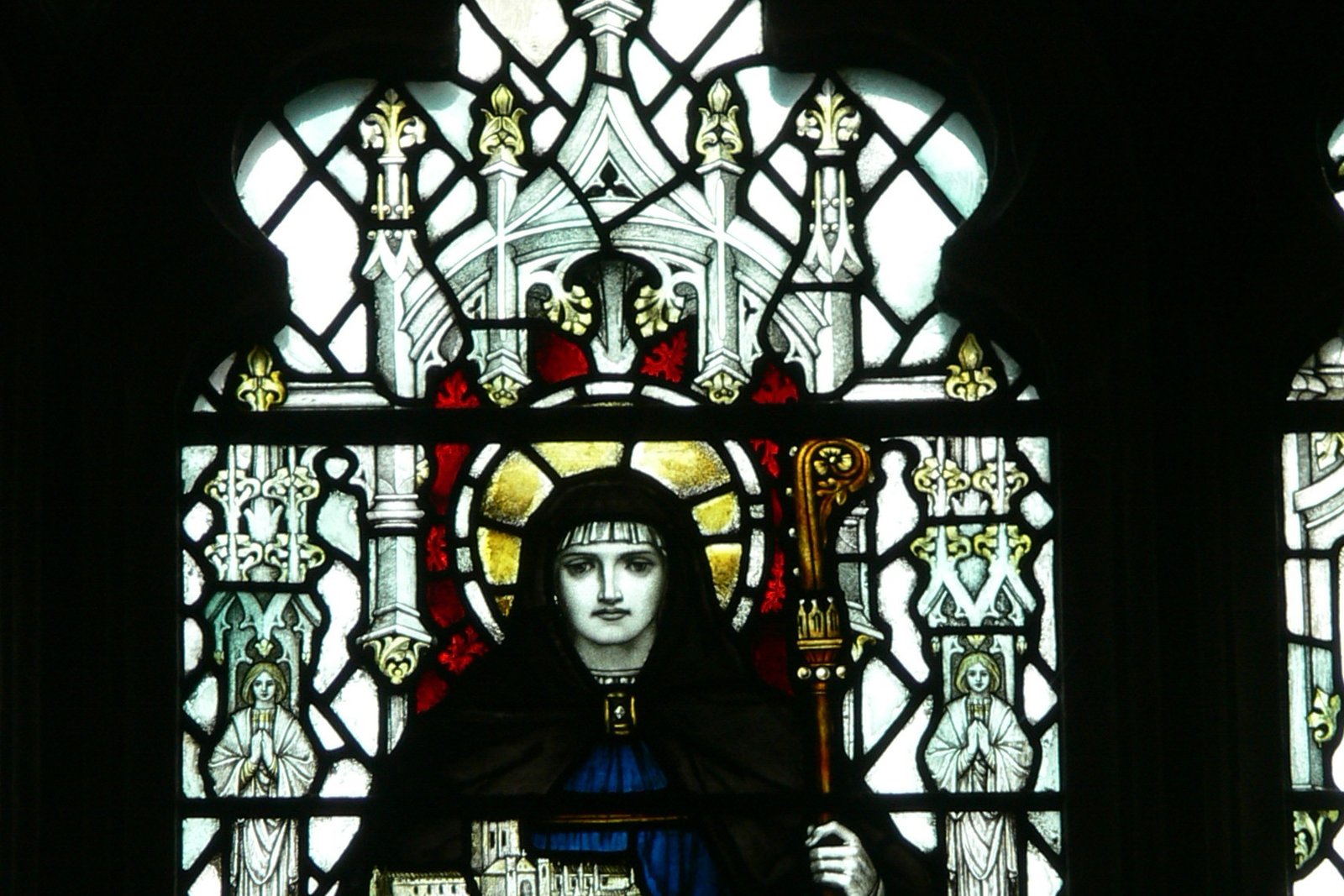
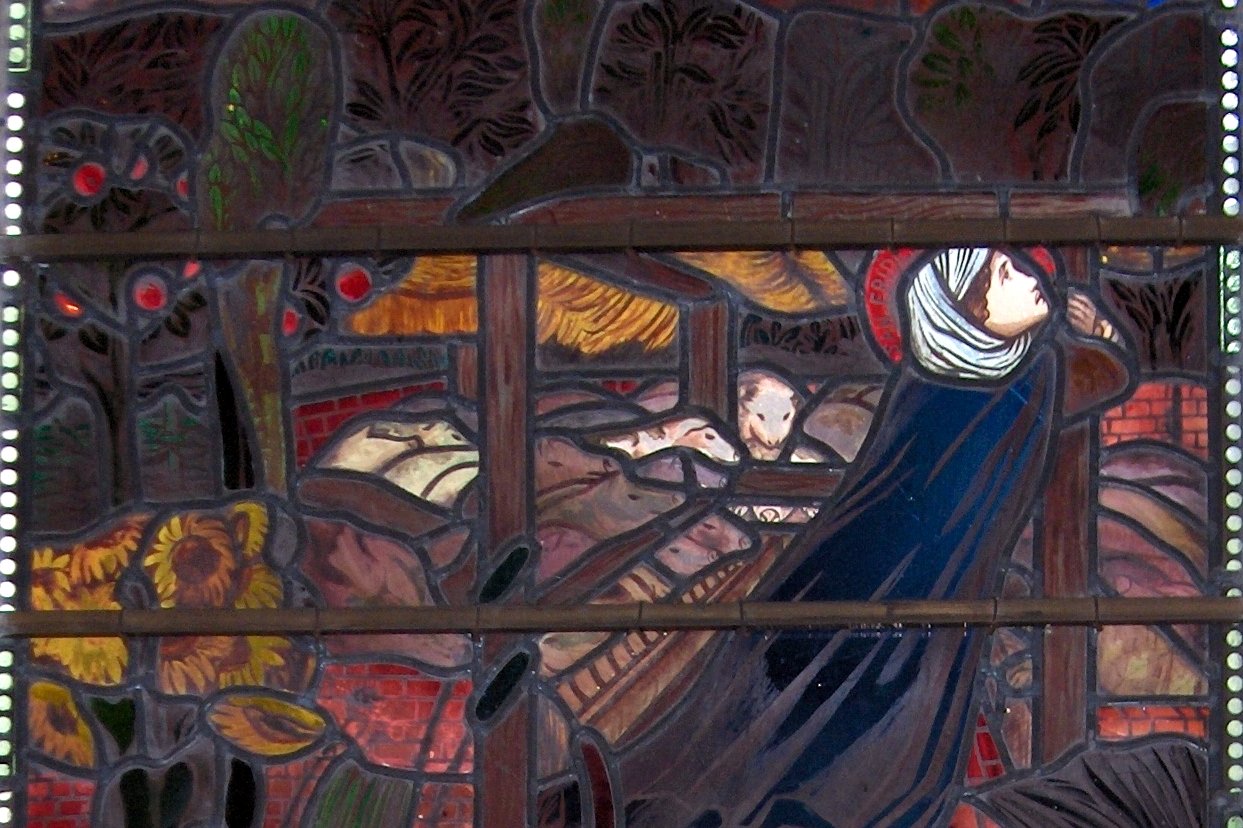
Stained-glass window depicting Saint Werburgh, Chester Cathedral refectory — public domain (photograph released under Creative Commons).
She turned all of it down. According to tradition, Werburgh instead sought religious life, entering the convent at Ely under the guidance of her great-aunt, Saint Etheldreda, one of the most celebrated royal abbesses of the entire Anglo-Saxon period and herself a princess who had famously refused the ordinary expectations of marriage and court life in favor of religious vocation. The family connection is a telling one: Werburgh's choice followed a pattern already well established among the royal women of her generation, for whom the convent offered both genuine spiritual vocation and one of the few positions of real independent authority available to a woman of noble birth in this period.
Ely and the world of the double monastery
The community Werburgh entered at Ely was not a small or provincial foundation. Etheldreda had established it as a double monastery, housing communities of both monks and nuns under a single abbess's authority — a model imported from Frankish and Irish monastic practice that had become common among the great Anglo-Saxon royal houses of the seventh century. Double monasteries of this kind were often led by women of royal blood specifically because only a princess's standing could command the resources, land grants, and political protection such a large institution required; abbesses like Etheldreda, and later Werburgh herself, functioned as powerful regional figures in their own right, receiving royal patronage, adjudicating disputes, and answering directly to bishops and kings rather than to any local lord. It was this same model of royal, female monastic authority that Werburgh brought back to Mercia when her father and uncle placed her in charge of Weedon, Trentham, and Hanbury.
Governing convents across Mercia
After her formation at Ely, Werburgh returned to Mercia, where her father — and later her uncle, King Æthelred, who succeeded Wulfhere on the Mercian throne — entrusted her with authority over several religious houses across the kingdom, among them Weedon, Trentham, and Hanbury. She is remembered in tradition as a capable and effective reformer of monastic discipline in these communities, at a time when maintaining consistent standards of religious life across a kingdom's scattered convents was a genuine administrative challenge, not merely a formality.
It's out of this period of her life that the best-known story associated with Werburgh survives: a flock of wild geese had been repeatedly damaging the crops at the monastery of Weedon, and, according to the tale, Werburgh had the geese rounded up and shut in a building overnight as a corrective measure. The next morning she addressed them directly, commanding them to leave the monastery's fields and never return — which, the story holds, they obediently did. Whatever its precise historical basis, the story has remained attached to Werburgh's memory for well over a thousand years and gave rise to one of the more distinctive and charming pieces of saints' iconography to survive from Anglo-Saxon England.
Death and the long journey to Chester
Werburgh died around the year 700 at Trentham, one of the convents under her care, and was buried, according to her own reported wish, at Hanbury in Staffordshire. Tradition holds that when her tomb was opened some years later — a customary practice associated with formally recognizing a person's sanctity — her body was found remarkably preserved, a detail medieval hagiography commonly cited as evidence of holiness.
Her relics remained at Hanbury for roughly two centuries, until the escalating threat of Viking raids across the English Midlands in the later ninth century made the site increasingly unsafe. Faced with the real prospect of her shrine being destroyed or desecrated, the monks responsible for her relics moved them for safety, ultimately bringing them to the fortified Roman-founded town of Chester. A church, and later a Benedictine abbey, grew up around her shrine there — the foundation that, following the English Reformation, eventually became Chester Cathedral, still standing on the same site today.
Patron saint of Chester
Werburgh's arrival transformed her from a regionally venerated Mercian abbess into the patron saint of an entire city. Chester adopted her as its protector, and her shrine became one of the significant pilgrimage destinations of medieval England, drawing visitors for centuries. Even now, elements of the medieval shrine survive within Chester Cathedral, and Saint Werburgh Street, running near the cathedral in the heart of the old city, still carries her name.
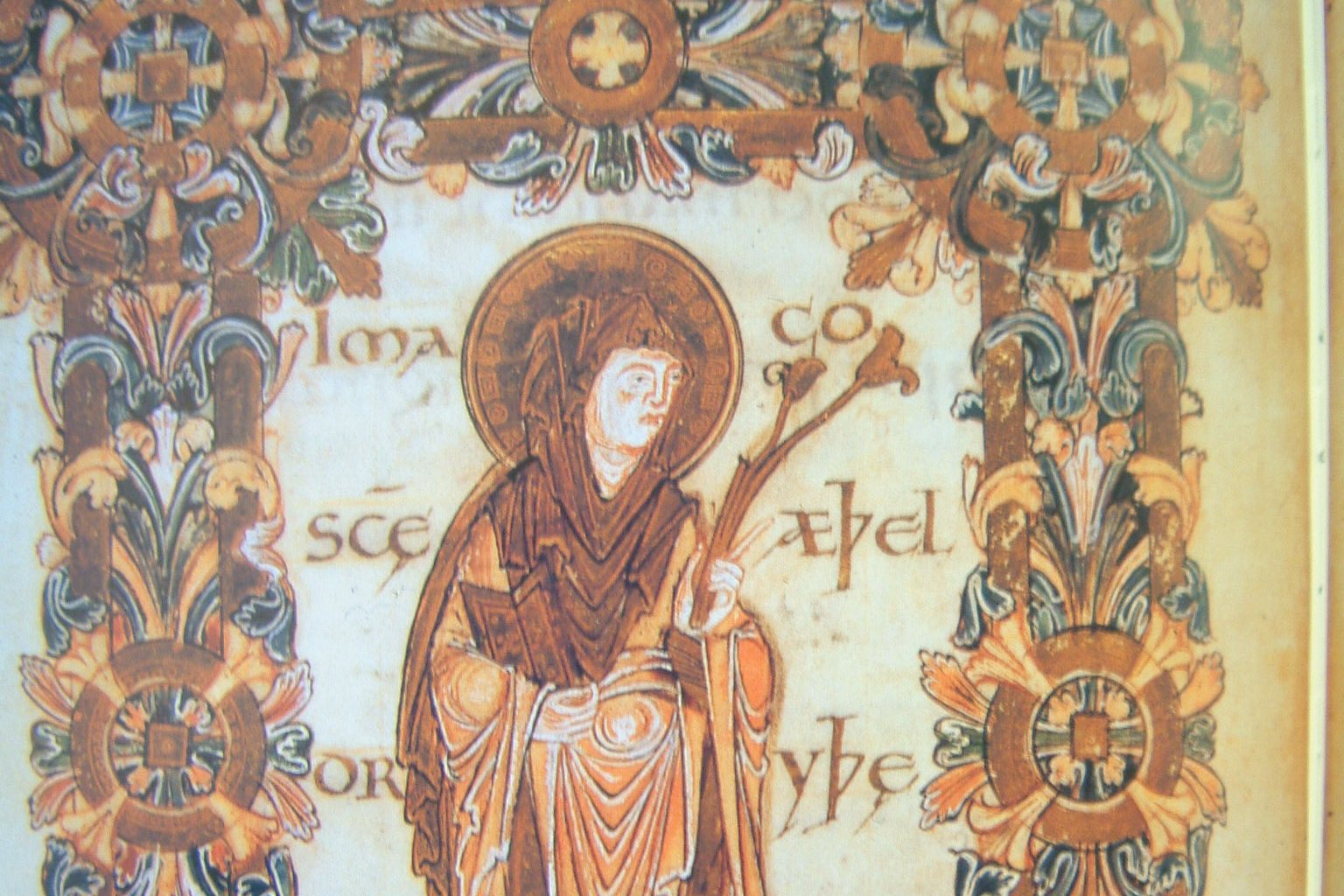
Her feast is kept on February 3. In art, she is consistently shown as an abbess in religious habit, carrying a crozier as a mark of her governing authority over several religious communities, and frequently accompanied by a goose in reference to the Weedon legend — the exact combination visible in the Chester Cathedral stained-glass window that anchors this article, which also depicts a small walled city beneath her feet, a fitting reference to the town that took her as its protector.
Readers interested in the broader tradition of royal Anglo-Saxon abbesses that shaped Werburgh's own vocation may also want to read about Saint Etheldreda of Ely, the great-aunt under whom Werburgh trained and whose own life offers one of the clearest parallels to Werburgh's rejection of royal marriage in favor of religious authority.
Trivia
Who was Saint Werburgh of Chester?
Why did Saint Werburgh's relics end up in Chester?
Was Saint Werburgh ever married?
What miracles are associated with Saint Werburgh?
When is the feast of Saint Werburgh?
You May Also Like
Related Reading