The Twelve Fruits of the Holy Spirit, and How They Differ From the Seven Gifts

An orchard image for the spiritual life
Paul's letter to the Galatians spends most of its length arguing about law and freedom, but it closes its moral section with an image that has outlasted every detail of that first-century controversy. The letter was written to churches Paul himself had founded in central Asia Minor, where a group of teachers had begun insisting that Gentile converts needed to adopt Jewish ritual law, circumcision included, to be fully Christian — a dispute urgent enough that Paul's tone through most of the letter is sharp, even indignant. Rather than issuing another rule, though, Paul contrasts "the works of the flesh," which he lists as a catalog of vices, with "the fruit of the Spirit," a very different kind of list: "the fruit of the Spirit is love, joy, peace, patience, kindness, generosity, faithfulness, gentleness, self-control" (NABRE, Galatians 5:22-23). The image does real theological work — fruit isn't manufactured by effort of will the way a product is manufactured; it grows, given the right conditions, more or less on its own. A soul genuinely open to the Holy Spirit, Paul is saying, will show it, the way a good tree shows itself in what it bears.
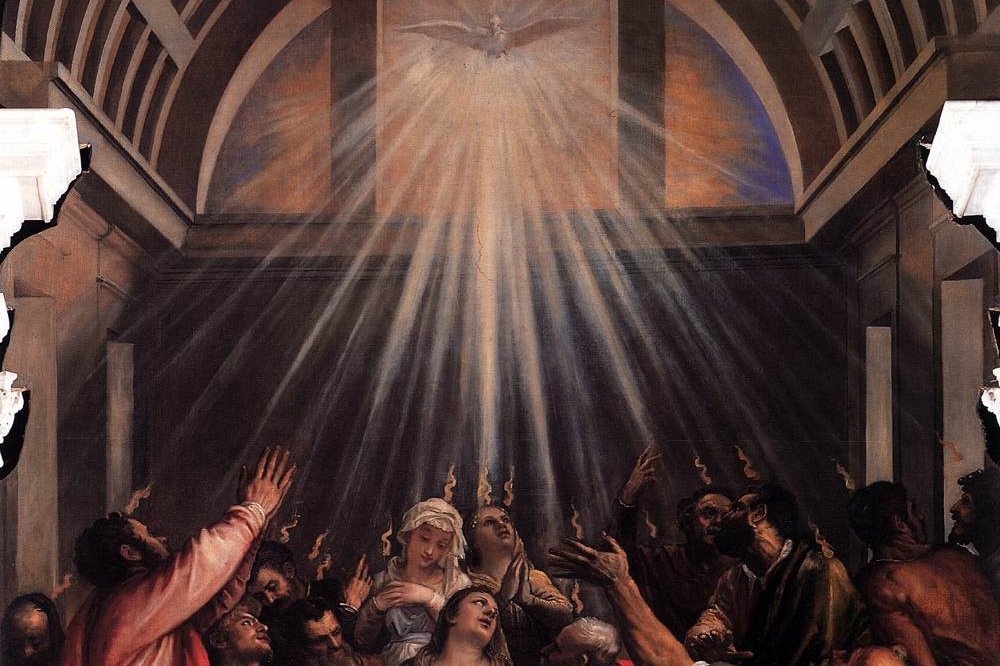
Titian, The Descent of the Holy Ghost, c. 1545 (public domain)
It's worth noticing, too, that Paul writes "fruit" in the singular in the Greek text, not "fruits" — a single harvest with many facets, rather than a basket of separate, unrelated items a person might possess some of and lack others. The implication, drawn out by later commentators, is that these qualities grow together as one integrated life in the Spirit rather than as a checklist to be worked through individually; a soul rarely develops patience while remaining a stranger to peace, or grows in kindness while staying closed off from joy.
Nine in Greek, twelve in the Church's tradition
Count the qualities in that NABRE translation above and you'll get nine — because it follows the Greek New Testament text directly, and nine is also the number most English Bibles list today. Catholic catechetical tradition, though, has long taught twelve fruits, and the discrepancy has a clear paper trail: Saint Jerome's Latin Vulgate, the Bible the Western Church used as its standard text for well over a thousand years, rendered the Galatians passage with three additional terms not present in the shorter Greek list — modesty, generosity (as distinct from Paul's own term for kindness), and chastity. The Catechism of the Catholic Church follows this Vulgate-based twelvefold tradition, listing the fruits as "charity, joy, peace, patience, kindness, goodness, generosity, gentleness, faithfulness, modesty, self-control, chastity" (CCC 1832). Both lists trace back to the same Pauline text; they simply reflect two different translation traditions of it, Greek and Latin.
Saint Jerome produced the Vulgate translation in the late 4th century at the urging of Pope Damasus I, working directly from Greek and Hebrew manuscripts to give the Western Church a single, reliable Latin text after centuries of inconsistent older Latin versions circulating in different regions. It became the Bible most Western Christians encountered, read aloud, and had explained to them for over a thousand years, right up through the Reformation and beyond — which is exactly why its wording became so deeply embedded in Catholic catechesis that the Church continued teaching the twelve-item list long after later scholarship clarified that the shorter nine-item list better reflects Paul's original Greek. Neither list is "wrong" in a doctrinal sense; the Vulgate's three additional terms don't introduce any new theological idea, since modesty, generosity, and chastity are all qualities the Church teaches elsewhere as flowing naturally from love, kindness, and self-control. They simply spell out, in slightly more specific language, dimensions the shorter Greek list already implies.
Not the same as the seven gifts
The fruits are easy to confuse with a related but distinct list: the seven gifts of the Holy Spirit — wisdom, understanding, counsel, fortitude, knowledge, piety, and fear of the Lord — drawn from Isaiah's description of the coming Messiah (Isaiah 11:2-3) and traditionally invoked at Confirmation. The distinction the Catechism draws is a matter of cause and effect. The gifts are capacities: supernatural dispositions that make a soul promptly responsive to the Holy Spirit's promptings, the way a well-tuned instrument responds readily to a musician's hand. The fruits are what those capacities actually produce when lived out — "perfections that the Holy Spirit forms in us as the first fruits of eternal glory," in the Catechism's phrase (CCC 1832). Put simply: the gifts are given, the fruits are grown.
Catholic tradition also distinguishes both of these from the theological and cardinal virtues — faith, hope, and charity, and prudence, justice, fortitude, and temperance — which are more properly habits a soul builds up, with the help of grace, through repeated good choices over time. The three categories work together rather than competing: virtues form the stable dispositions of a well-ordered soul, the gifts make that soul unusually receptive to the Holy Spirit's direct promptings, and the fruits are the visible, tasteable evidence — Paul's own word — that both are actually at work in a person's day-to-day life, not just held as abstract beliefs.
Evidence, not achievement
What makes Paul's image durable is exactly what makes it different from a checklist of virtues to be willed into existence through effort alone. Joy, peace, patience, and the rest aren't goals a Christian strains toward the way an athlete trains for a race; they're the visible, almost involuntary evidence that something deeper is already underway — a life genuinely opened to the Holy Spirit, showing itself, as Paul puts it, in fruit rather than in force of will.
That doesn't mean effort plays no role at all. Paul's own language earlier in the same letter urges believers to "live by the Spirit" and to be "guided by the Spirit" (Galatians 5:16, 5:18) — an ongoing cooperation, not passive waiting. The image of fruit doesn't remove human freedom from the picture; it simply reframes what that freedom is for. A gardener doesn't manufacture fruit by main force, but good gardening — tending the soil, clearing away what chokes healthy growth, staying close to water and light — makes a real difference in what eventually grows. In the same way, the Catholic tradition has long paired Paul's image with a life of prayer, the sacraments, and ordinary daily choices as the "tending" that lets the Spirit's fruit actually ripen, rather than treating holiness as either pure grace with no human part or pure willpower with no need for grace.
Trivia
What are the twelve fruits of the Holy Spirit?
Where does the list of twelve fruits come from if Galatians only lists nine?
What is the difference between the fruits and the gifts of the Holy Spirit?
Are the fruits of the Holy Spirit the same as virtues?
Why do Catholic and Protestant lists of the fruits of the Spirit differ?
You May Also Like
Related Reading